
I’d never heard the poetic form, villanelle, until last year on the Daily Poem podcast. I knew right after I heard one that I wanted to write one. Perhaps one of the most famous villanelles is Dylan Thomas’s poem Do Not Go Gentle into That Good Night.
Anyway, it’s a tightly controlled form: 19 lines divided into 5 groups of 3 lines, followed by the last group of 4 lines. There are two lines that are repeated throughout in a defined pattern, and a strict rhyme scheme, which provides the biggest challenge. You basically only get two sounds for rhyming at the ends of your lines, so it wouldn’t be wise to choose a word like “orange” as one of those sounds unless you’re Ogden Nash. He could definitely make that work. The number of syllables per line is up for grabs.
If any of you are still with me after that somewhat dry and academic paragraph, thank you. You have passed the test and may proceed.
Before you read my killdeer villanelle, I should tell you that the word “plover,” is usually pronounced as rhyming with “cover,” but can also be pronounced as rhyming with “over,” so I took advantage of that. Even so, I ran out of rhyming words and had to fudge it a bit, as you will see.
The Mighty Plover
I am the mighty plover.
Look, but you will not find me;
A killdeer undercover
I call out over and over,
Shrill, to make you seek me;
I am the mighty plover
O see that lovely plover!
Her neck rings surely bind me.
A killdeer undercover
To find my nest is tougher,
I’ll drag my wing and trick thee,
I am the mighty plover
Watch me pretend to suffer,
Grade my performance kindly,
A killdeer undercover
O’er fields I soar and hover.
But still you will not find me,
I am the mighty plover,
A killdeer undercover
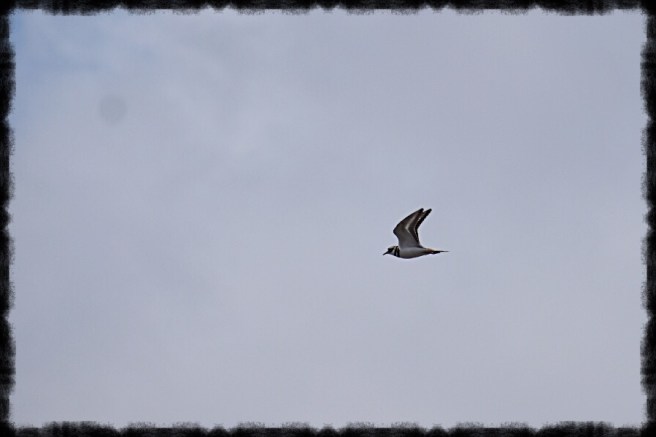
It was harder than I thought to write one of these and this one could definitely use some tweaking, but you’ve got to start somewhere, right? Here’s hoping I can improve on the craft if I try this again.
And speaking of trying to improve things, here’s the latest crop of bluebirds:
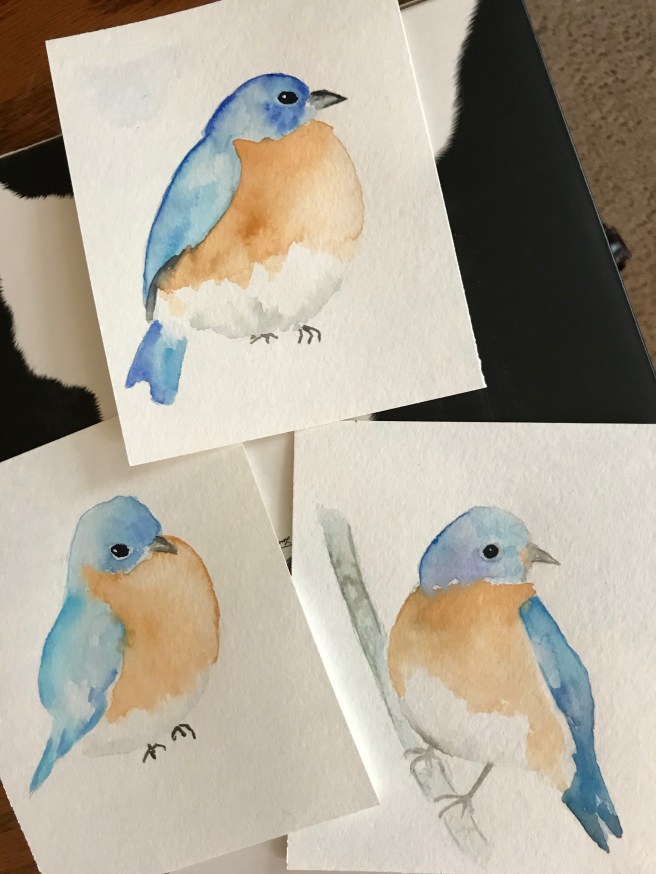
That top one looks like she’s about to lay one dozen eggs, what I like to call a “fat little buffer” (borrowing from Wodehouse). I’ll keep working at it.
I’ll probably delete you in the morning. Ha ha – just checking to see if you still read the last line.

 Lynniebeemuseoday