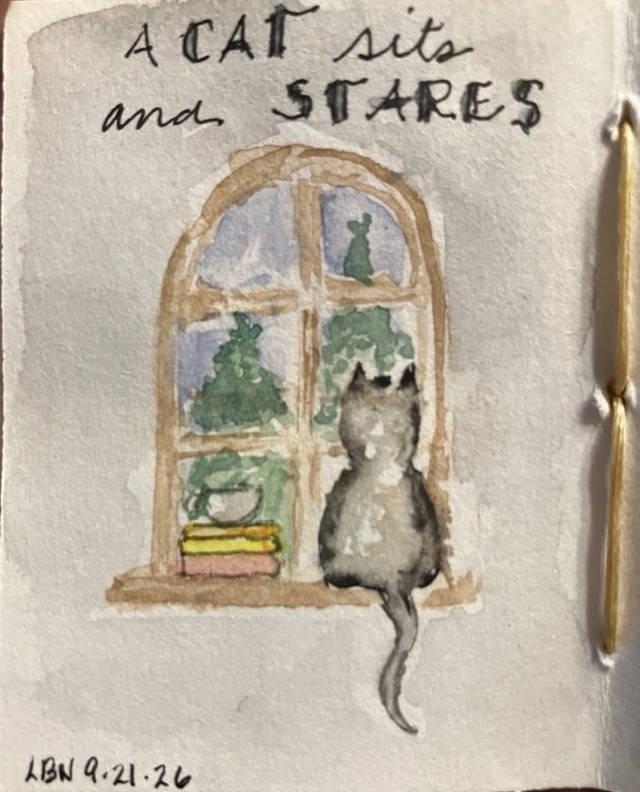
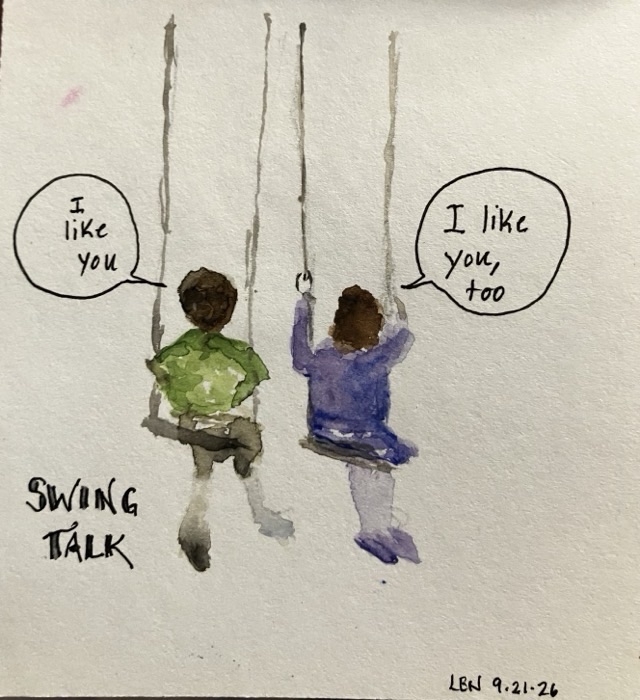
To set things straight, the comma in the title is important. The cat is not, in fact, swinging, as you shall see.
To be honest, sometimes I wonder why I bother with trying to paint at all. This was one of those weeks. I’ve been thinking lately about taking watercolor painting lessons from an actual person, rather than trying to learn things from Pinterest and YouTube.
I dipped into my Tiny Art books recently and here’s what happened:
And this:
Then I tried my hand at painting from a photograph. The original flower was just exquisite, something that makes you say, “Of course there’s a God! Isn’t it obvious?” I’m afraid my painting doesn’t do it justice.
Are you still reading? Today, I feel that your attention is more than I deserve, but I thank you. Truly I do.
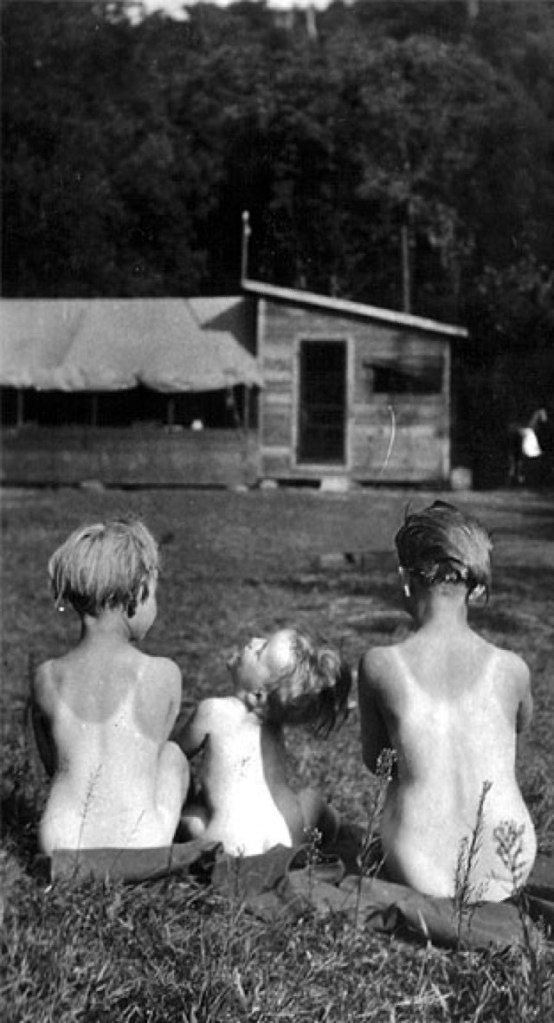
My mom was the youngest of three sisters. I love looking at old black and white photos of them from nearly 100 years ago. The sibling bond is a unique one. You share memories, for better or for worse, of growing up in the same home with the same parents. These three played dolls together, had to get the same kind of haircut, and no doubt shared a bed, a room, sometimes their clothing as hand-me-downs. The things that shape you as person are often bound up with your siblings, for better or for worse.
These three little girls kept up with each other their whole lives, though the oldest one went off to New York, followed by the middle sister. Eventually the middle one went through some tough times and came back to her roots in Minnesota and stayed. When their mother was dying of cancer, all three sisters sat vigil with her in the hospital. My mom told me later that they laughed like crazy with each other, and they wept together as they witnessed their mother slipping away. And the sibling bond strengthened, as it does when you share that kind of intimate experience.
Photographs capture a moment in time, and these are just a few of the many that we have from those years. All three of these little girls have passed on now, but oh, how young and vibrant and funny they were back then. The years have marched on, but the memories remain.
Blessed be the name of the Lord.
The blog post must march on, but the memory of it will be deleted in the morning.
We lived in a big, drafty house when I was growing up. The only sources of warmth in the winter were the radiators, sprinkled throughout the house, with one in most of the rooms. Sometimes the radiators were warm and comforting to lean against. Sometimes they were very hot, not enough to burn, but enough to keep you from wanting to be too close.
We spent a lot of time in our living room and dining room, both of which could get uncomfortably cold even with the radiators radiating. My mom’s solution was to make a huge quilt which she hung up as a wall to separate the living room from the entry way, which we always called “the foyer.” Sometimes that quilt meant the difference between having a room that was livably warm and one that required sweaters, blankets and mittens for added bulk.
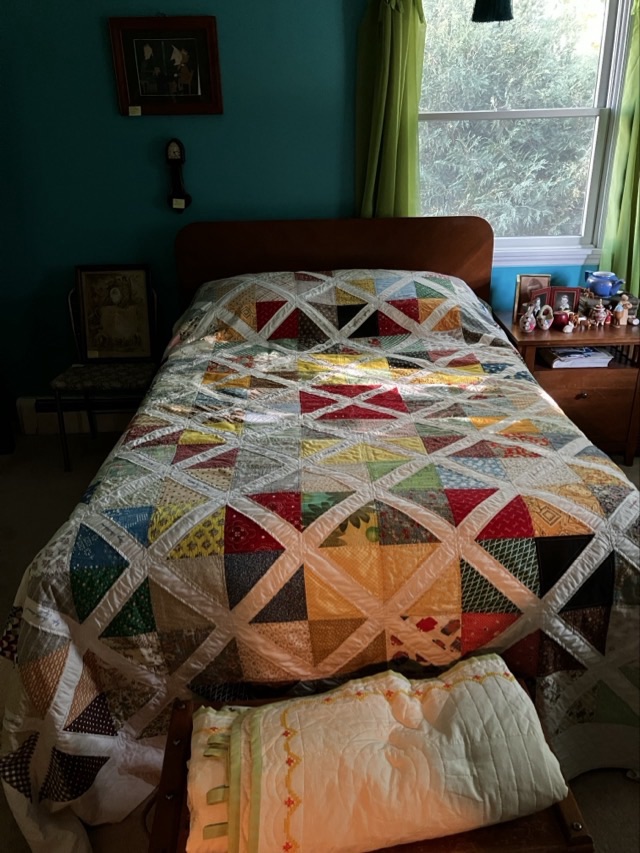
Mom could have just hung a blanket or two up, but she took the time and effort to make a beautiful quilt, one that I didn’t appreciate nearly enough at the time. You see, this was no ordinary quilt; it was embroidered with our names, our parents names, our grandparents’ names and the names of ancestors further back than that. Mom added the names in the white channels around the squares. This was before sewing machines could be programmed to do such things. She did it with her own clever hands. Our names (my siblings and me) were the darkest colors and each generation back from us was embroidered in successively lighter colors. It was an exquisite heritage quilt! Occasionally I would look at the names, but mostly the quilt became a wall, one that we did not dare leave pulled aside on those cold days.
When did she have time to make this quilt? How is it that I have no memories of seeing her work on it? How long did it take her to sew all those names on it? What a triumph it was!
Recently I heard from my youngest sister that this quilt and one other were in Mom’s cedar chest that she’d taken when Mom died. She didn’t think she’d ever use the quilts and offered them up to the sibs. “Me! Me! Pick me!” Well, no one else wanted them and they now reside in our house. For the first time in its whole existence, the quilt is covering a bed. I marvel at it and wish I could tell my mom, “Oh, what a wonderful work of art and family history you did! God blessed the work of your hands.” And I would hug her and kiss her dear cheek.
I might feel rather quilty if I have to delete this in the morning.
I’m going to serve up an eclectic dish of musings today on a number of unpredictable topics. Intrigued? Read on!
AI Commenter. It’s a first for me. I got a somewhat lengthy comment on one of my recent blogs posts from an unknown fellow. The comment was essentially a summary of my post, reduced to its basic elements and reeking of AI. Is that the best you can do, my friend?
High School. I was visiting my father-in-law recently and came across his senior yearbook from the year 1945. It’s been over 80 years since he graduated!
I thought that seemed like a lot of time until I remembered that my own 50th class reunion was this year. How the time does fly! I’ll have to ask my friend Julie if I should regret that I didn’t go to the party. Have you gone to your high school reunions?
(I am struck by the complete lack of wrinkles!)
Grasshoppers in Strange Places. What are the odds of a hopping grasshopper hopping into your rain gauge? My husband thinks there are two grasshoppers in the photo so perhaps it was a pre-arranged assignation. What do you think – one or two grasshoppers?
Wake up Call. One of our neighbors across the street in the apartments had the most unusual alarm I’ve ever heard. Keep in mind that I could hear this from across the street through my open windows. It began with a recording of a man shouting “WAKE UP! WAKE UP! WAKE UP NOW!” followed by some rambling chatter by the same man, and then looping back to the original WAKE UP…etc. It was about a 20-second loop. One day this started around mid-morning and went on for over an hour. Isn’t that strange? I wonder what his neighbors in the apartment buildings thought? It happened every day for about a week and then stopped. Somebody must have complained. Initially I was kind of irritated, but now I sort of miss it. Ha ha!
I guess that’s enough rambling for today. WAKE UP! (In the morning, so I can delete this post)
Young Mr. Jones was perplexed. Just two months ago, he’d married the most beautiful woman he’d ever met. Though they hadn’t known one another long, it was clear they were meant for each other. They said their vows, looked upon one another with love, and started their new lives together. Now it seemed as though nothing he did or said could please his young bride. She seemed to think him incapable of the simplest things. She argued with him at every turn. If he said left, she said right. If he said up, she said down. She was particularly upset if he left any item of clothing on the floor. He tried to remember this, but if his thoughts were preoccupied with something, it wasn’t always on his mind to make sure his socks made it into the clothes hamper. Lately, if she saw something of his on the floor, she would roll her eyes, and pick it up with a grim set to her mouth. He got up in the morning before she did and made sure to greet her cheerfully every morning when she got up. For this, he either got a dirty look or no response. And if all that wasn’t enough, he’d be begun to notice a strange leak in the house, just a little dripping here and there. He wasn’t sure where it was coming from and he could never actually spot water on the ceiling. Nevertheless, it had to be coming from somewhere. When he asked his wife if she was feeling it, she gave an irritable sigh and said, “I don’t know what you’re talking about. You’re imagining things.”
Young Mrs. Jones was irritated. She had thought Mr. Jones to be the perfect man until she started living with him. Good grief, he couldn’t even pick his clothes up off the floor! Did he think she was his maid? Wasn’t it enough that she did all the cooking? He didn’t make any allowances for the fact that she had times of the month when she was moody. She couldn’t help that! He also seemed to think that she should start her day as cheerfully as he did. Cheerful?! When she hadn’t had her coffee yet? Well, she loved him, but he was turning out to be an awful lot of work. He was continually making little mistakes that she had to correct. How he had ever been able to drive someplace before she came along was a mystery to her. She wasn’t being argumentative; he just needed guidance. She sighed as she thought about his latest preoccupation. He had begun talking as if there was water dripping from their ceiling. She’d never felt any such thing so she discounted it, but there was no doubt he was beginning to look a little moist around the edges.
Young Mr. Jones was confused. He had thought married life was going to be a joy, and that they’d face difficulties together. When they were engaged, people had joked about how they’d regret getting married, saying “It’s not too late to back out!” but he and his fiancé laughed that off. Two people who loved one another as much as they did would never feel that way. How quickly things had changed. He was a fairly mild mannered fellow, but even his patience was wearing thin when they were in the car together. From her perspective, every maneuver he made needed her input. Well, he loved her and wanted to please her, so he would see this through. The dripping seemed to be getting worse, however, so he decided to go up in the attic to see if he could spot any problems from up there. Lo and behold, he found a corner of the attic where there was no dripping whatsoever. What a relief! He took to going up there more often just to be in a dry place. He furnished it with a plump armchair and a lamp, and brought up his books.
Young Mrs. Jones was incensed. She noticed that Mr. Jones seemed to disappear entirely for long stretches of time when he was supposed to be home. She thought perhaps he was out running errands, but when she looked in the garage, his car was there. Perhaps he was puttering in the back yard? But no. Was he going out for walks? If so, why didn’t he say something when he left? She was busy with the unending tasks of cleaning and cooking, as well as the amount of time it took for her to get caught up with important discussions on social media. She had created an Instagram account called “Keeping the Home,” where she put photos from her immaculately decorated home, and she curated discussions about the newlywed life for young wives. It turned out she wasn’t the only one experiencing a bit of “shock” after the wedding. She felt proud of her attempts to provide a safe place where they could all support one another. These things kept her so busy that she didn’t noticed her husband’s absence at first. But really! Where was he when she needed him to do something around the house? He always showed up for meals and disappeared again after doing the clean up. (They had agreed, upon her recommendation, that since she was doing all the cooking, he should do all the clean up.) Last night, she decided to follow him, and what did she find but that he had created his own little nook up in the attic! The selfishness of the man! Well, at least now she knew where to go when she had jobs for him to do.
Young Mr. Jones was in a pickle. He’d been found out! Cornered! That had been an unpleasant scene. He supposed he shouldn’t have been “hiding” from his wife. He tried to explain that he was just trying to stay dry, but that seemed to make her even more angry. Worst of all, as soon as she’d found his little corner, the attic had sprung a leak of some sort and the dripping started up even there. He’d better give some serious thought to the situation. He sat down on his formerly comfortable armchair, but sprang up again when he realized it was a little damp. This was untenable! He’d have to straighten Mrs. Jones out with some plain talk, appealing to her love for him. He’d gone downstairs with firm resolve, but without losing his temper. He got Mrs. Jone’s attention, which was not very easy. She was looking at her tablet and typing something that seemed vitally important to her. “Yes?” she finally answered, looking peeved. He laid it all out, telling her the ways things would have to change between them if their marriage was going to succeed. She did not take this well. “You’ve got some nerve! I bend over backwards continually to make life better for you and this is the thanks I get? I’m a forgiving woman, so we’ll just pretend this conversation never happened.” And with that, she went back to her device, tsking to herself as she continued typing.
Young Mrs. Jones was actually pleased to have more fodder for her latest post for young wives. This latest incident with her husband would fit right in with her remarks about the need for wives to be understanding and forgiving when their husbands blundered and ran roughshod over their feelings. It was late when she went to bed and she didn’t notice that Mr. Jones was not in the bed. She got up in the morning and was vaguely aware that Mr. Jones wasn’t there with his irritatingly cheerful greeting. “Well, at least he’s stopped that nonsense,” she said to herself. She had a nice leisurely time drinking her coffee and it wasn’t until she got up to put her coffee cup on the counter that she noticed a note that Mr. Jones had left for her, no doubt an apology for his rude behavior from the night before. She picked it up and read
“To my wife, I can’t live with you. I have gone to the wilderness to be by myself. Don’t try to find me. Your husband, Mr. Jones”
“Of all the NERVE!” Mrs. Jones yelled to no one. She paced angrily around the kitchen for a few minutes, but soon calmed down. Life might actually be easier for her without him around. She felt certain that her online community of young wives would be sympathetic and gather around (metaphorically) to comfort her in her hour of need. She sat down and began a new post for her account.
“…the contentions of a wife are a continual dripping.” Proverbs 19:11b
“A continual dripping on a very rainy day and a contentious woman are alike; whoever restrains her restrains the wind and grasps oil with his right hand.” Proverbs 27:15-16
“Better to dwell in a corner of a housetop, than in a house shared with a contentious woman.” Proverbs 21:9
“Better to dwell in the wilderness, than with a contentious and angry woman.” Proverbs 21:19
Better to delete the post in the morning than to keep it.
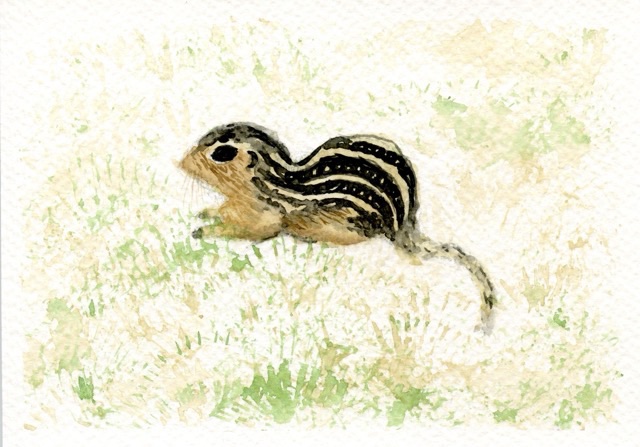
These two things have no point of intersection, by the way, in case you were hoping for an essay in which the fashion rules of striped ground squirrels was in the offing.
First, fashion rules. On some level, it seems like one should be aware of these things, but I have remained embarrassingly unaware. About 10 years ago, someone let slip to me that we are not supposed to wear white before Memorial Day and after Labor Day. I feel a little haunted by that revelation. In my ignorance I could wear white whenever I felt like it, but now, having received the Law of Wearing White, I am aware of and accountable for this Fashion Sin. Today someone told me that she wouldn’t be able to wear neon green very much longer because of the time of year. Okay, not that I’ve ever had neon green in my wardrobe, but what’s that about? She also told me that the Law of Wearing White includes white shoes. What?!? Please don’t tell me anymore.
Now for the striped ground squirrel, my latest postcard painted from a photograph I took a month ago.
I call him “Stripey Guy.”
If there’s a fashion rule about deleting blog posts, I don’t want to know about it, because I’m used to doing it in the morning.
A couple months ago I read a little snippet in World Magazine about the importance of our local historical societies. It impressed me enough that I contacted our local HS and asked if they could use a volunteer. It turned out they needed someone to help with research projects so I said, “Sign me up!” Or something to that effect.
I drove over and was greeted with this delightful tableau, which I felt was a sign of good things to come.
After meeting the director and the woman in charge of research, I got a tour of the research room, which looks something like organized chaos. One wall is packed solid with research books of various kinds, some of them quite old. There are city directories from the late 1800’s and early 1900’s, plat books, old yearbooks, memoirs, history books, state, county and city records of interest, etc. Another wall is half covered with file cabinets. A table in the middle of the room is comfortably rumpled with paper, pencils, foodstuffs and the occasional file, out of place.
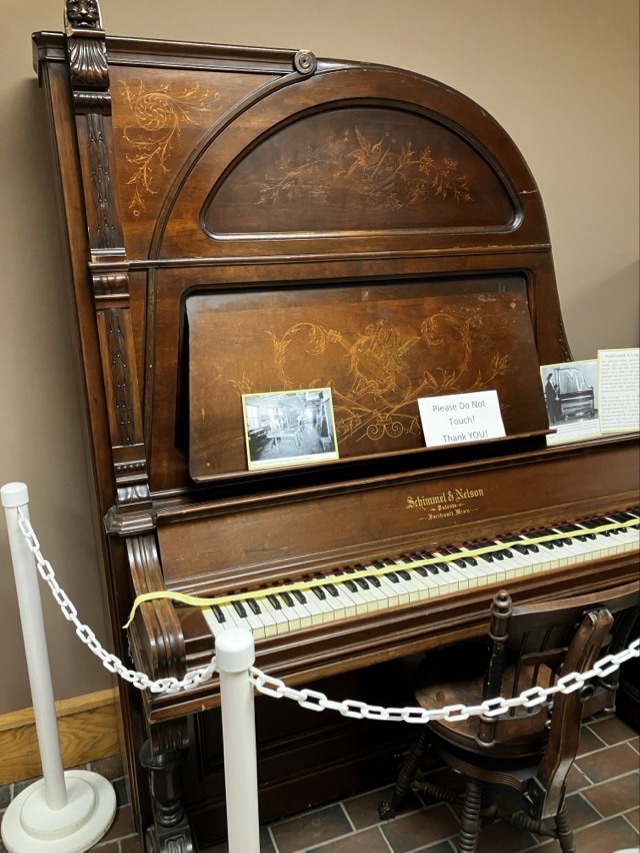
I also found out that there was a company back in the day that made upright grand pianos! Isn’t that odd? They were apparently almost impossible to tune and not very handy, so the not very many were made.
When I report for research duty (currently volunteering about 4 hours per week, two hours at a time), the head of research hands me a piece of paper on which she’s jotted some notes after taking calls with requests for research, either on families, businesses or even sometimes some land. There’s an old computer that I use to access an online database, as well as an index of all the subjects found in the files. Once I’ve got my assignment, I’m off and running!
I find it completely engrossing. The two hours get gobbled up so quickly that I’m almost sad it’s time to go. Dream job!
So that’s what I’ve been up to – a little busier than usual, but loving it.
What have you been up to? Do tell!
I’ll probably delete this in an historical way in the morning.
Hello, friends! I have a question: didn’t summer just start? I turned my head for just a moment and it sped past in a blur. We’ve had a busy summer in all the best ways and I am, as always, ready for the beautiful days of autumn to be upon us.
The workshop has been a bit barren. Lots happens in my head, but I have little to show for it, except for this sweet little bunny:
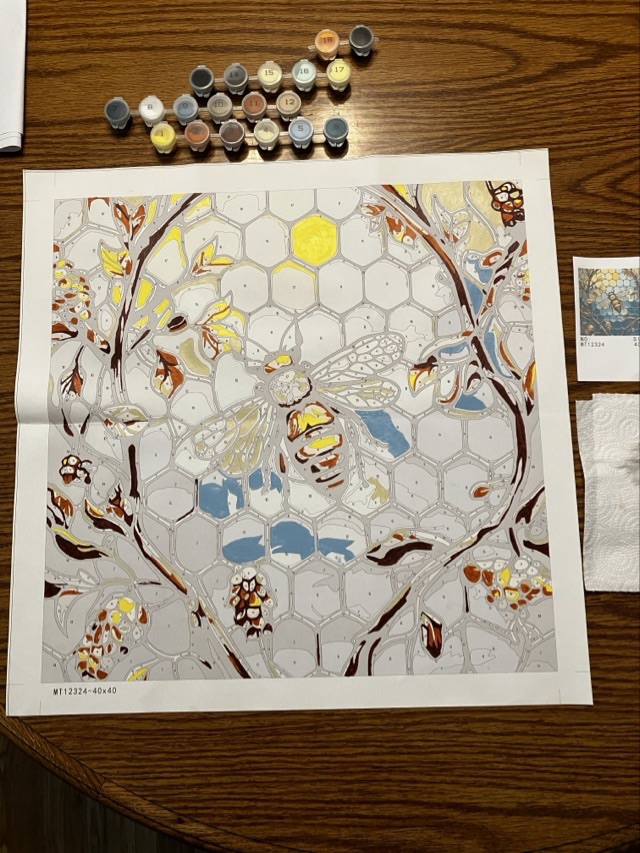
And progress on the Paint-By-Number Bee:
I started the PBN Bee in January before my surgery and it has lain fallow until recently. I want to finish it before Christmas, since it was a Christmas gift.
Bee and Bunny Are awfully funny. Bunny and Bee Are friends, you see.
Bee gives Bunny All the best honey And Bunny gives Bee Her best willow tea.
Honey in tea Bunny and Bee All go together Most happily!
Until I wrote the first line, I didn’t even know a poem was on its way, and *whoosh* there it was! I call that a kind Providence.
The blog by me Will have to be Deleted in the morning Most happily!
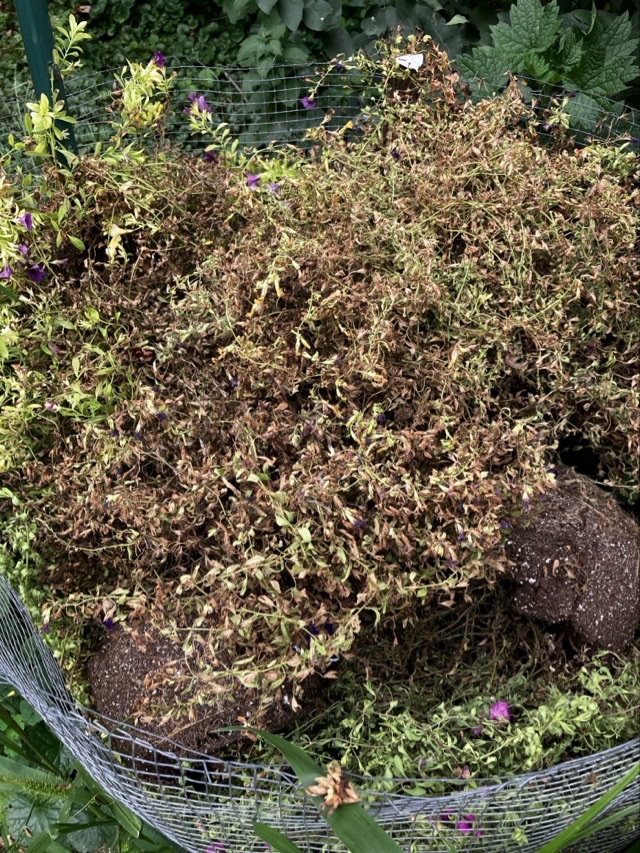
Here lie the pitiful potted petunias that started life with such sparkle and optimism in May. ‘Tis no fault of their own that they have suffered an early demise.
I find it a joyful prospect to keep them watered in May and June. When July comes, I am slowing down in my enthusiasm. I might let a day slip by and get to the watering later in the afternoon, rather than in the morning. The petunias sense my lack of commitment and feel it keenly. Once or twice I might accidentally forget altogether and run out in the morning with water and abject apologies. But they know. They know my fickle heart.
By August, the petunias are becoming a weight on my soul. “What? You need water AGAIN?” I drag my feet and bring the watering cans to the hoses for refills. “Didn’t I just water you guys?” Even with consistent watering, they are showing their age. The bloom of youth is gone. They know it. I know it.
I usually rally and make sure they don’t die off until late September when it becomes more in the natural scheme of things. But a few days ago, I skipped a whole day of watering. The thought came unbidden: “I could just quit.” Okay, maybe it was bidden. Another day went by. “I should water them, shouldn’t I? What kind of person lets their flowers just die of thirst?” Another day. And another day. I guess I am that kind of person. I’m not proud of it, but the deed is done.
Here lie the dried-up petunias, Dead before their time. I confess that I did ruin ya, Then I made a bad rhyme.
But just to cheer you up, there’s still lots of pizazz in the perennial garden where the flowers aren’t dependent on me. And the beetles are enjoying themselves a bit too much!
Here lies the dried up blog post I’ll finish it off in the morning, It’ll be just like dried up toast Gone without much warning.
I am a puffin and I have orange feet. This is my story.
I was born with orange feet, as were all my friends and relations. We were endowed with orange feet by our Creator, the Puffin Maker. I happen to think that we are an extremely attractive group, and it’s not just our beautiful orange feet. Take a look at my beak. I don’t like to boast, but I will if you insist. You do? Let the record show that you insisted that I boast, in spite of the fact that I initially demurred. About my beak: it’s a delightful swirl of orange, yellow and black. And let’s not forget the yellow-orange splotch where the beak starts. “What’s that for?”I hear you asking. I’m not sure, but I’m open to suggestions.
It may surprise you to learn – lean in closer now; I’m about to reveal something shocking. As I was saying – pay attention, please – our beaks are actually a rather dull gray color in the winter! In the spring, quite when we are least expecting it, our beaks burst into color like a sunrise over the ocean. It’s a time of laughter and song among us, a sign that romance is blooming over the horizon, just like the sun. And with that enticing bit of foreshadowing, the first chapter of my memoir has come to a close.
Oh, you want to know my name? In puffin language, it would be “bra-ha-whir-whor-orrrrrrrrrrrrrrrrrrrrrrrr.” It might be easiest if you call me Rufus. Rufus, the Polite Puffin.
It’s me now – Lynniebee – to tell you that I might be deleting this orange-footed post in the morning.