Tuesday, June 30, 2020 Three Simple Things

Busy day = subpar content (also known as “Scraping the Bottom of the Barrel”). I feel an obligation to give my faithful readers something interesting to read, but we might have to fudge a little on the definition of the word “interesting.”

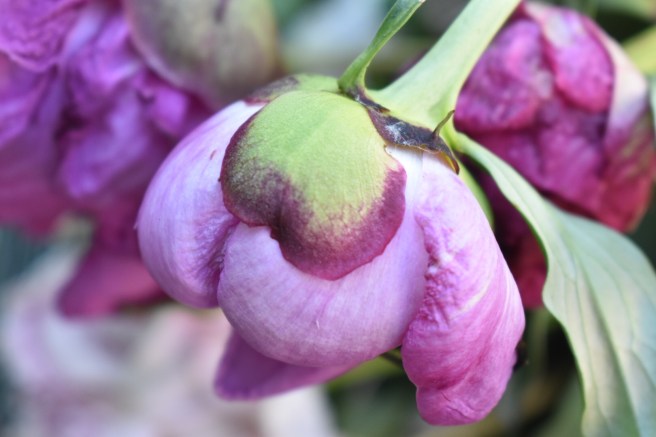
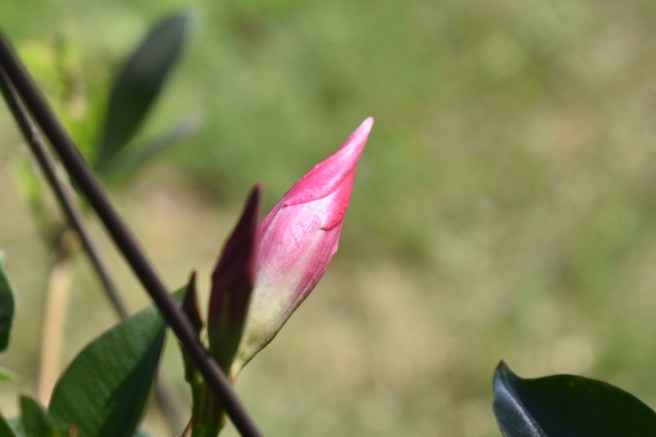
First of all, let me share something beautiful:

That should count for something.

I am reminded of a book about homeschooling that I read which said that whatever curriculum you used, you should be sure that each day your children have:

Something or someone to love
Something worthwhile to do
Something to think about

Here’s what I wrote in the book at the end of that chapter as I mused about it way back when I first read it:

“Three simple things…yet not so simple with 6 children. I believe my children are given something to think about each day, but I’m not so sure about worthwhile things to do. What about something to love? I’d like to think that we all are providing for each other someone to love, but maybe this needs to be more purposeful than just our general co-existence as a family. I need to ponder that for awhile. Nobody seems to love the cat – I perhaps haven’t modeled that well.”

Ha ha – well, if you knew our cat, November, you’d know why I said that.

Don’t we all need those three simple things every day? For me, now more than ever.

Let’s not delete this in the morning. It’s important!

P.S. Bonus points for any of my homeschooling friends who can tell me what book that was. 🙂 I’ll give a hint: the subtitle is “Personal Reflections on the Gentle Art of Learning.”

Monday, June 29, 2020 Daucus Carota

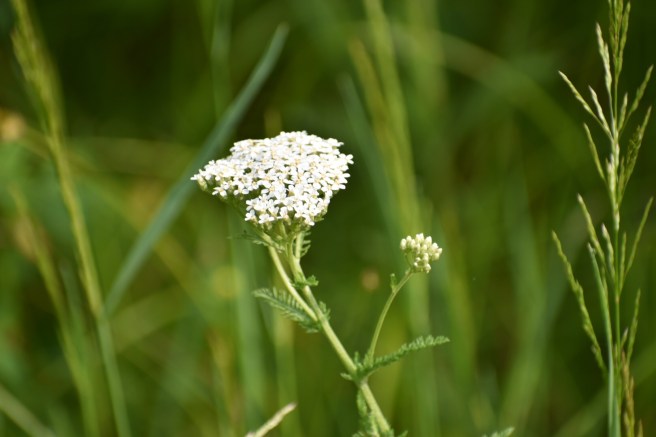
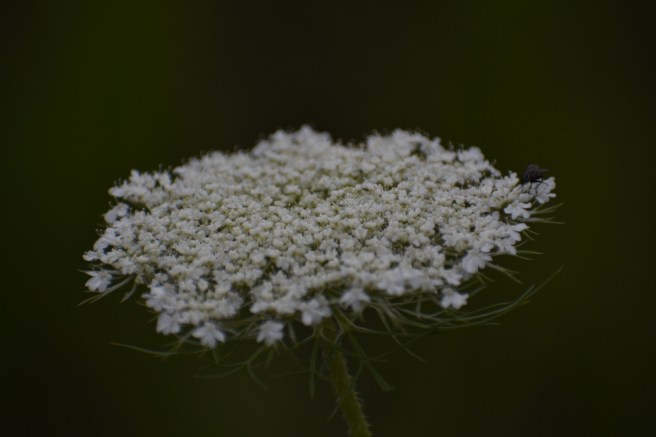
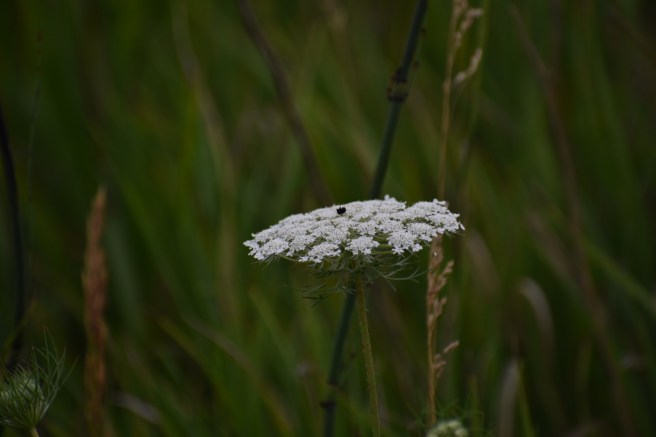
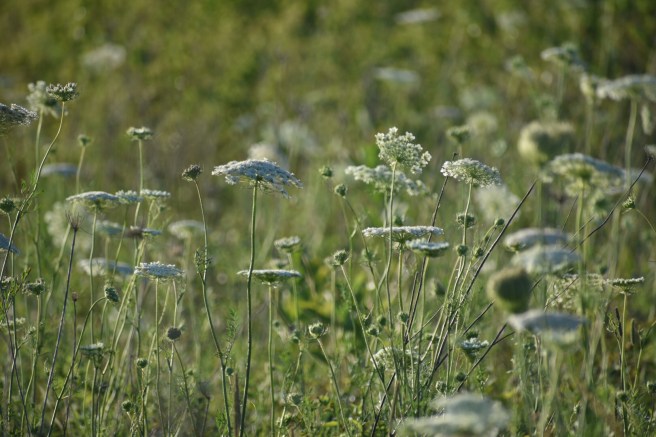
Daucus Carota…what a name for such a beautiful girl. She’s a wild carrot, showing up in very unorganized gatherings in places like ditches and roadsides. You might say she’s a commoner. But someone looked at her and saw something very uncommon, an appearance like the lace worn by royalty. And so she became “Queen Anne’s Lace,” which I think much more befitting her carriage and appearance. Wherever she appears, she brings beauty and grace.

Daucus Carota,
Wild threads from God’s true bobbins.
Royalty, indeed.

I haiku a lot, don’t I? My motto: In a world full of haiku, there’s always room for one more.

I’ll probably delete this in the morning.

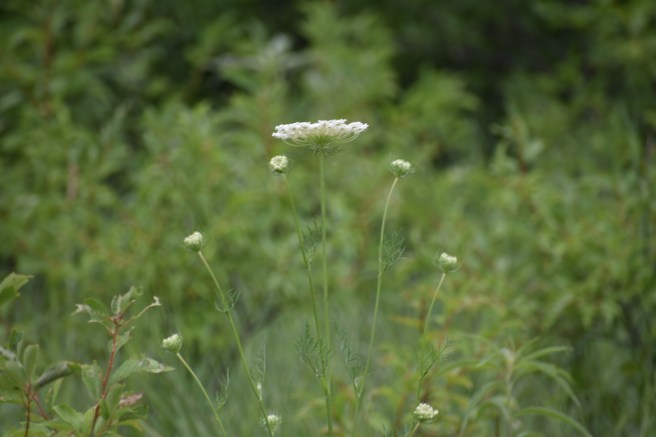
P.S. Found out later that the photo above was of a yarrow plant. How embarrassing! A commoner imposter usurping the place of royalty! So here’s the elegant lady reclaiming her rightful place on the throne:

Friday, June 26, 2020 The Secret Signs of Flowers

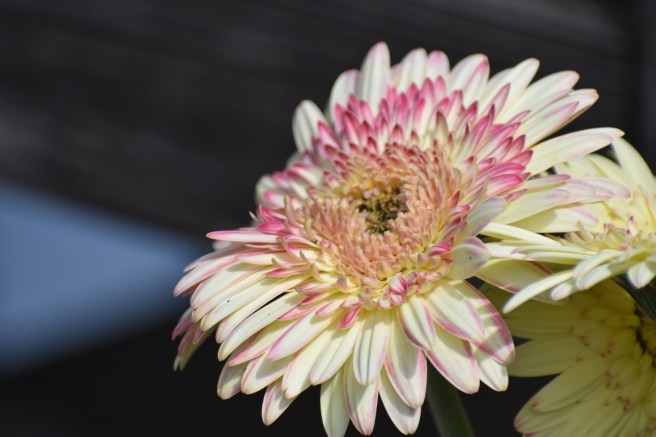
Look at this Gerbera Daisy,
Look deep into its center
And there you’ll find a tiny sign
saying “Speak friend, and enter.”

I know it’s true (though I haven’t seen it)
T’was a chickadee who told me.
I watched him knock and enter in,
And dine within quite boldly.

A little whimsy to start off your weekend well.

I’ll probably delete this is in the morning.

Minnesota Valley State Recreation Area: Quiet, Buggy, Fast

At last we made it to the Minnesota Valley SRA! It’s not too far from where we live (relatively speaking) and is the last Minnesota State Park that won’t require a lot of driving and/or overnight stays. I was surprised to learn that that this park was created fairly recently, established in 1994. The 4-mile hiking club trail consists of a somewhat straight trail that runs along a backwater stream, a loop, and then back on the original straight trail. Easy peasy!! The Minnesota River runs alongside the trail as well (thus, the name of the park), but is not clearly visible from it. The trail description also told of a Beason Lake that we’d be passing. Let’s get started.
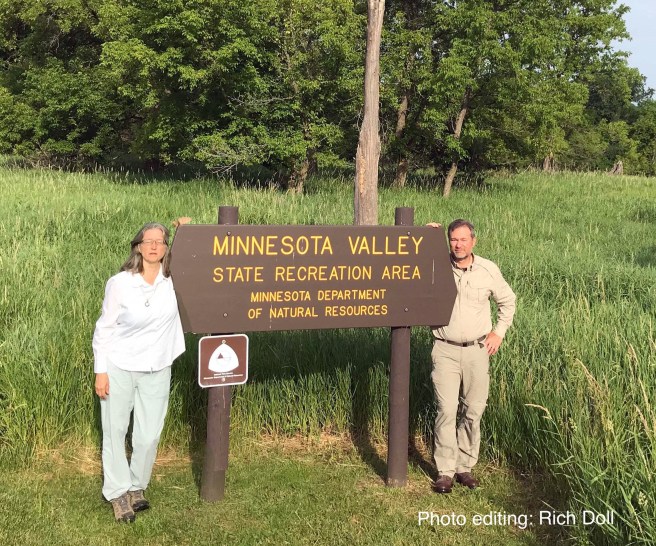
It was a good day for hiking: 64 degrees, a little humid, but not oppressively so. The hike started at the Trail Center, but we stopped first to see the Samuel B. Strait house (closed, of course), built in the late 1850’s by SBS himself with the hopes of it being the beginning of a new town called St. Lawrence. The town never took off, but the house remains. Something else of the Strait family remained as well, but we didn’t encounter it until later in the hike – a surprise in the wilderness. Ooh, foreshadowing!!
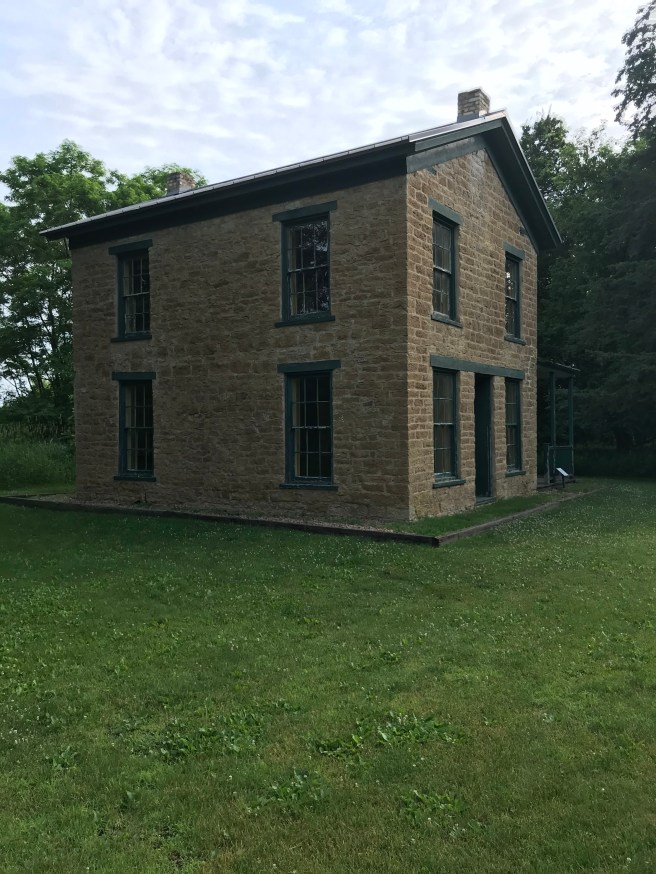
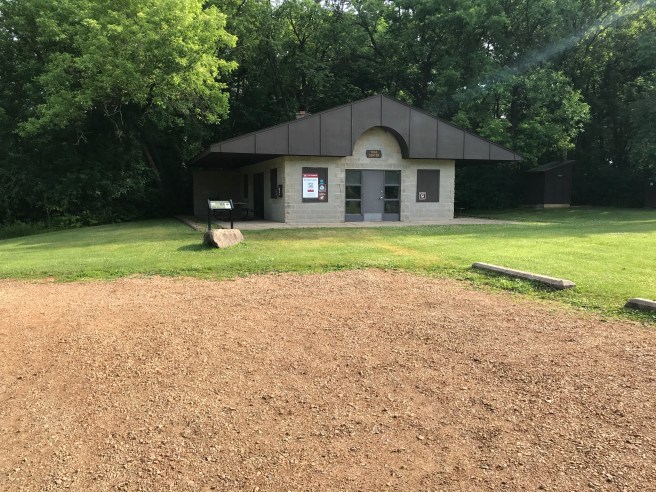
The Trail Center was deserted; ours was the only car in the lot. We carry a Minnesota State Parks Passport with us that gets stamped at every park. Fortunately, in these times of closed park offices, all the parks keep a self-serve stamp outside the door, along with bunches of park maps. We availed ourselves of both, I doused myself with mosquito spray and we got ready to hike.
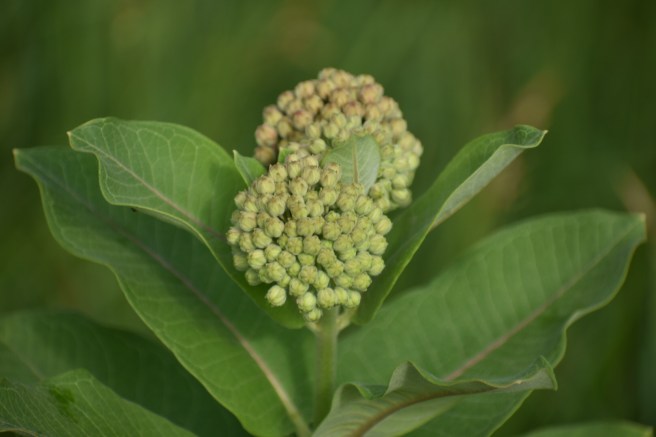
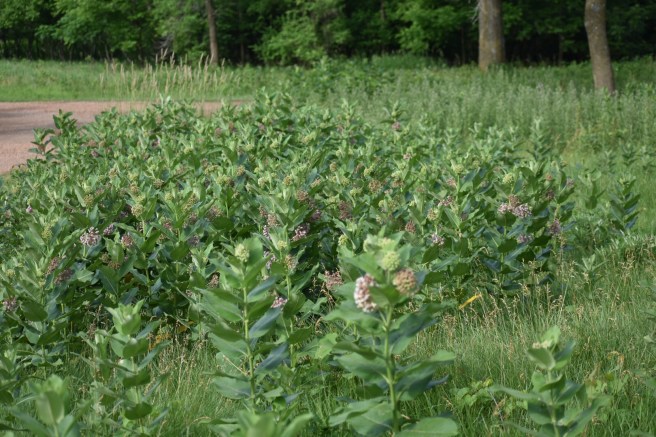
There’s lot of milkweed growing in the area where the trail starts. It’s really a beautiful plant in all its stages of life, I think. The pale green buds were just beginning to take on the pinkish cast of the bloom. I checked a couple plants for monarch eggs, but didn’t see any. I nicknamed the area “Milkweed Forest.”
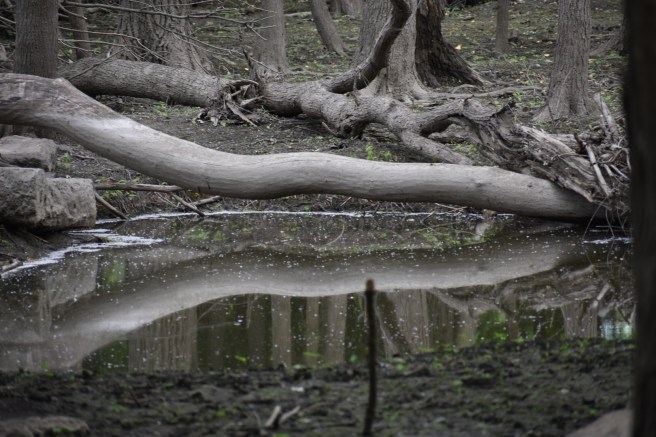
As we walked along by the backwater stream, I was struck by the stillness of the water and the many lovely reflections.


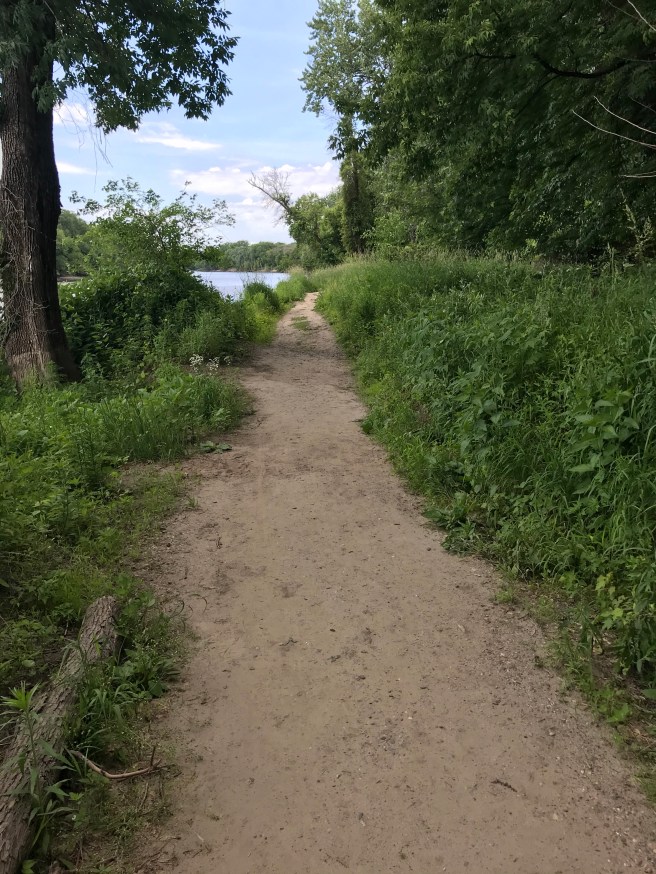
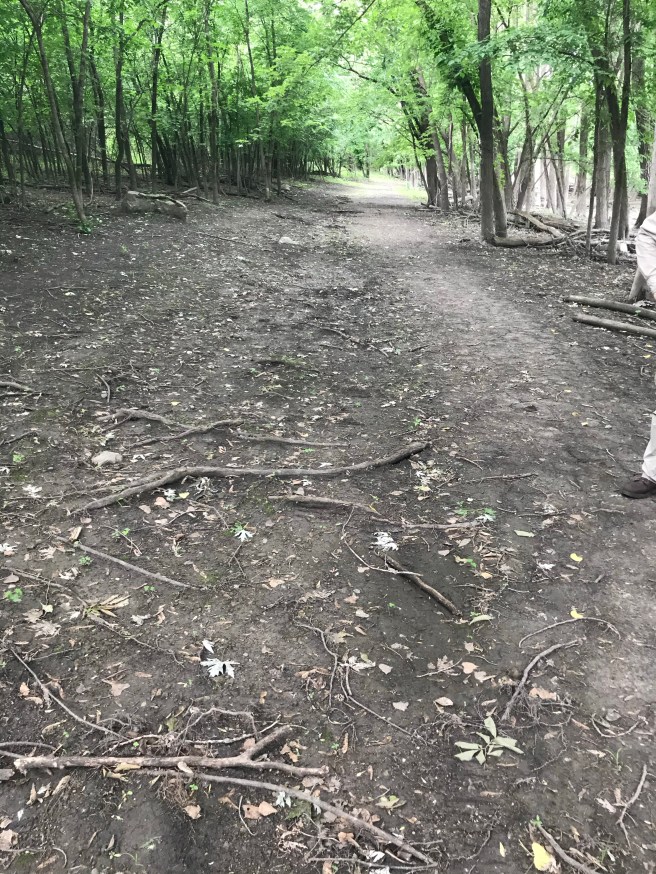
The noise of our hiking caused a big white bird to take flight. Kris thinks it was a Great Blue Heron, but it was too busy to stop for a photo op. The wide path was well cleared, but contained a lot of little tree roots sticking up at just the right height to catch your boots as you walked. I dub thee “Tripping Root Trail.”
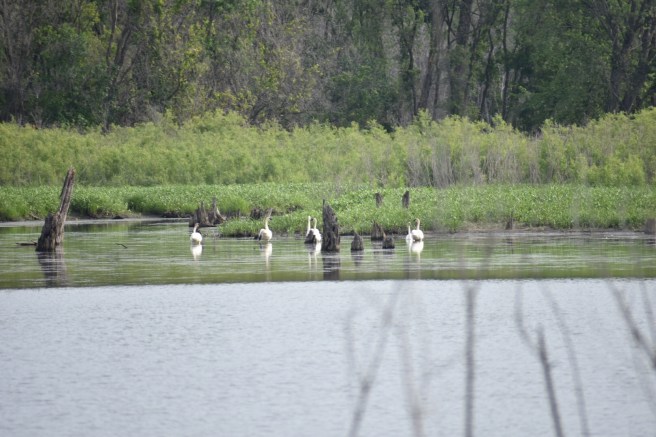
As we turned a corner away from the stream, we saw in the distance a number of white waterfowl lollygagging by the edge of the water. Hard to know what they were. Swans? Geese?
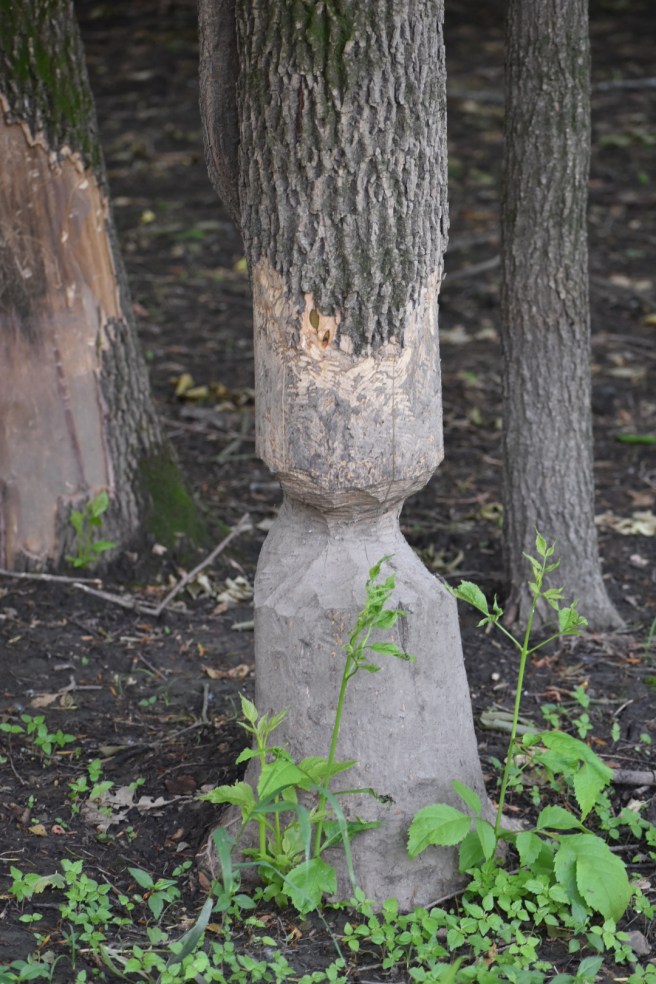
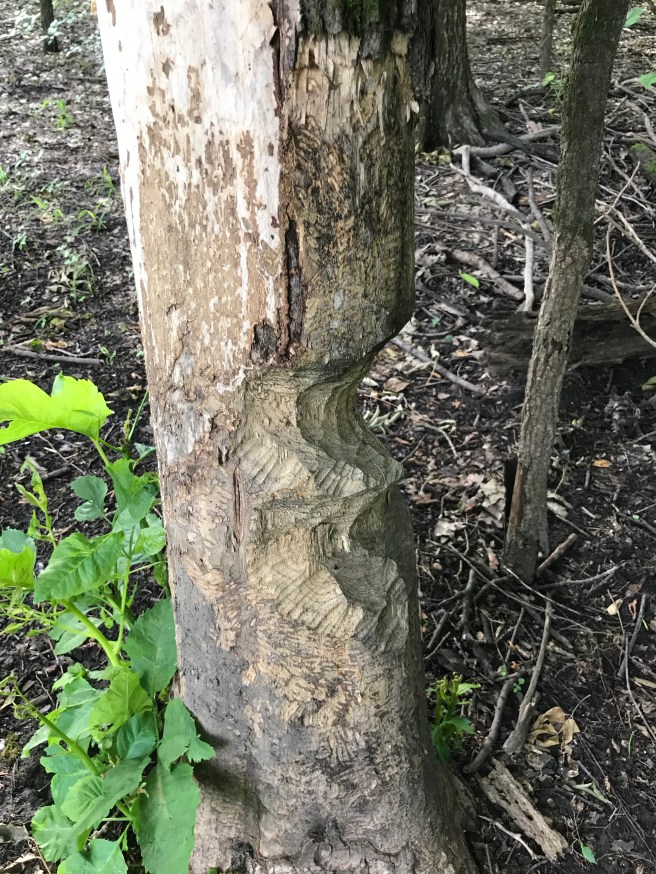
We also saw evidence that Beavers had been busy here at the turn in the road, so let’s call that intersection, “Beaver’s Corner.”
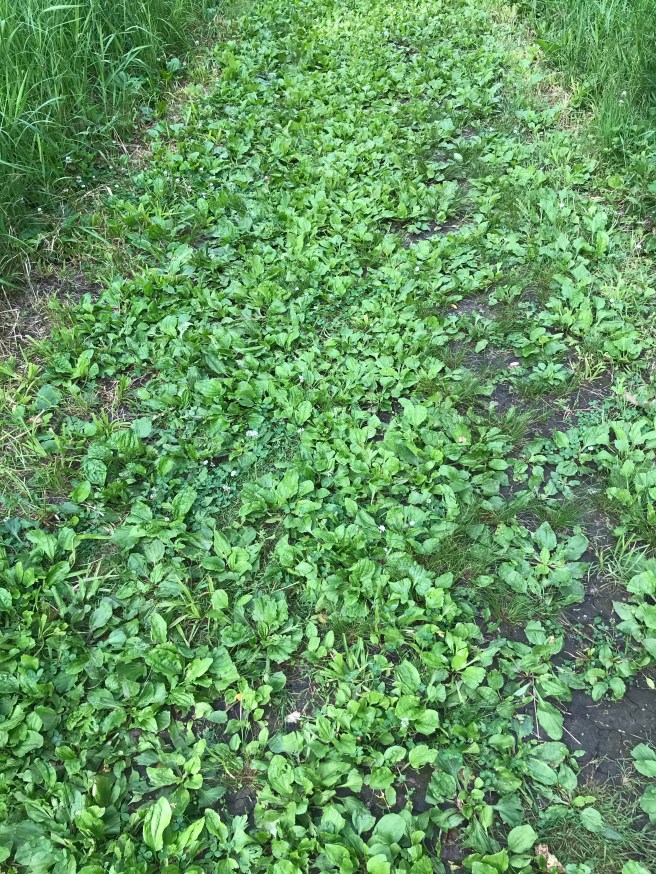
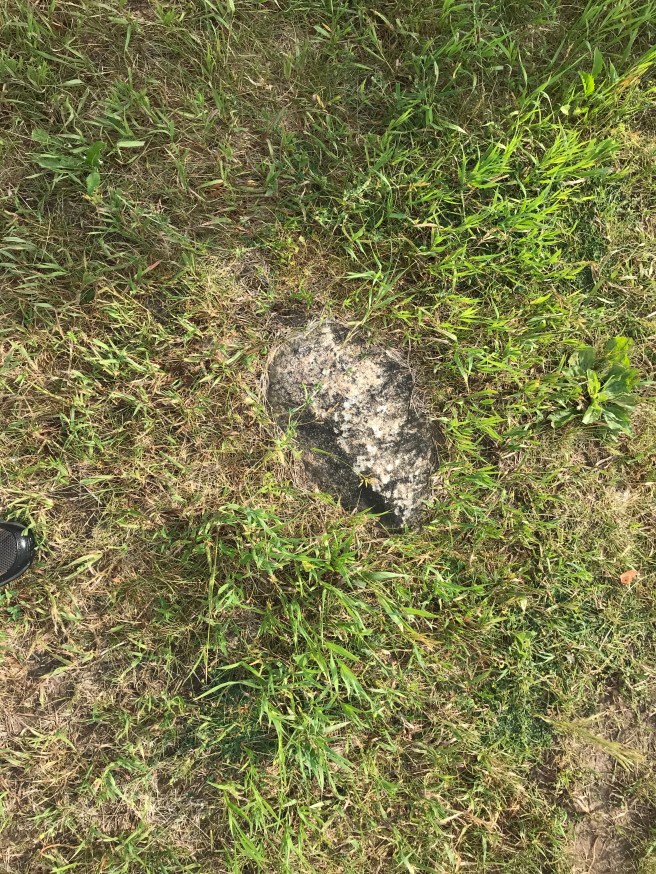
It wasn’t long before we came to the fork in the road where the loop started and ended. We hiked through a meadowy area where the path was almost purely plaintain. Anne of Green Gable’s practical friend Diana Barry would have named it “Plantain Path,” and I say, “Why not?” Sometimes it is what it is. The trail was also strewn with clever boulders, just random enough in their placement and subtle enough in their height to keep you a little off kilter as you hiked. Well played.
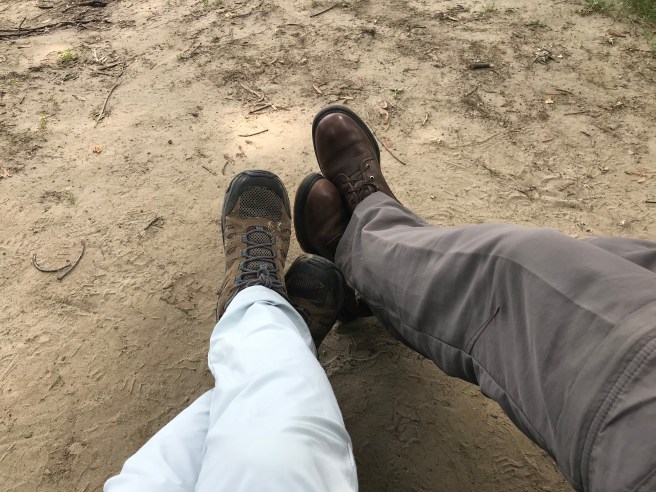
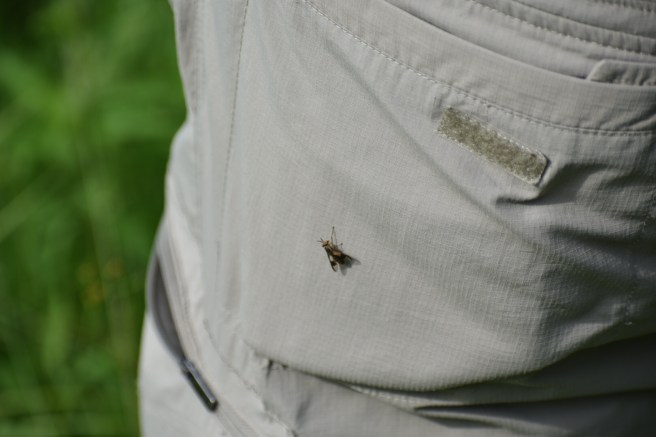
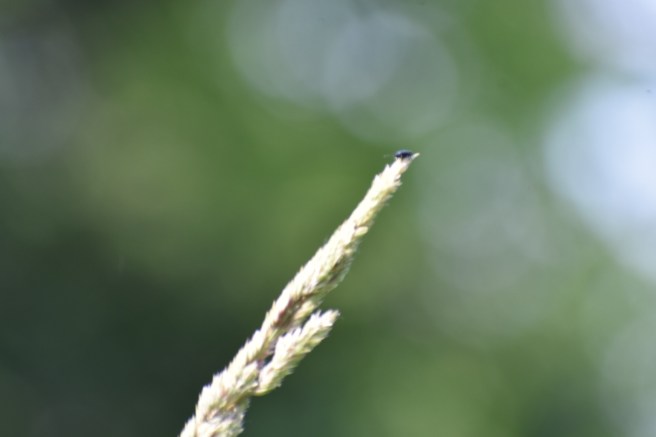
Ah, but I haven’t mentioned the biting insects yet. We could hear what sounded like mosquitos, but the one that landed on my hand and bit it wasn’t one of their ilk. I took a photo of another one on Kris’s pants so that one of you could identify it for me. This is an interactive blog – I have to give you something to do.
We left the meadow and were in a more heavily forested area. It was tucked into that quiet reserve that we found this:
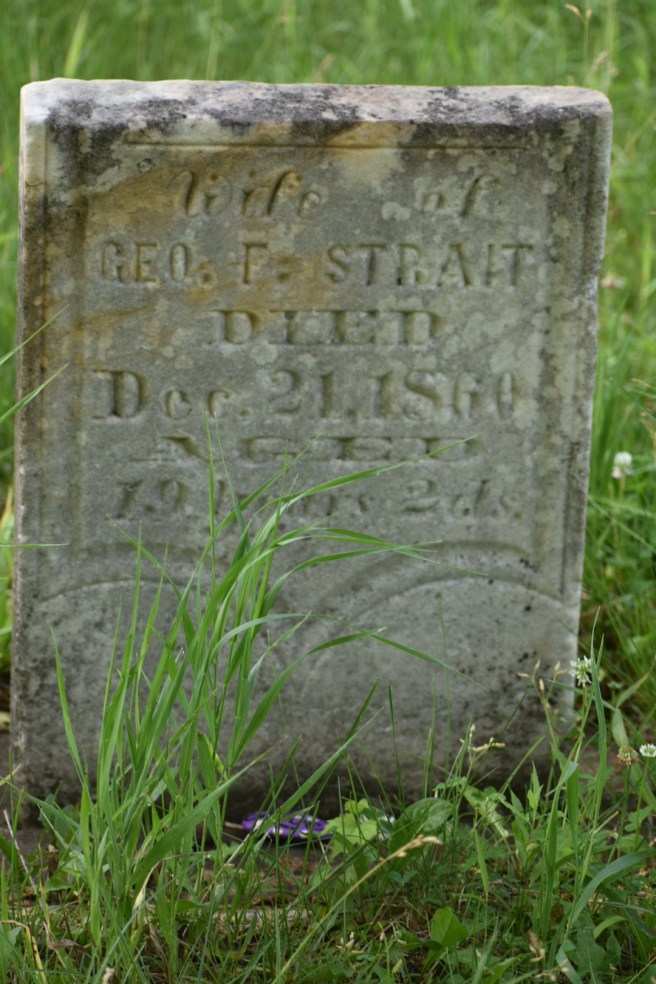
The darling young wife of Geo. F. Strait found her resting place here. Just a young lass of 19 years and 2 days (oh, how poignant the mention of those 2 days), her body was planted here and a forest grew up around it. I guess George couldn’t afford the extra cost of having her name etched in the stone. Her burial bower is kept cleared and we found evidence of love there.
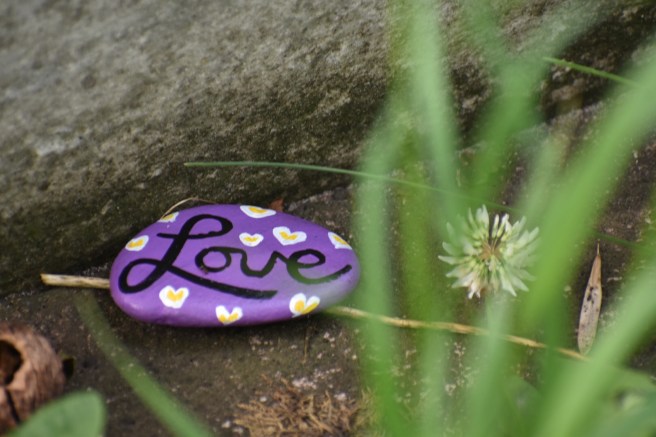
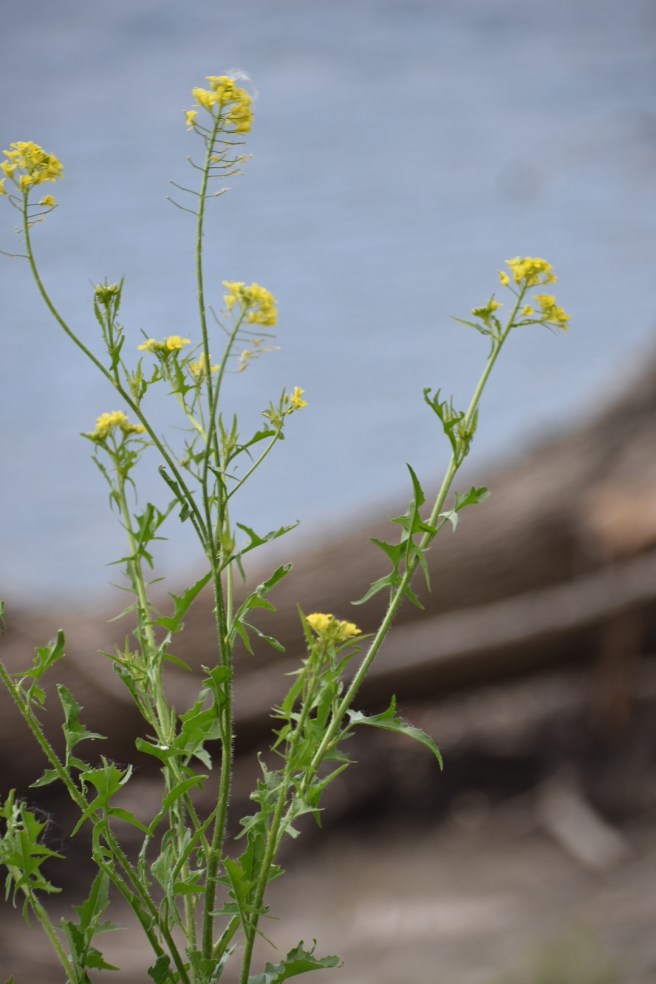
I continued to take a few photos here and there of interesting plants.
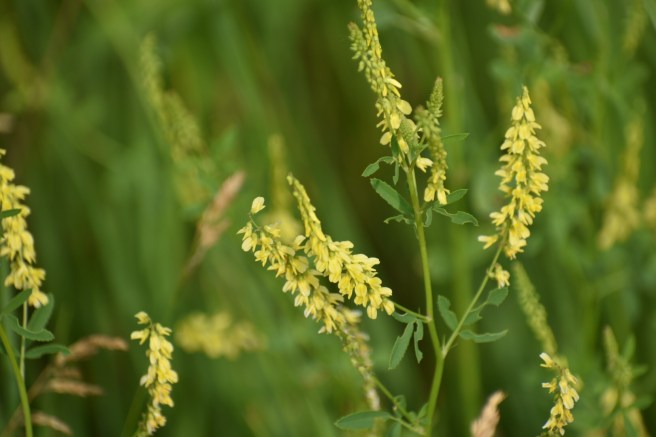
Here’s one that Kris said he thought was called “timothy:”
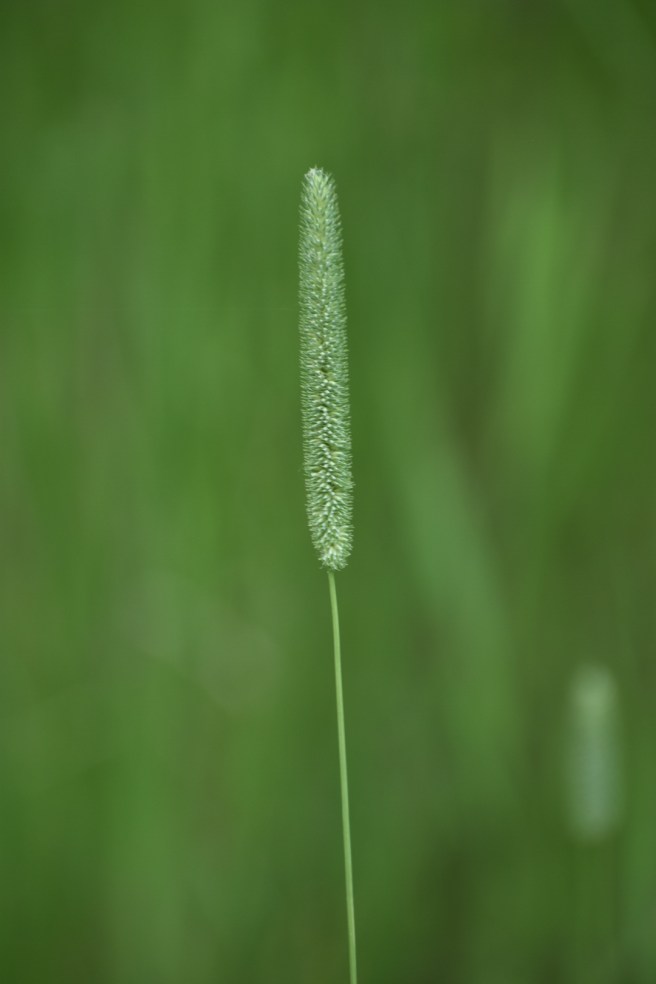
It should tell you something of my age that I had an immediate Pavlovian response to that word which prompted the remembrance of singing this 70’s era song:

Timothy, Timothy, where on earth did you go?
Timothy, Timothy, God, why don’t I know?

Is it true that that song is about poor Timothy being cannibalized or is that just urban legend? *shudder*

We picked up our pace as we walked. The biting bugs kept their distance as long as we kept moving, but their rules of engagement did not preclude taking advantage of a slow plod. The scenery began to go by in a blur as our cruel taskmasters harassed us. We noticed on our way back an opportunity to walk a short distance over to see the Minnesota River. Oh, why not? YOLO!
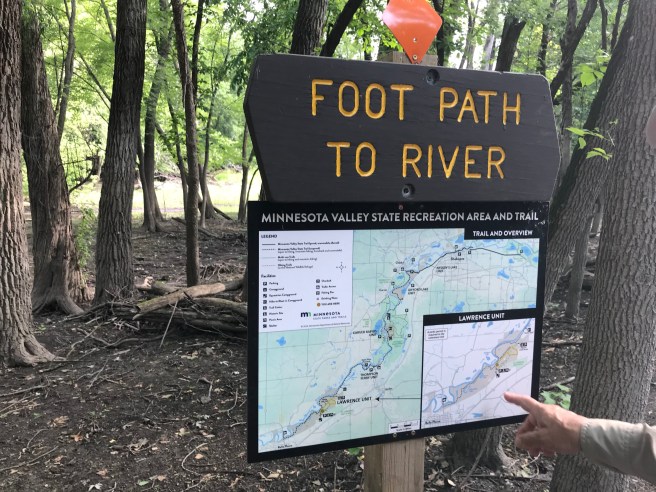
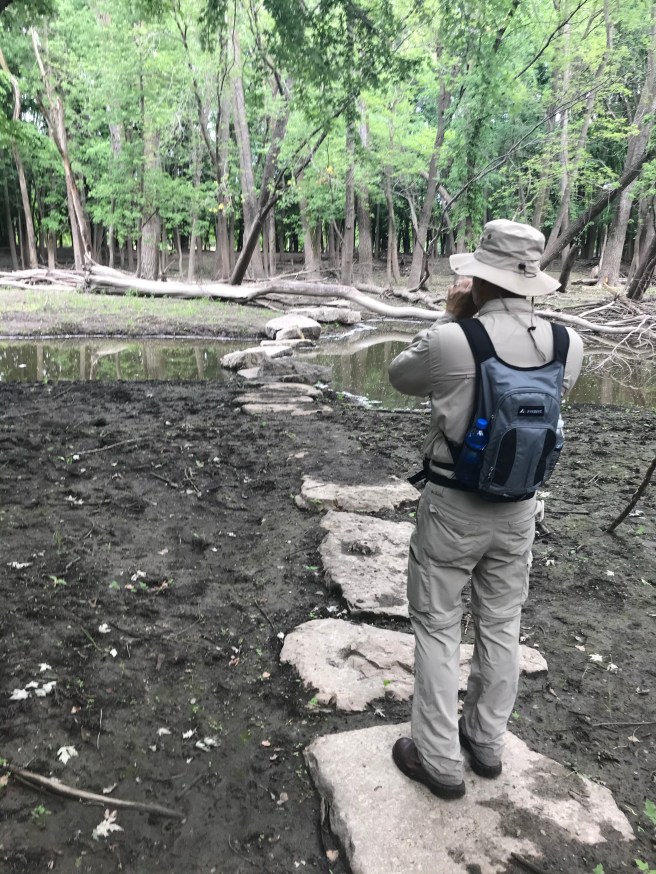
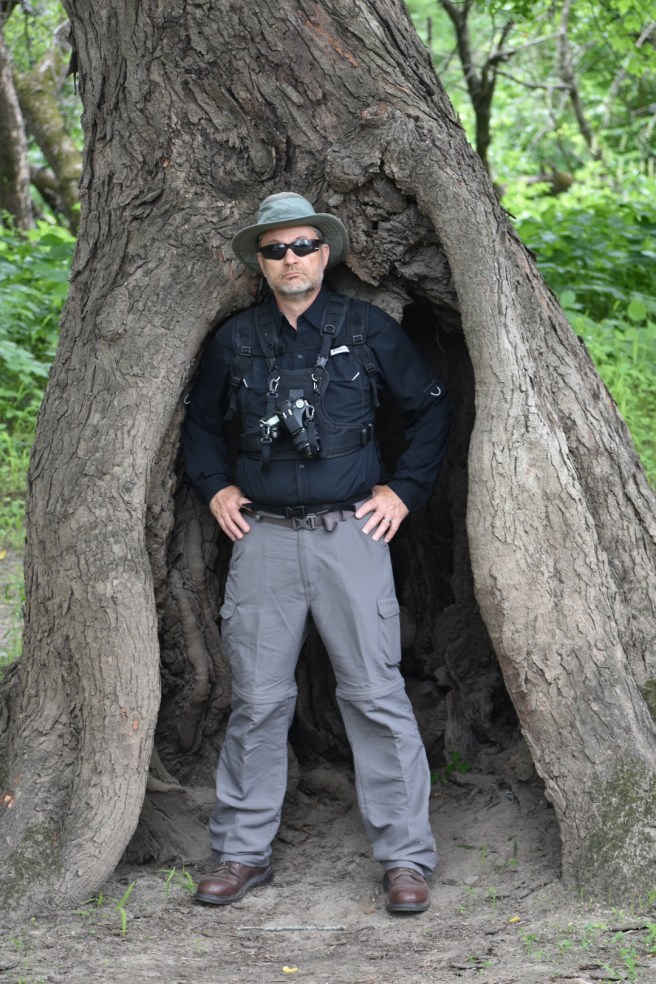
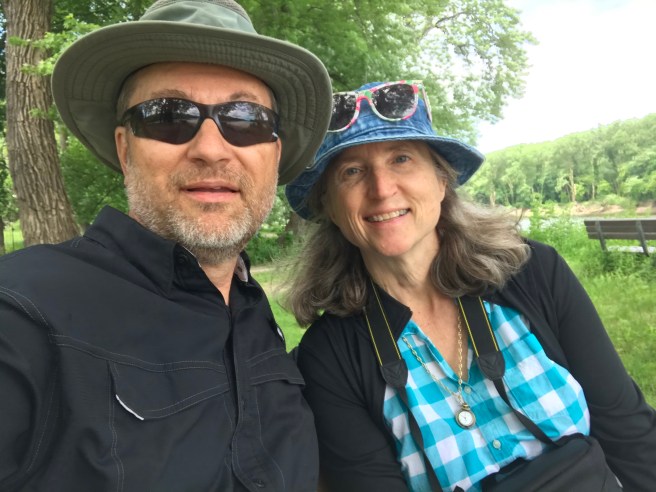
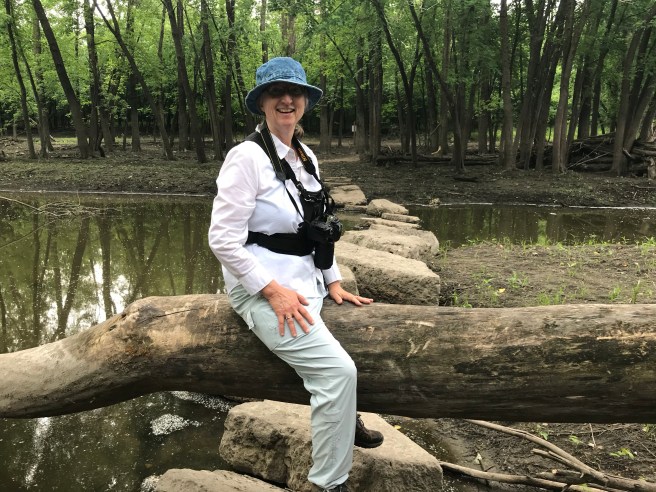
The only impediment was a large tree in the path, which we had to straddle to get over. Here’s a charming photo of me in all my “who cares what I look like” hiking regalia glory. You’ll note that Kris and I traded camera holders. I like his better and he likes mine better. Not all situations in a marriage get resolved this neatly; ’twas a happy providence.
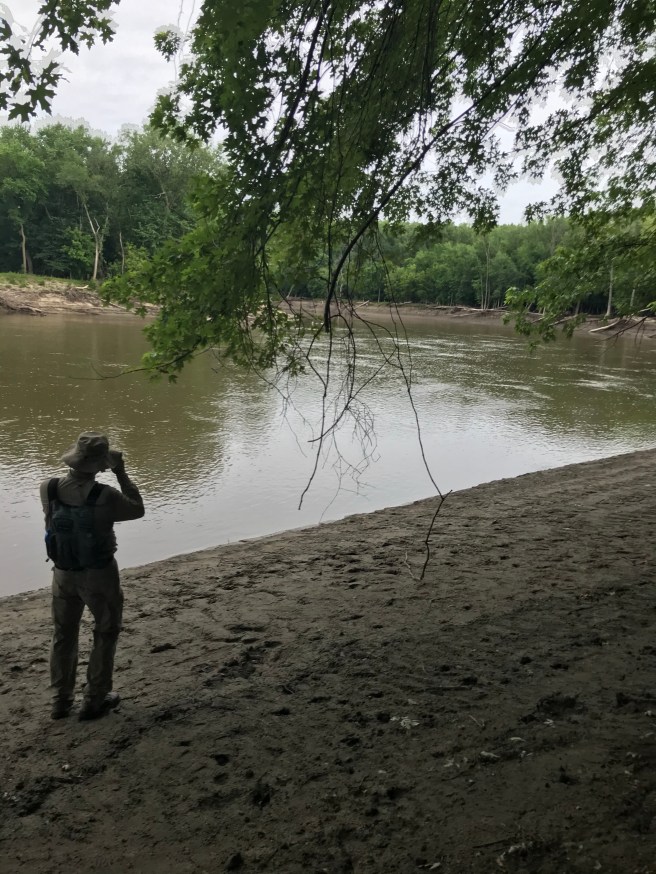
We got to the river and took photos. Not much else to do. We call the Mississippi the Mighty Mississippi, so what should we call the Minnesota River? Majestic? Mere? Mystic? Muddy?
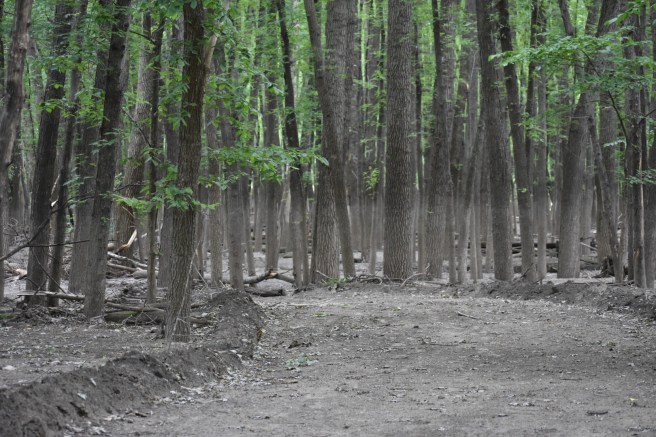
You can see the flood line in this photo of a stand of trees near the river.
We broke all speed records on this hike. While it took 90 minutes for us to do the 3-mile Fort Snelling hike, we polished off this 4-mile hike in 80 minutes. Not bad, eh? As for the rumored Beason Lake, we never saw it. Sing this with me:

Beason Lake, Beason Lake, where on earth did you go?
Beason Lake, Beason Lake, God, why don’t I know?

Knee Score: 2 out of 10. Crosby-Manitou was a 10. Level but uneven terrain. 7522 steps.

We have now hiked a total of 65.3 miles since starting the Hiking Club in July of 2018.
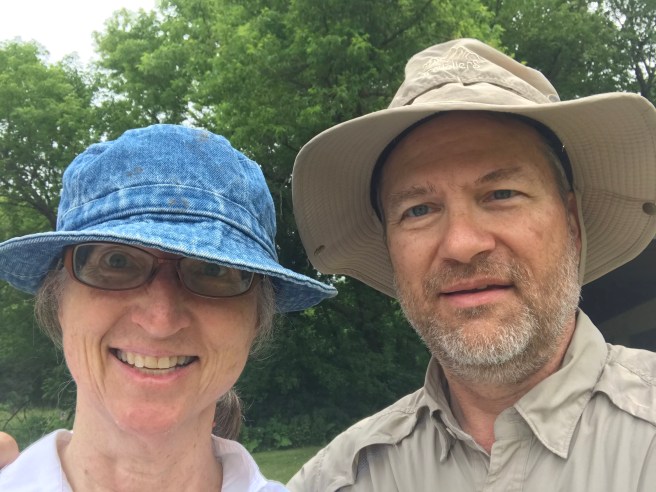
I’ll probably delete this photo in the morning.

Next Hike: Blue Mounds State Park

Wednesday, June 24, 2020 When Your Relatives are Planters

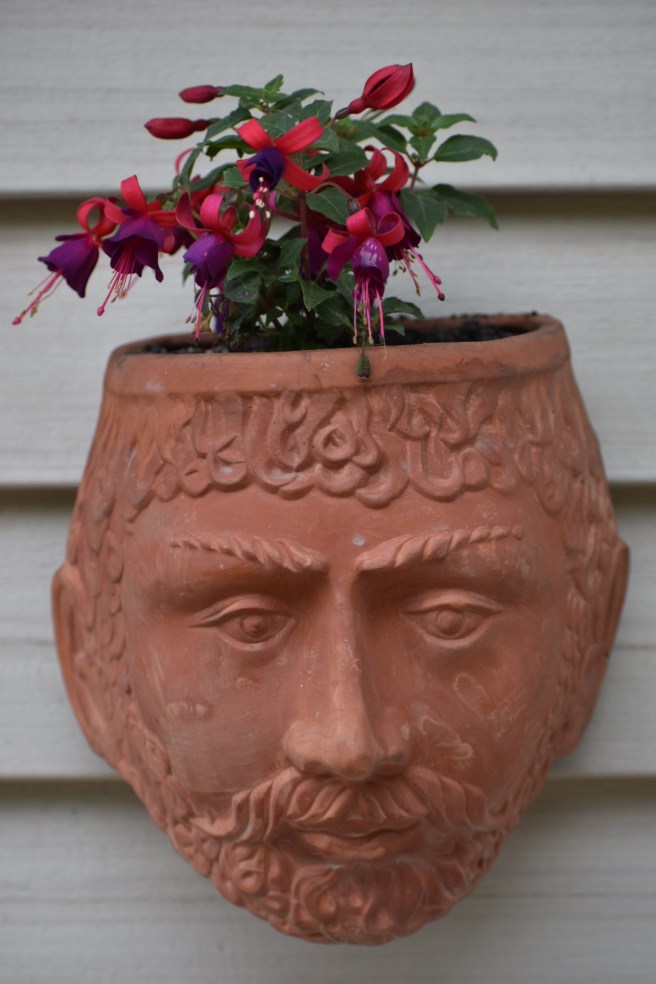
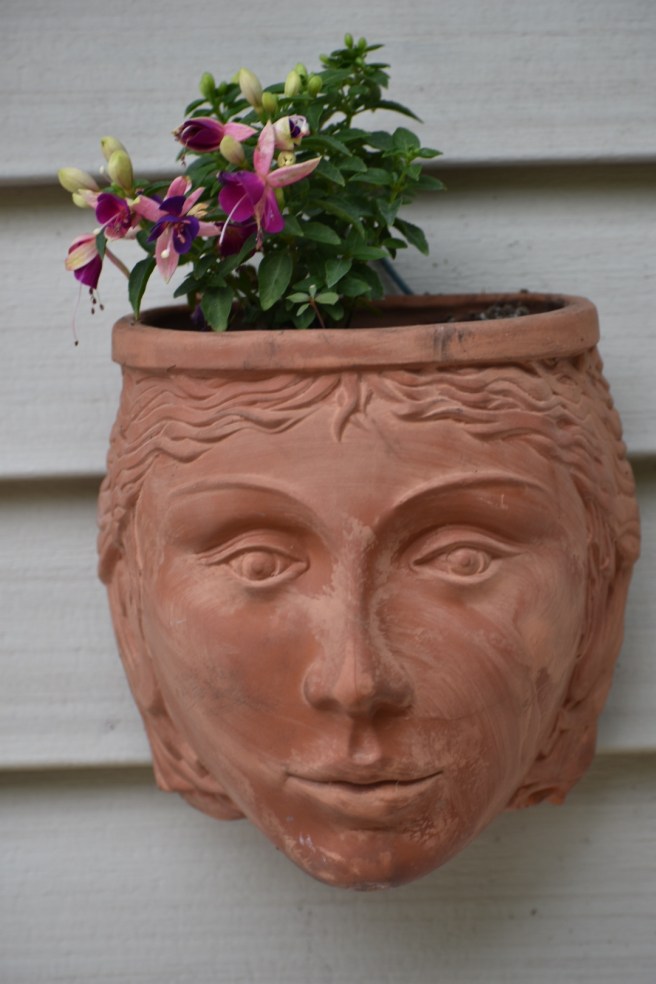
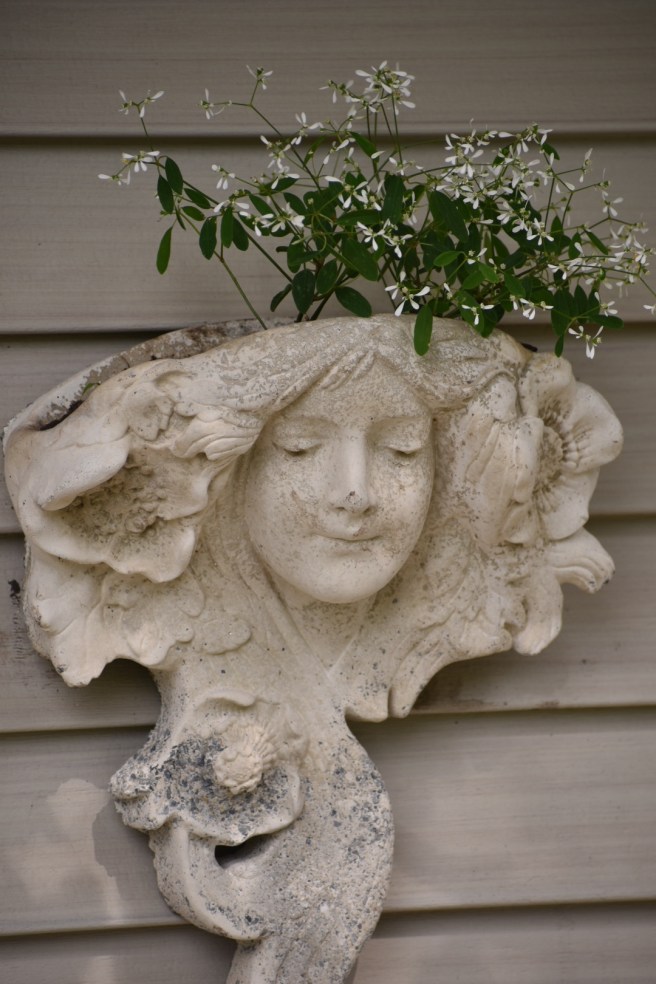
There are some things that make me happy just by their very existence. I want to introduce you three of them. Meet Michael, Betty and Queen Mary:

My mom bought the Michael and Betty planters many years ago and named them after her sister and brother-in-law, my Aunt Betty and Uncle Michael. First of all, the real Michael and Betty always seemed exotic and interesting to me. Michael was an actor who started his own acting studio in New York City and knew lots of people in acting circles there. Betty taught voice lessons and was well-known in the same circles. This was so far out of my realm that I was both fascinated and just a little intimated by them on the rare occasions that we visited. My sister Sarah and I went out for a visit when I was in college and I still remember us all being out at a restaurant, dining with an actress from a soap opera that we watched. She gave us the inside scoop on a story line involving her character. Pretty heady stuff. When Betty died a few years ago, we went to her “Celebration of Life” gathering and were impressed when the actor Michael Douglas showed up to share his own fond memories of her. Uncle Michael died earlier this year, so they are both gone now.

When Mom stopped using the planters some years ago, I eagerly swept them up and adopted them as my own. It’s a great pleasure each year filling them with plants and watching their “hair” grow. This year, they have fuchsia hair.

The third planter was one my mom acquired later in her esteemed gardening career and I wasn’t as familiar with it but was glad to add it to the “family.” I think Mom called her “Victoria,” but I decided to call her “Queen Mary,” after my mom (the Mary part, not the queen part). She has beautiful white hair this year, just like Mom.

Aren’t they exquisite?

I’ll probably delete this in the morning, after contemplating how I might feel about having a planter named after me.

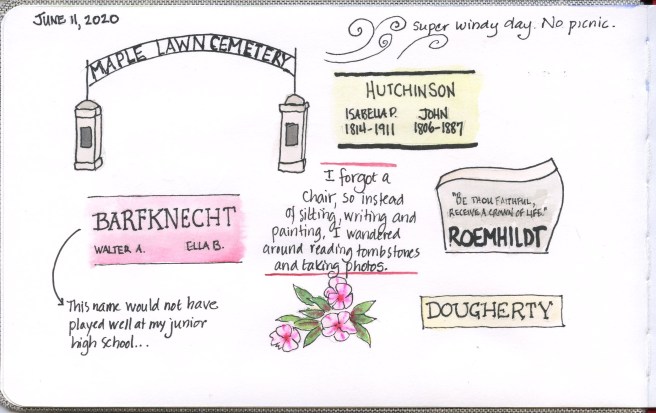
June 22, 2020 Grave Musings 2: Maple Lawn Cemetery and Chief Taopi

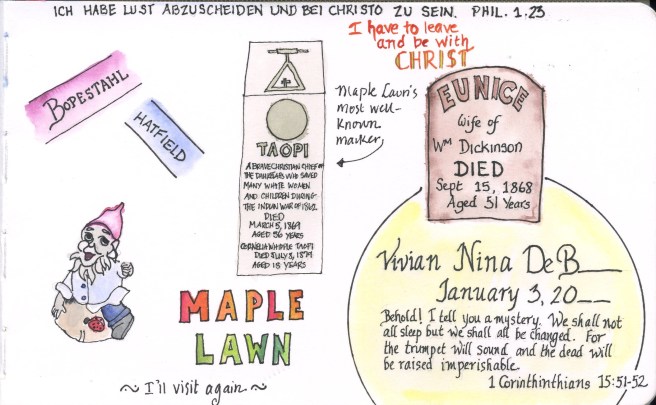
I’ve already written about my visit to Maple Lawn, (Grave Musings 1) but I wanted to go into a little more detail about Chief Taopi, who is buried there. The U.S.-Dakota War of 1862 is an event that touches several of the areas we’ve been to as we’ve hiked: New Ulm and Fort Ridgely, where raids were carried out, and Fort Snelling, where 1600 Dakota peoples were held on Pike Island after the conflict before being forcibly moved to camps in Nebraska and South Dakota. From an article that I read online: “The U.S.-Dakota War of 1862 lasted just five weeks, but it stands as a hideous stain in American history. The execution of 38 American Indians in Mankato following the war remains the largest mass execution carried out by the U.S. government.”

Taopi grew up near present-day South St. Paul and was a member of Chief Little Crow’s Mdewakanton band of Dakota. At some point, Taopi converted to Christianity and became close friends with two men who were key leaders in the city of Faribault: Alexander Faribault and Bishop Henry Whipple. I would love to know more details about how Chief Taopi came to Christ, but in reading his story, it is not hard to deduce that this conversion placed him in a unique and difficult position among the Dakota Indians during the Dakota Conflict of 1862. He was committed to finding a peaceful resolution and ended up defying his former chief, Chief Little Crow, in pursuit of it. The war brought division among the Dakota; Taopi and others formed the Dakota Peace Party. Suing for peace among a people who have been unfairly treated must have been a hard road to walk. In the end, Chief Taopi chose to try to save lives, even when that likely meant being seen as a traitor to his tribe. I cannot imagine the pressures that must have been on the man. To follow Christ, and Christ alone, brings a great cost. Taopi had seen the great injustice done to the Dakota people, as well as the folly of the killing raids committed by them. He chose the way of Christ and peace and suffered many losses as a result. I hope that he, like Paul, was able to say, “…I have suffered the loss of all things, and count them as rubbish, that I may gain Christ.”

I haven’t been back to Maple Lawn yet, but I did finish the two-page spread in my Cemetery Musings book. I’m still working out how best to use that book. I’ve discovered that you can’t erase things on watercolor paper. 😊

Next: Grave Musings 3 Sneak Preview

I’ll probably delete this in the morning.

Monday, June 22, 2020 Into Each Dark and Loveless Place
I came across a hymn recently that was a new one for me. I play and sing it frequently, for it gives me much courage and light in these days that often seem so dark. Scenes of injustice, rioting, and looting play through my mind as I sing “In these last days of great distress…” And when I experience a desire to retreat, I am emboldened to “shine Your Word of saving grace into each dark and loveless place.” Philipp Melanchthon, Luther’s right-hand man during the Reformation, wrote the first stanza, while Nikolaus Selnecker, a German musician and theologian, wrote the other five. He was a contemporary of Luther and Melanchthon. Those were tumultuous times – as are these.
Lord Jesus Christ, with us abide
For round us falls the eventide.
O let Your Word, that saving light,
Shine forth undimmed into the night.

In these last days of great distress
Grant us, dear Lord, true steadfastness
That we keep pure till life is spent,
Your holy Word and Sacrament.

To hope grown dim, to hearts turned cold
Speak tongues of fire and make us bold
To shine Your Word of saving grace
Into each dark and loveless place.

May glorious truths that we have heard,
The bright sword of Your mighty Word,
Spurn Satan that Your Church be strong,
Bold, unified in act and song.

Restrain, O Lord, the human pride
That seeks to thrust Your truth aside
Or with some man-made thoughts or things
Would dim the words Your Spirit sings.

Stay with us, Lord, and keep us true;
Preserve our faith our whole life through –
Your Word alone our heart’s defense,
The Church’s glorious confidence.

This is a proper battle hymn. Our worship is warfare. We carry light into darkness and hope into despair. Let us be bold and unified in act and song.

I will be bold – I will not delete this in the morning!

Friday, June 19, 2020 Lost and Found

As I was rummaging around this morning in a closet getting something off of a high shelf, there, crammed in with some old purses, was this macrame plant hanger.

I gave a cry of great joy, since this was something lost that had now been found. My brother went through a tremendous macrame phase over 30 years ago and I had been given two of his creations, both plant hangers. Early on, one of them had been stepped on and broken beyond repair. A few years ago, I was reminiscing about these hangers with my siblings and went on a hunt for this one, which I was SURE we still had. When all my searches came up empty, I conflated the memory of that broken one with this one and mourned over its loss. And now, that which was dead to me was suddenly very much alive!

How fitting that today in my Bible reading, I came across the parable that Jesus told of the lost sheep. He is the Lord of lost things. He is the Lord who searches out and finds them. He is the Lord who brings prodigal sons to their senses and rejoices over their return. And I was one of those lost things, a wasteful, prodigal child that He found and restored to my true Father – oh, what amazing grace! John Newton said it well:

Amazing grace, how sweet the sound
That saved a wretch like me.
I once was lost, but now am found –
Was blind, but now I see.

That which was dead was given new life. Hallelujah!

I’ll probably delete this in the morning, but He will never fail me nor forsake me, nor delete me!

Thursday, June 18, 2020 Plodding Along

I just finished reading a book called Ploductivity by Douglas Wilson that was very thought-provoking for me in terms of how I approach “work,” and specifically creative work. I’m not a very exacting person. When I make a mistake, I laugh it off and call it “homespun charm,” instead of trying to fix it. Most of the time that works just fine, although my propensity to fudge and substitute when following a recipe has led to some notable failures.

But Wilson has a different approach:

“The idea of mastery is to develop genuine expertise within the radius or labor that God has given you…”

“Craft competence is a virtue to be cultivated.”

…the first step in achieving mastery is taking responsibility for the results. …Some want the results of mastery without all the tedious efforts that go into attaining to mastery.” (Ouch)

“Work for the work, not the reward.”

“Another key to mastery is realizing that the key to originality is imitation. …pick a good model to imitate… …it enables you to build on the good work that others have done…”

The third key to mastery is repetition. …When people do something over and over again – and this should not come as a surprise – they get good at it. But to some, this seems suspiciously like work.”

Again, ouch. Wilson is of course talking about any kind of work, whether it be the labors in the office, at the computer, on the farm, playing the piano…or watercolor painting.

I took up watercolor painting a few years ago and have dabbled, but not with any sort of systematic effort. As Wilson says, “…productive work requires a rhythm, a metronome.” He refers to this as “plodding,” or basically just plugging away at something a few minutes a day. I can always find reasons not to sit down and paint – I’ve got other things, easier things, effortless things to do (like watching a favorite show, checking Facebook, playing Spider Solitaire…). Another nugget from Wilson: “…an awful lot of us waste an awful lot of time.” Ouch for the third time!

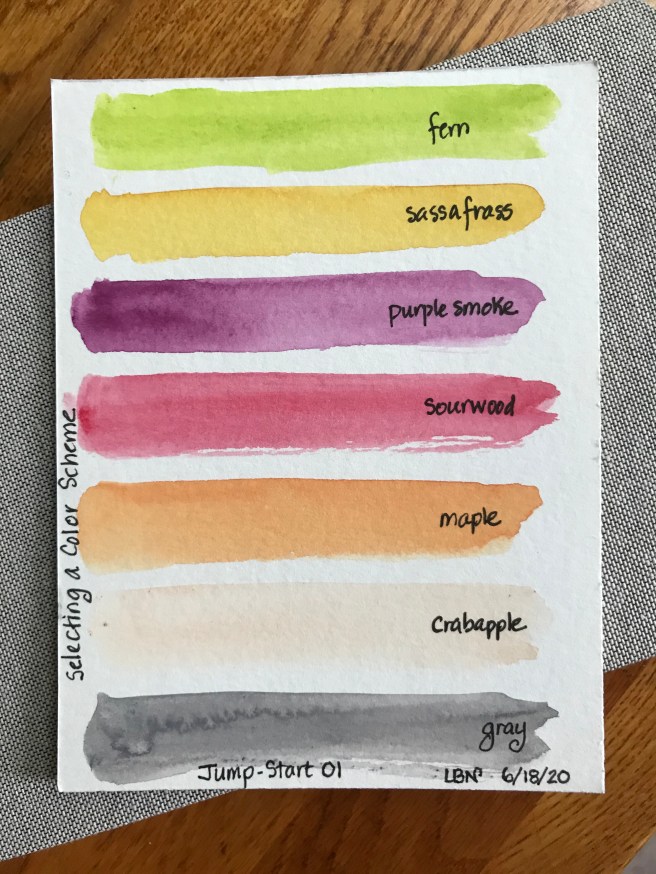
I don’t expect to become a renowned “Watercolor Artiste,” but I do want to spend more time learning the craft. So to start out, I found an artist on YouTube who has put out 31 watercolor lessons that she calls “Jump Start.” My goal is to do one per day and see where it takes me. The first lesson was called “Selecting a Color Scheme.” This was mine:

Not too hard or tedious so far!! 😆

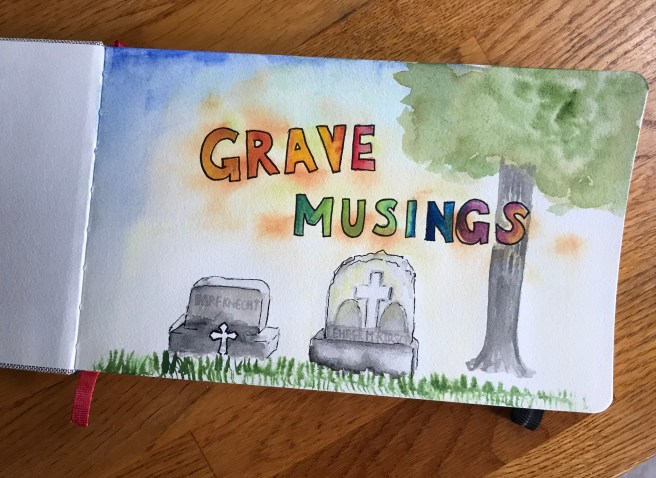
I also worked on the title page for my Grave Musings book, which is one of the reasons I decided to try to improve my skills. I worked really hard on those gravestones, but they don’t look anything like what I was seeing in terms of the shading and coloring. There’s a lot of homespun charm in this!

But we all have to work with what we’ve got, right? And I like how the letters turned out.

Thanks for coming along with me. I intend to subject you to future efforts.

I’ll probably delete this in the morning unless I decide that’s a waste of time that I could be spending working on the next lesson.

Fort Snelling: Easy on the Knees, Haunting History

We finally made it to Fort Snelling State Park, the state park of our home towns, the Twin Cities. Kris remembers visiting Fort Snelling back in the day; I don’t have specific memories of it, but it seems likely that my family went there at some point.

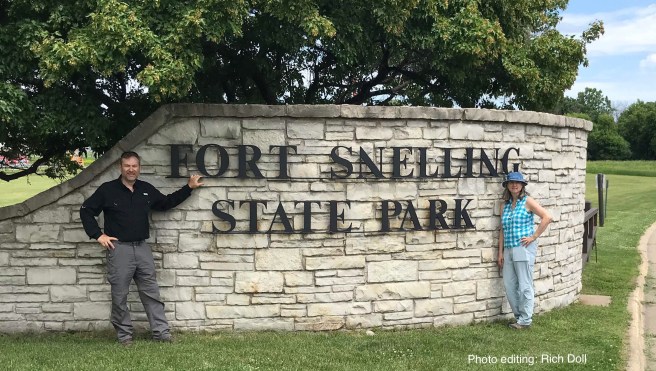
It was a relatively cool day when we started out mid-morning: 64 degrees, perfect for hiking. I was debuting my new lightweight hiking pants recommended by a friend (thanks, Lori!). The Fort Snelling hike is 3 miles and winds around the perimeter of Pike Island, the halfway point being the confluence of the Mississippi and Minnesota Rivers. We didn’t actually get anywhere near the fort of Fort Snelling. Maybe another time.

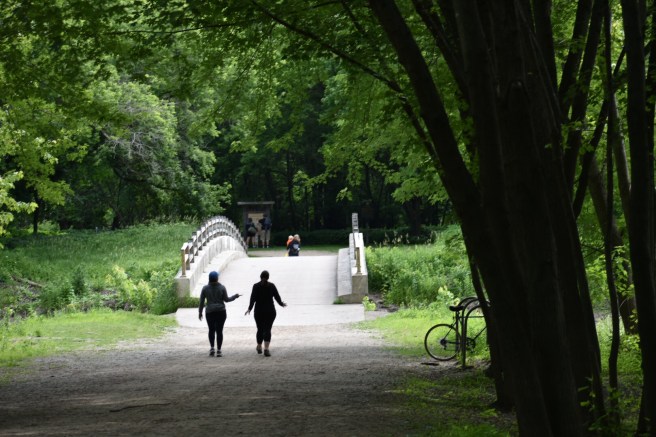
To get to Pike Island, you cross a nice foot bridge, which is almost directly under the Mendota Bridge. It is named for Zebulon Pike, who purchased the island from the Mdewakanton Dakota Indians in September 1805.

Unlike Myre Big Island SP, Fort Snelling had almost no maps or hiking club signs. You’d think this wouldn’t even be an issue on an island – how far wrong can you go? However, there are 3 hiking trails on the island and at the start it wasn’t completely clear which of the 3 paths we should take. We chose one and started off. Although we saw no Hiking Club signs, it soon became clear we were on the right track.

Fort Snelling has seen a lot of flooding and storm damage, the reason we weren’t able to do this hike last year. As you go along, it’s not uncommon to see downed trees and trees closer to the water’s edge with roots systems exposed by flood erosion.

There were a lot of people hiking at the park, not unusual for a park located in a large metropolitan area. What was unusual was the relatively unfriendliness of the hikers we passed. They seemed unwilling to return greetings if we said hello while passing. Some did, but not with any warmth or the sense of camaraderie that fellow hikers usually display. We wondered if this was due to big-city culture, virus paranoia, or a somberness due to the recent riots in Minneapolis. Maybe it was a combination of all three. Most people weren’t wearing masks (not needed outdoors), but one couple passed us in full mask regalia and practically walked into the brush on the side of the trail in their effort to make sure they were far enough away from us. Oh dear…

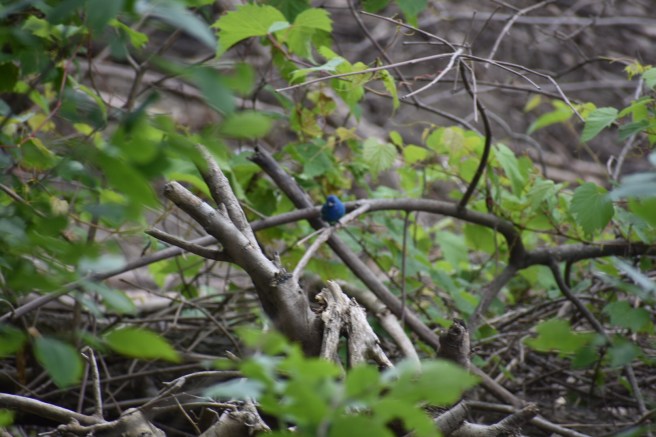
At any rate, the trail was well cleared and easy to walk. We saw a bald eagle flying close to us, but my camera was too late to catch it. I also spotted what I think was an indigo bunting. It’s not a very good photo, but it’s all I’ve got.

It was interesting to see several large trees with hollowed out bases. What causes this phenomenon? The trees still had lots of healthy leaf growth, so they didn’t appear to be dying.

The confluence of the two rivers was on a sandy point. This was apparently a sacred place for the Mdewakanton Dakota people. Sadly, this island is also the place where 1600 Dakota people were held in an internment camp over a harsh winter before being forcibly moved after the Dakota War of 1862. It’s a haunting history to contemplate while looking out on the place where the rivers meet and become one.

We stopped there for our Clif Bar break, sitting on a bench.

The hike back was over a narrower, sandy trail, but still easy to navigate. We passed by what we thought was some wild parsnip. This is an invasive plant which “can kill you or make you wish you were dead,” to quote something I read online. The roots are edible, but the plant produces a compound that causes “intense burning, rash, severe blistering and discoloration on contact with the skin on sunny days.” We gave it wide berth.

The usual noises of a park – the bird and insect sounds, the wind rustling through the trees, the river waters running – were punctuated by the noises of the city: trains, traffic on the highway, airplanes overhead. Two worlds colliding. Two rivers merging.

The three-mile hike took us 90 minutes to complete. I’d like to go back sometime to see the fort.

Knee Score: 1-2. Even terrain, nice paths.

I’ll probably delete this in the morning.

Next Hike: Minnesota Valley SRA

Tuesday, June 16, 2020 Closer than Ever

My brother-in-law lent his tele-extender to me. It’s a relatively inexpensive way to extend the focal length of the lens on the camera without buying a new lens. It goes between the camera body and the lens itself. Anyway, I got busy yesterday taking some photos with it. See what you think.

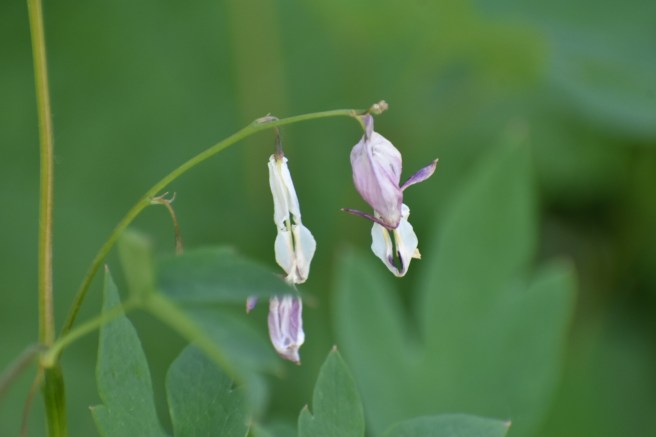
Bleeding Hearts are all bled out.
Glorious mini-petunias. I’m smitten! 🥰
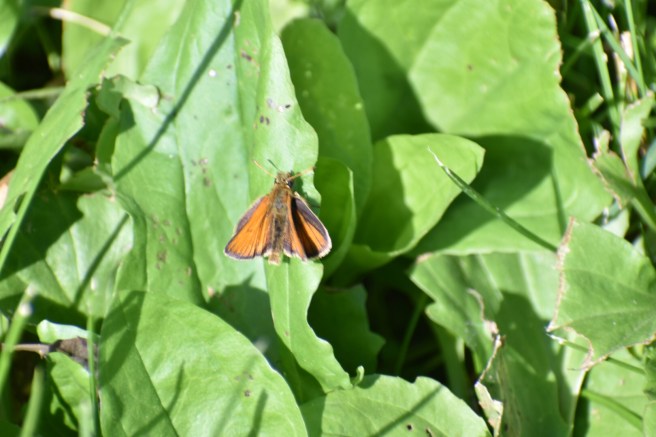
This was actually a really tiny little butterfly.
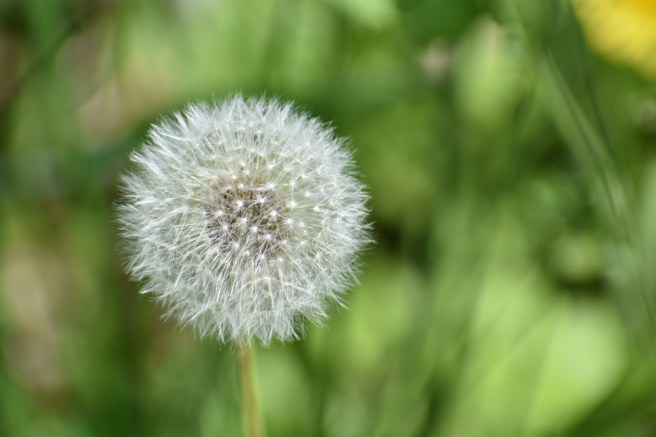
Ready, set…blow!!
Wish the focus was sharper on this one.
I didn’t even notice the teeny tiny bug on this until I saw the photo!

Gerbera Daisy.

So I also just figured out how to add captions to my photos after having used WordPress for over two years.

I’ll probably delete this in the morning. Or maybe just the photo that was a little out of focus. That one could go.