July 31, 2020 Grave Musings 5: Rice County Poor Farm Cemetery

Previous: Grave Musings 4 Oak Ridge II

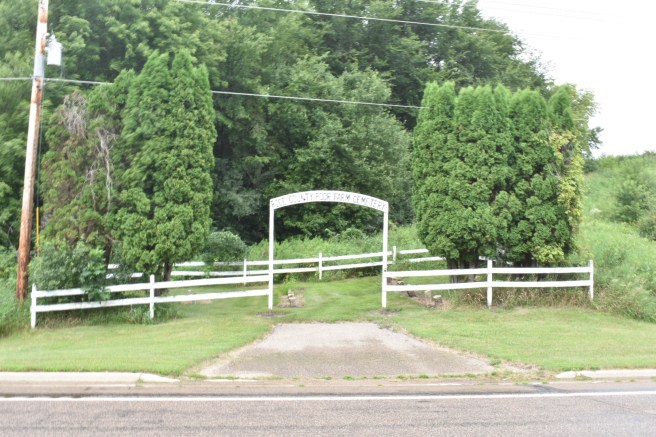
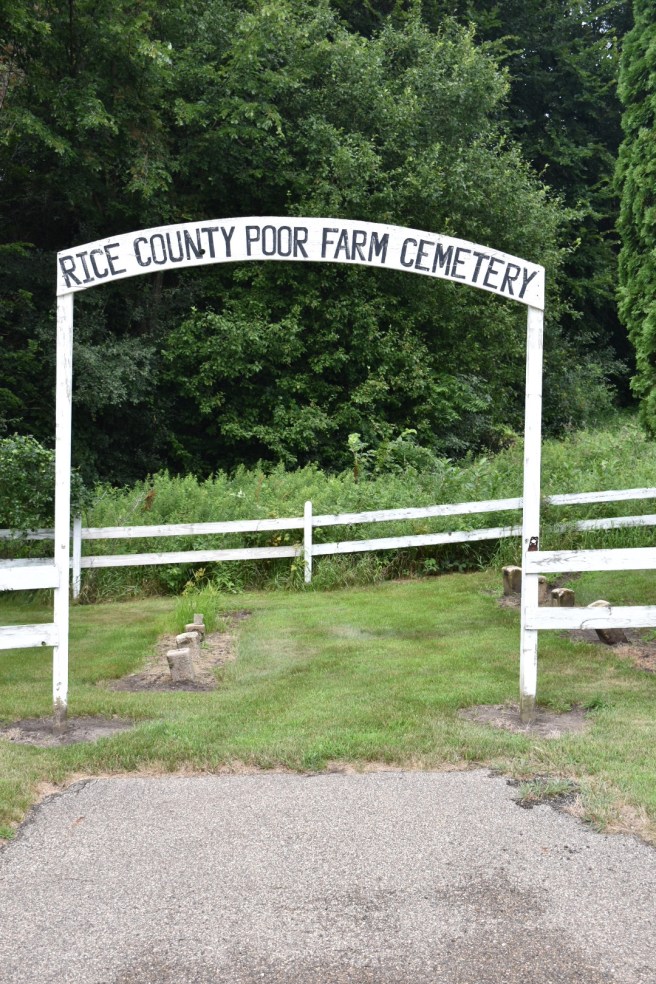
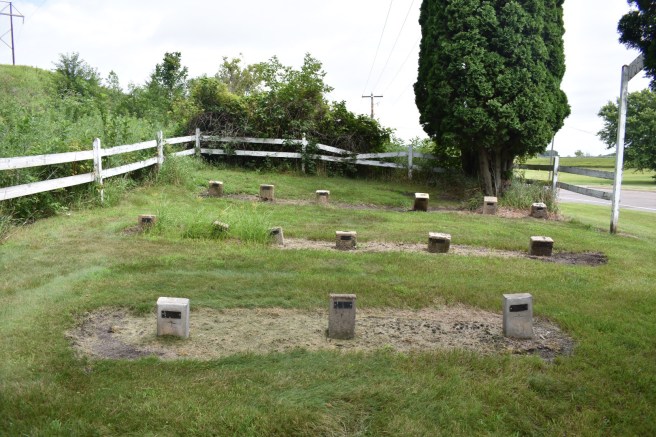
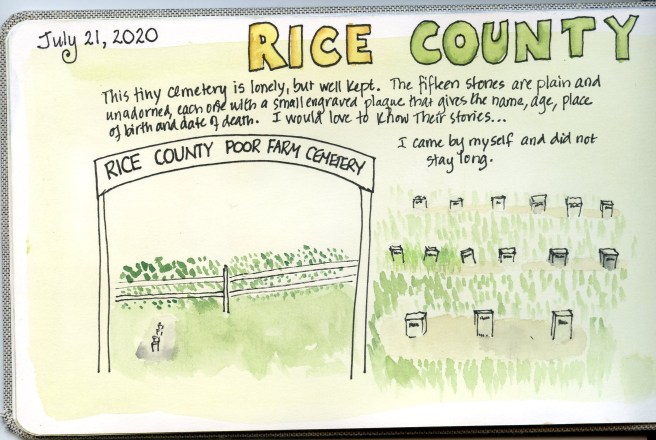
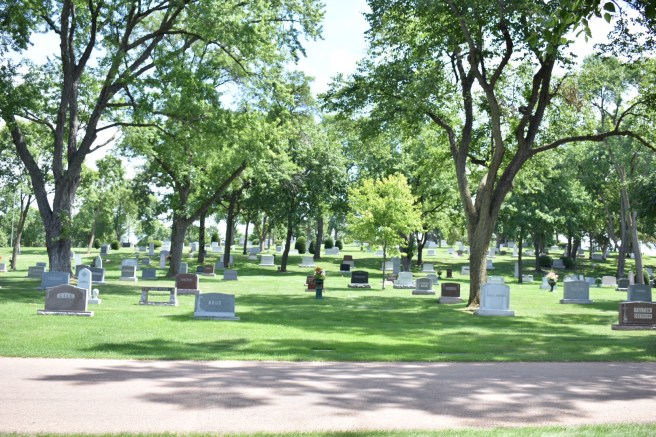
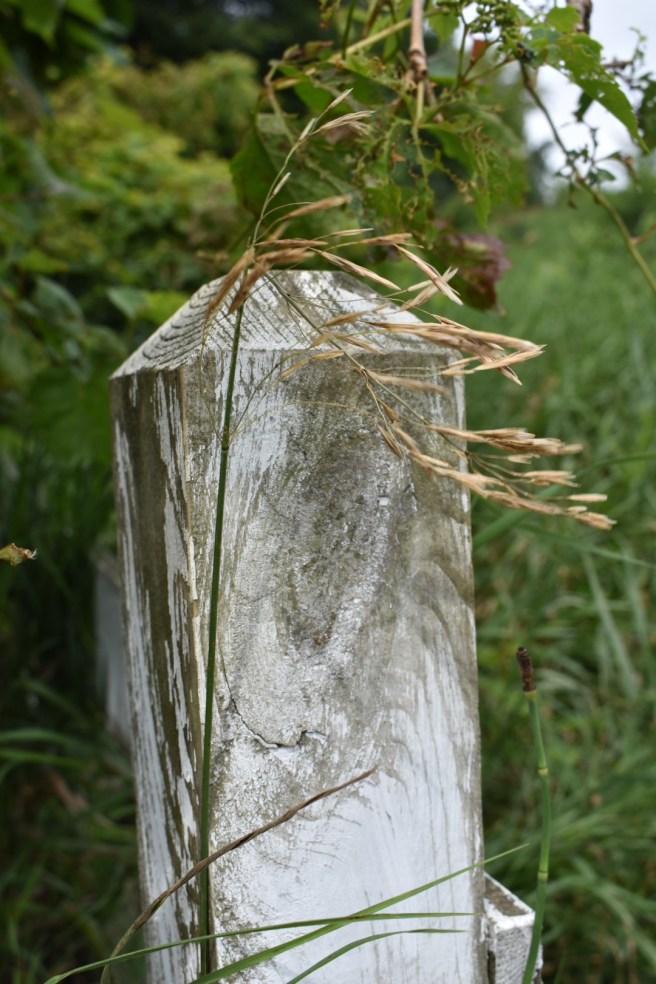
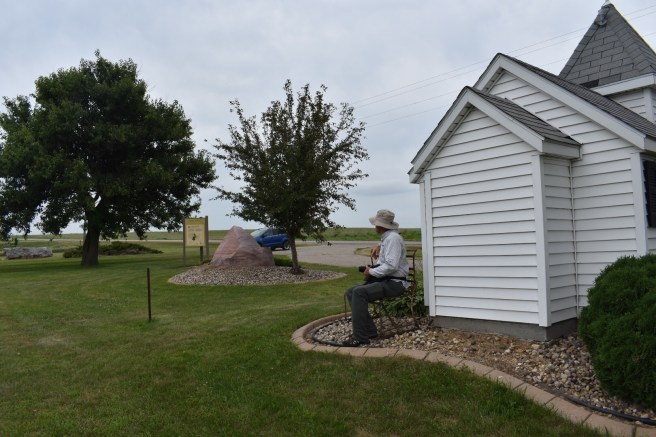
I was astonished the first time I saw this cemetery. It’s so tiny you could easily drive right by and not notice it. There are no glorious monuments, no epitaphs, no statues, no mausoleums, no lovingly placed flowers, no plaques giving the history of the place, and no posters with rules for cemetery visitors. It is spare, and that spareness makes it all the more poignant. Only fifteen stones are placed there, fifteen names etched onto plaques and attached to the stones. For all its simplicity and the sense of being forgotten, someone keeps it mowed and tended. I suspect that job belongs to a city or county employee.

I found an article online by Ethel McClure entitled “An Unlamented Era: County Poor Farms in Minnesota.” The article opens with this statement: “A time comes in the history of all enlightened communities,” wrote a local historian in the 1890s, ‘when some provision must be made for the aged and infirm poor, who have no means of support.’ That time came early in Minnesota.” These places were put in place to help those who were “sick, infirm and mentally incompetent…some were penniless, finding it impossible to make a living in the new country; not a few lost their savings to the ‘demon rum.'” Although originally support was given to those in need as individuals, eventually populations grew and the idea arose to build homes and farms for the support and care of these unfortunates, many of whom were in need of medical care as well. The concept of the farm was especially popular with county boards, since it was a way to produce some of their own foods and use the labor of the inmates to contribute to their own support. Eventually these poor farms fell out favor and were either taken down or repurposed. The last poor house in Minnesota was closed on October 1, 1963.

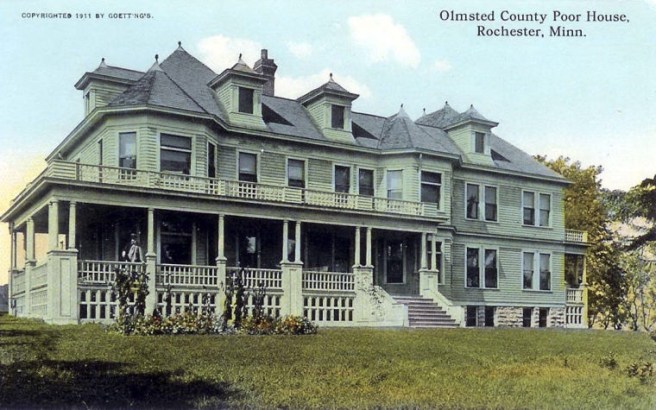
I don’t have a photo of Rice County’s poor house and farm, but I found one online of the poor house of one of our neighboring counties, Olmsted, located in Rochester.

My mother was fond of telling the story about how she and Dad lived in a poorhouse the first year or two of their marriage. Technically, this was true – they lived in an apartment building that had been the county poorhouse years before.

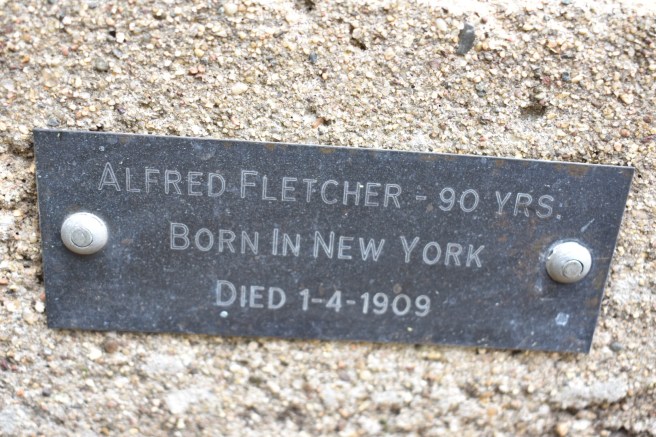
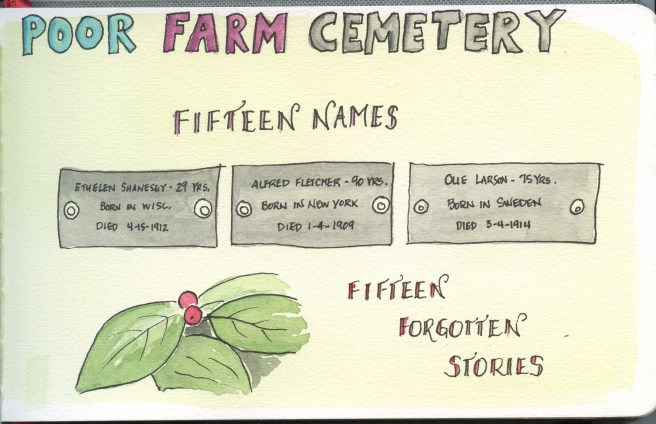
I strolled around the cemetery and decided to take photos of each name plate on a stone. I typed up all the details and sent them to a friend who loves genealogical research, so perhaps at some future date I will have stories to tell about some of the residents of this place. For now, they are only names, but each one represents someone made in God’s image, someone who had parents, a birthplace, and circumstances that brought them to the extremity of having to live at the Rice County Poor Farm.

This small community consists of 13 men and 2 women who range in age from 29-90 years old at their death (although the 29-year-old is a definite outlier – most are 60 and older). They were born in Denmark, Sweden, Germany, Norway, York State, New York and Wisconsin. Do they have descendants in our town? Does anyone visit these graves to find a relative that they recently learned about?

I did not tarry here, but when I drove away it was with many photos and questions about these fifteen forgotten stories.

Next: Grave Musings 6 Lakewood Cemetery

Start at beginning: Grave Musings 1 Maple Lawn I

I’ll probably delete this in the morning.

Thursday, July 30, 2020 Woe Has Come

It’s story time today. I have a true story that combines all the elements of a good novel: hope, despair, ruination, vengeance, death, rebirth, good guys, bad guys, and if we stretch it a little, maybe even a little romance. So here we go.

Once upon a time in the springtime of innocence, we planted two apple trees of very good stock and reputation. You know them as Honeycrisp and Zestar, both Minnesota hardy. As the years went by, we waited with eager anticipation for our first fruits to appear. And when they did, we rejoiced. There weren’t very many, but more would come in future years. We were confident…and a little naive.

The honeycrisp apples were often small and misshapen. Some years we didn’t get any at all. In the meantime, the Zestar could crank them out, but lots of them fell early and the rest became food for birds, squirrels and/or raccoons. We never caught any of these creatures in the act, but this isn’t really defamation of character, so I freely malign them without proof. They’d take one bite and throw them down on the lawn. I made lots of apple sauce and apple butter. It was time to start taking this whole business more seriously.

We attended a talk about growing apples at the state fair one year and picked up some good information. It turns out you really have to thin them out severely. It isn’t just a suggestion; in fact, the Honeycrisp won’t produce any apples at all in the next year if you haven’t sufficiently thinned them. The best way to prevent pestilence and disease is to spray them, so we (and by “we” I mean my husband) began spraying them. Oh, don’t be so shocked – I never said we were purists.

This was the year, the golden year, when everything was going along according to plan. We thinned the apples early and often. We sprayed on schedule. The trees and their apples had never looked better. In the movie version of this, the menacing music starts playing. You know what comes next: THE EVIL JAPANESE BEETLE INVASION.

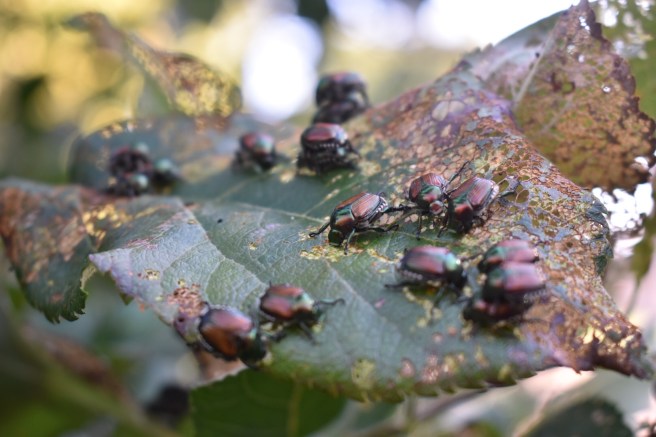
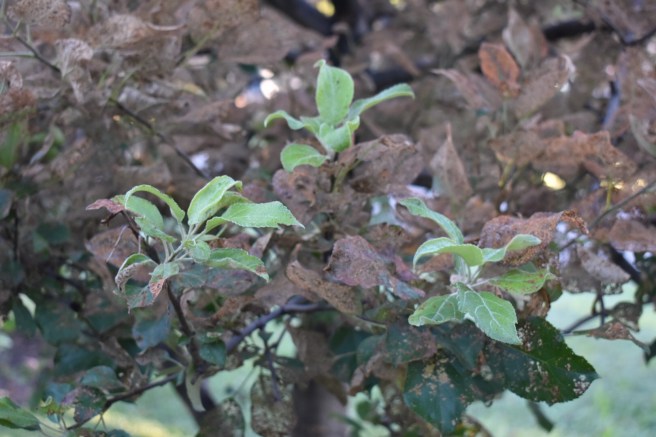
The beetles loved our apple leaves and made beautiful skeletons out of them.

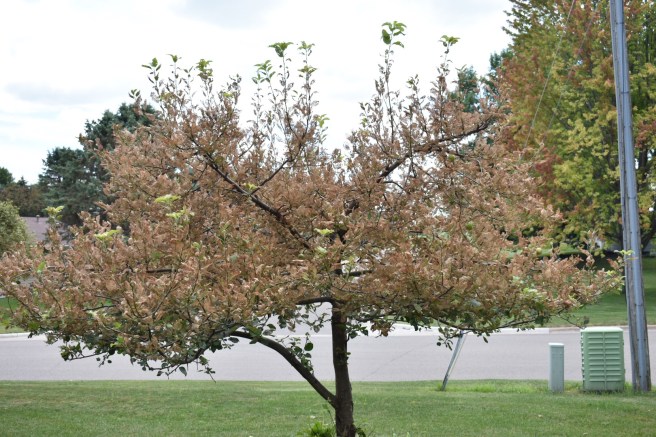
In an impressively short time, our trees were shadows of their former selves and this had aroused our ire. I wrote of this in a previous post with my proclamation of “woe to the Japanese beetles.” See: Woe To the Japanese Beetles

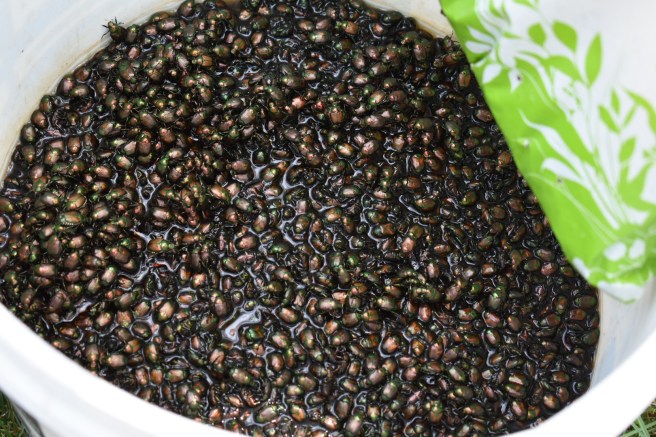
It might seem like closing the barn door after the horses have escaped, but we had to do something, so Kris put out a trap for the army of invaders, a pheromone trap (romance, right?). It was love at first smell and they’ve been coming to our trap in droves. Oh, sweet vengeance. Woe has come. No pity, no regrets (well, except that we should have done it earlier). I hope that doesn’t sound too callous.

There’s nary a beetle on the decimated trees now and some of the apples are hanging in there, so maybe we’ll have a crop after all. And in response to the devastation, the trees are putting out new leaves, a resurrection worthy of great songs and celebrations.

The apple tree has been brought low
Its leaves have been eaten as plunder.
But the morning after its nighttime of woe
Green leaves reappeared, to our wonder.

The memory of that awful invasion
Shall soon be completely forgot.
And the beetles of origin Asian
All lovesick in our compost shall rot
.

That was off the cuff, but you get the idea. Happy ending, we hope!

I’ll probably delete a bucket of dead beetles in the morning.

Wednesday, July 29, 2020 Lunch with Leslie

I went to Lakewood Cemetery today with my cemetery buddies, Lori and Teresa. Lakewood is a beautiful cemetery not far from where I grew up and I have fond memories of taking occasional walks through there with my older sister, Leslie. Teresa and I also had an informal “funeral” there over 40 years ago as we said our goodbyes to an elderly woman she’d known. Good times!

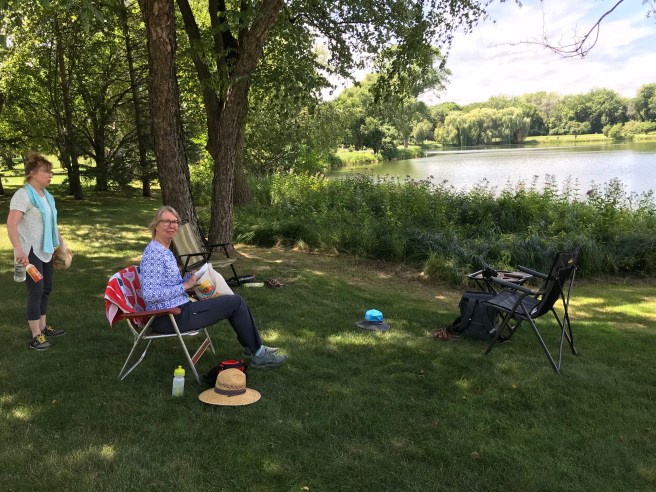
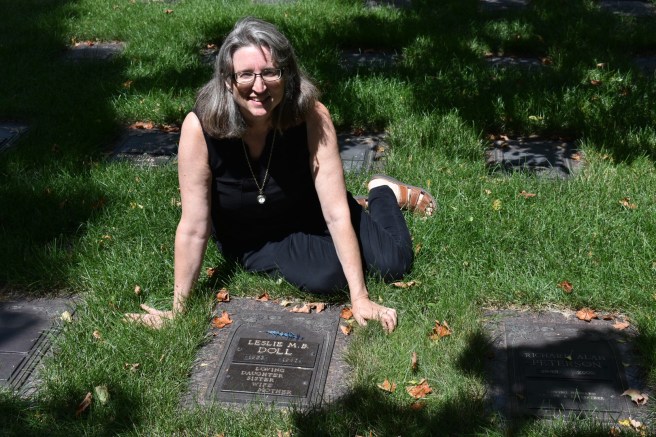
I’ll do a Grave Musings post soon about our time at Lakewood, but this post is more about our “lunch with Leslie.” Both Lori and Teresa had done their homework and knew the section where Leslie’s marker is, so when lunchtime came, we drove over there and after a few minutes of looking over all the flat markers, we found hers. We set up our chairs in a nice shady spot nearby and had our lunch. It’s such a lovely spot.

Leslie was five years my senior; she died of cancer at age 33. I’d love to share a couple of my memories, so you can get a glimpse of her. This is part of what cemeteries are all about – the memories of those who are buried there.

When Leslie and I were both in the church choir that our mom was directing, we had a hard time staying serious. If one of us started giggling about something, the both of us were gone and we’d shake with silent laughter, hoping no one was noticing. Mom noticed and eventually separated us (Leslie was in college by this time; I was in high school). One time, the pastor gave a sermon, at the end of which he told the congregation that we should each tell someone that we loved them. Leslie and I felt extremely uncomfortable at this prospect and after a moment’s consultation, we decided to slip out of the sanctuary by a side door, so we wouldn’t have to face anybody. The plan went smoothly until we opened the back door and went through to find ourselves alone in a little alcove with the pastor himself! He promptly said, “I love you,” and after an awkward moment (writhing in discomfort), I finally mumbled, “me too.” As soon as he left, we laughed until we cried.

When I was in college, I took a ballroom dance class and toward the end of the quarter, we were paired up with someone and were supposed to come up with 3 original variations to one of the dances for the final. The guy I was dancing with was never available to work on this, so finally in a panic I went to Leslie for help. She spent some time dancing with me (I remember working out one routine in a public bathroom somewhere!) and between us we made up all three variations, although my contribution to this was quite a bit less than hers. She was always available to help me if I got into a bind and was generous with her time and talents.

Well, as Captain America is fond of saying, “I could do this all day!” I’m so thankful for the treasure house of memories I have of Leslie and now you know a little bit about her, too.

I’ll probably delete this in the morning.

Monday, July 27, 2020 After the Rain

We had a recent deluge of rain here, raining all night and into the morning.

I was reminded of Andrew Peterson’s song “The Rain Keeps Falling,” in which the rain is a metaphor for depression.

“I tried to be brave, but I hid in the dark
I sat in that cave and I prayed for a spark
To light up all the pain that remained in my heart
And the rain kept falling…”

I loved that song from the first time I heard it. I have struggled sometimes with depression – not truly deep and debilitating – but I get it.

“Well I’m scared if I open myself to be known
I’ll be seen and despised and be left all alone
So I’m stuck in this tomb and you won’t move the stone
And the rain keeps falling”

Toward the end of the song, a different voice is heard: “Peace, be still” and a note of hope is sounded.

“My daughter and I put the seeds in the dirt
And every day now we’ve been watching the earth
For a sign that this death will give way to a birth
And the rain keeps falling

Down on the soil where the sorrow is laid
And the secret of life is igniting the grave
And I’m dying to live but I’m learning to wait
And the rain is falling.”

The song ends with Peterson crying out to God for deliverance from this darkness, interspersed with the beautiful refrain “Peace. Be still.” The last word in the song is “Peace.”

I have been experiencing a lot of mental agitation for the last few months and I am craving God’s peace in the midst of this storm.

“Teacher, do you not care that we are perishing?” And He awoke and rebuked the wind and said to the sea, “Peace! Be still!” And the wind ceased, and there was great calm. He said to them, “Why are you afraid? Have you still no faith?”

Why am I afraid? Have I still no faith?

Peace, be still.

Peace.

(A link if you’d like to hear the song: https://youtu.be/_TU2YW-6E3M. I actually recommend listening to the whole album, The Burning Edge of Dawn, since there’s a flow to the songs as they reflect a season of Peterson’s life and faith.)

I’ll probably delete this in the morning.

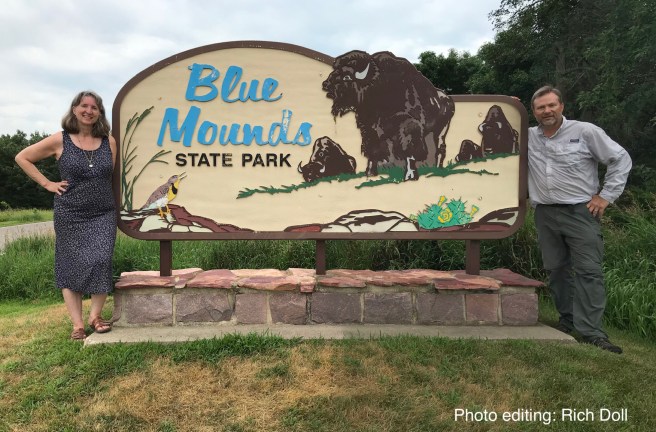
Blue Mounds State Park: A Banner Day

We decided to camp at Blue Mounds the evening before so we could get a nice early start on our hike. In fact, we had ambitiously decided that we would do two hikes on this trip: Split Rock Creek (2.6 miles) and Blue Mounds (6.2 miles). We figured we’d get in early on Saturday, hike SRC and then go over to Blue Mounds and set up camp. Things don’t always go according to plan.

We ended up leaving late and decided to drive directly to Blue Mounds, set up camp, eat supper and do an early evening hike at Split Rock Creek before retiring for the evening in our cozy little tent. It was a hot, humid day with a heat advisory in effect, but even so, we thought it would cool down enough after supper to do the shorter hike. Things don’t always go according to plan.
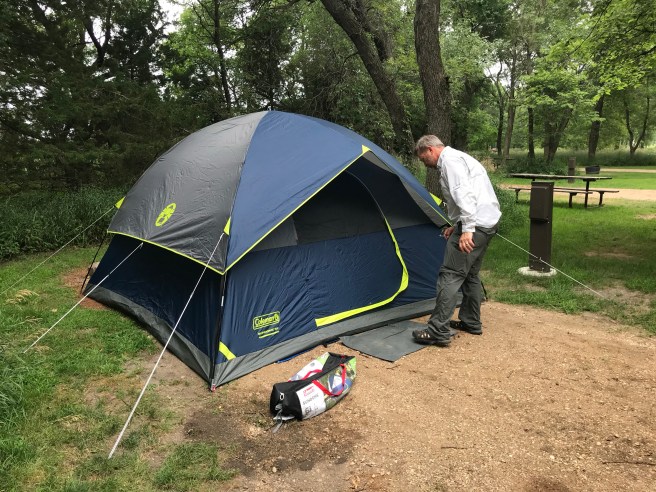
Reality: We arrived at Blue Mounds late afternoon and found our campsite. It only took us ten minutes to set up our tent, but they were very meaningful minutes, imparting much wisdom and knowledge to us. I’m not sure where the phrase “sweating like a pig” came from, but it’s fair to say that we were living it out.
We sat down to rest our sweaty bodies and found that wonderful harmonious marital bliss of being in complete agreement: Split Rock Creek got crossed off the agenda. We drove into Luverne, got pizza and beer (mine was root), checked out the Wayside Chapel, Eagle Rock (the highest point in the park), and the bison viewing platform. We saw neither eagles nor bison.

Eagle Rock actually is the place of the former home of Fred Manfred, an author who built the home back in 1960. A funny little tidbit about Manfred: he started out in life as Fred Feikema. His first novel, The Golden Bowl, was published under the name “Feike Feikema.” Clearly, he wanted to have some sort of repeating rhyming vibe to his pen name. I can just see him taking stock of things, pacing around a room murmuring “It’s not quite right – I think I can do better. What about Fred? Maybe I could use THAT name instead of Feikema for the repeating sound…something like Fred Manfred. Eureka!!”

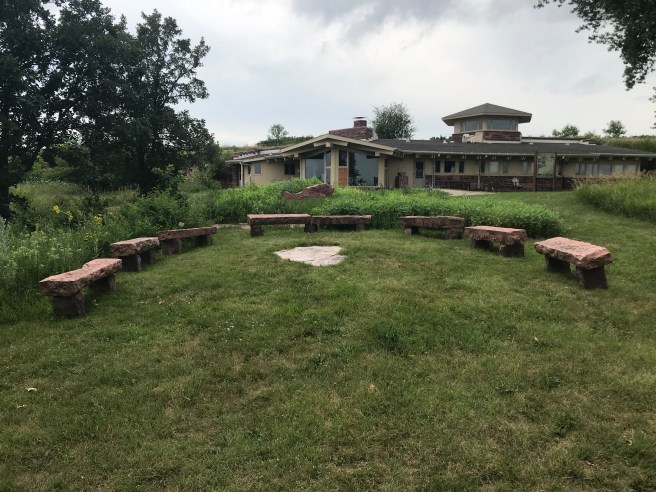
The Manfred home is now an interpretive center, but it was closed. There was an interesting little rustic amphitheater there which was photo-worthy.
Amazingly, by the time we got back to the campsite, it was starting to cool down, which meant that it was not going to be the night of humid torment that I feared. We slept fairly well, although at one point my slumber was disturbed by loud snoring in the other cot. Usually I just gently shove the handsome offender onto his side and things get quiet. I was too far away for this maneuver, so I did the next best thing: I grabbed the huge tome I am reading (The Way of Kings by Brandon Sanderson) and poked him with it, which did the trick. He woke up enough to suggest that I should have brought my hiking poles in and used one of those for the prodding. He’s very thoughtful about these things, even if he didn’t remember making that suggestion the next day.

Look how much I’ve written and we haven’t even started hiking yet! Buckle up, people. My motto has always been: “Make a short story longer.”

We hit the trail at 6:48 a.m., starting off with the sun still somewhat low to the horizon and temperatures around 60 degrees. Perfect!
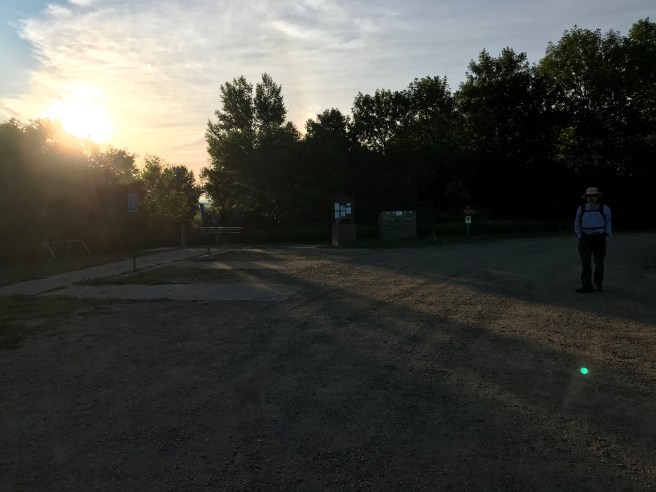
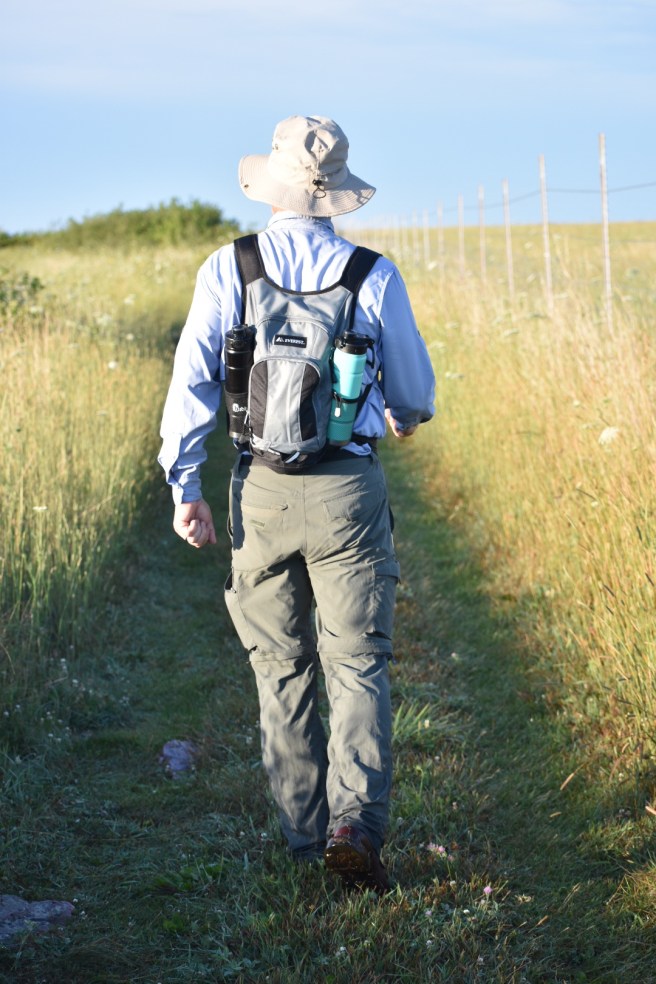
We needed to be able to finish the hike with more than usual speed because we still had a 2-hour drive to church afterward. We started off at a good clip, full of general joie-de-vivre and energy. It was the maiden voyage for my new sun hat and trekking poles, the latter of which I had hoped would help with knee stress.
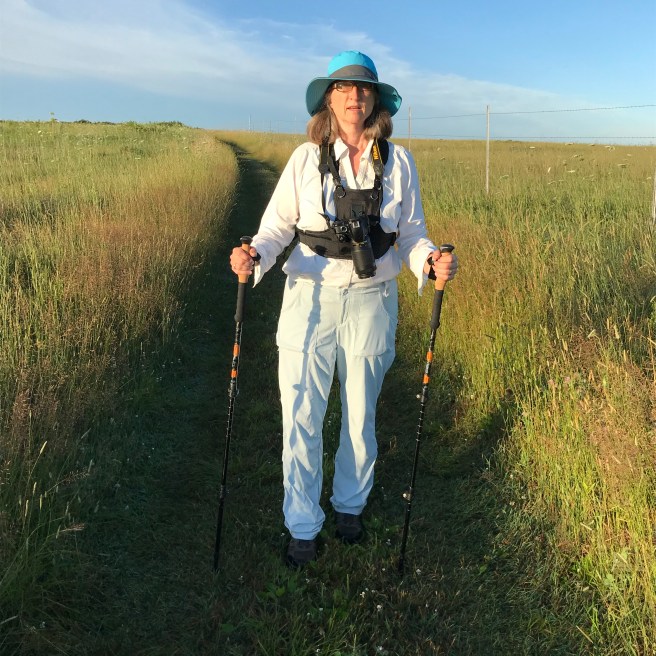
Our path was a nicely mown area through meadowy grasses and wildflowers.

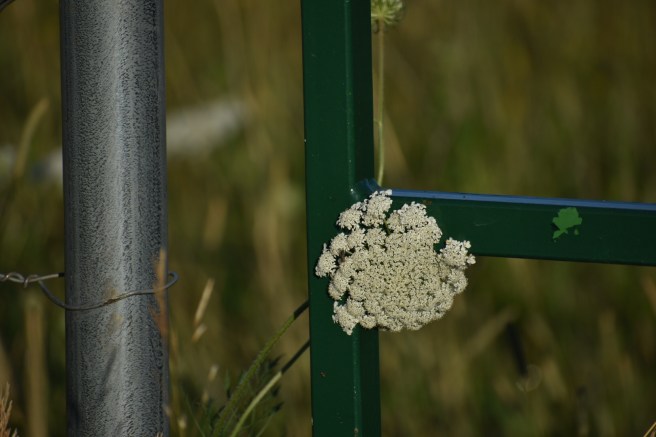
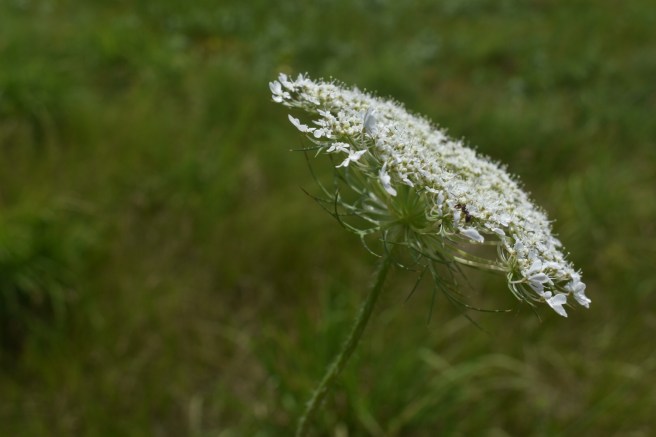
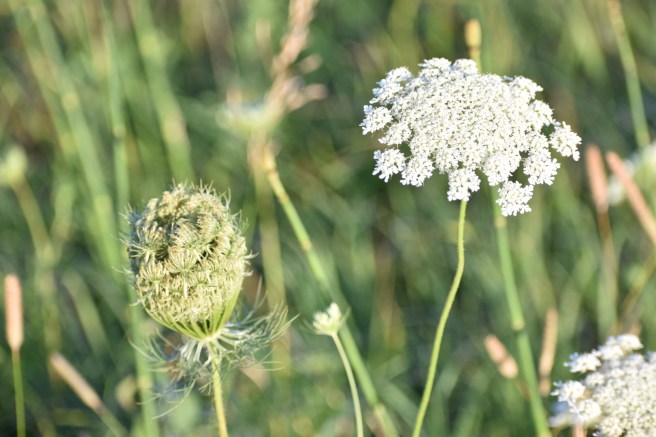
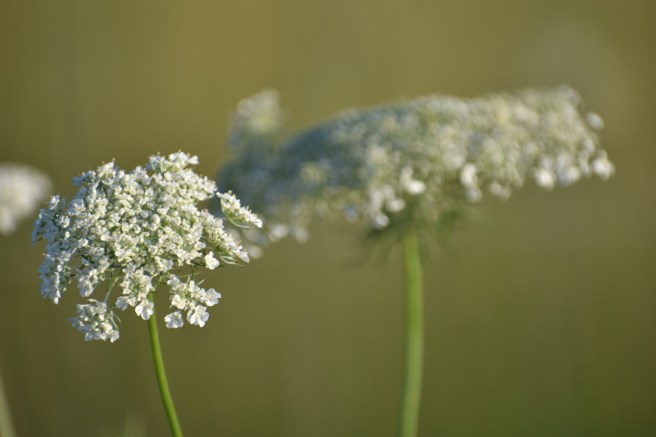
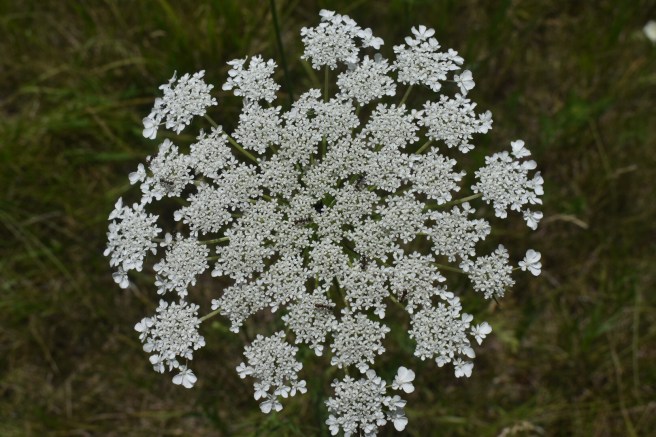
Queen Anne’s Lace is in ascendency at this time of year and I took lots more photos of it than I will actually share here. Before it blooms, it looks like a closed umbrella, so I think it could as easily been called the Bumbershoot flower. That’s why I’m not consulted on these things.
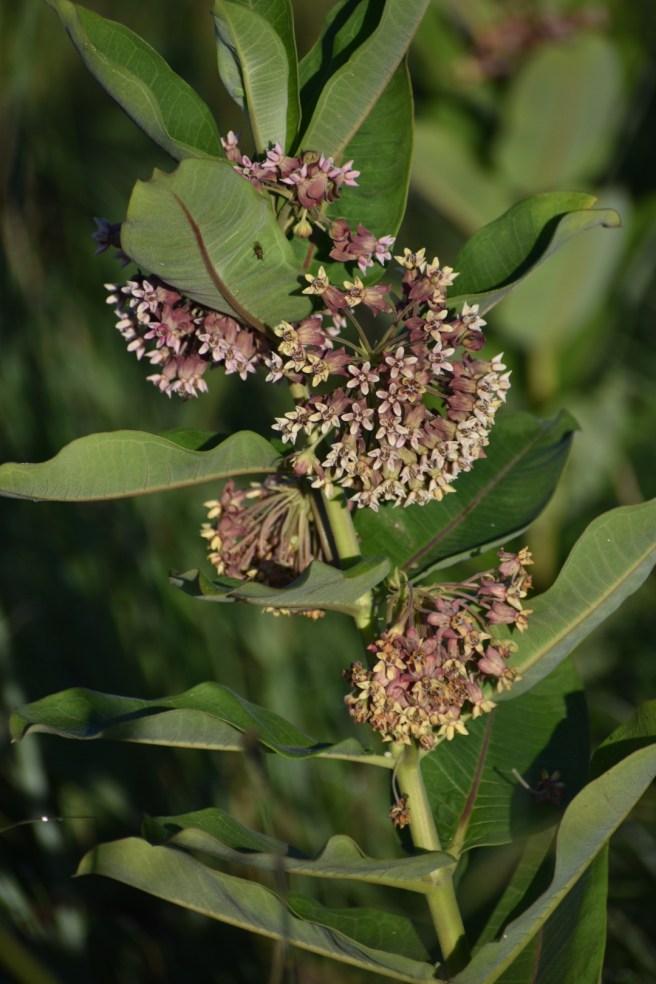
We also saw plenty of milkweed in the next phase of its growth. I checked under some leaves for monarch eggs or baby caterpillars but came up empty. They are all probably hiding in the same place as the elusive bison and eagles.
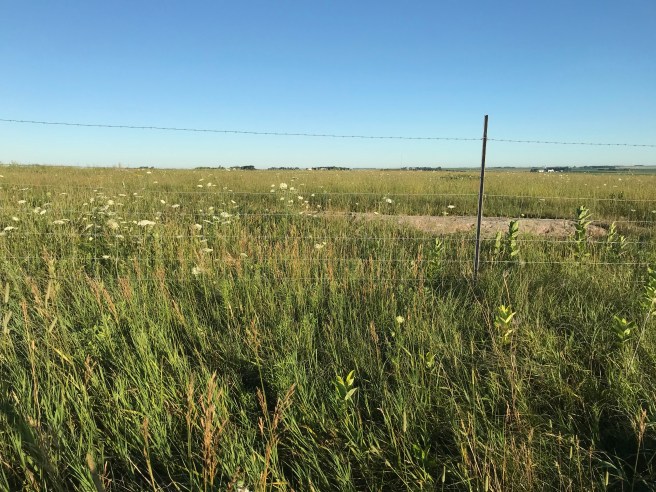
The first part of the hike takes you alongside the fence that separates us from the bison. The fence looks surprisingly wimpy – Kris observed that it definitely wouldn’t stop a determined velociraptor. Fortunately, they were all hiding, too.
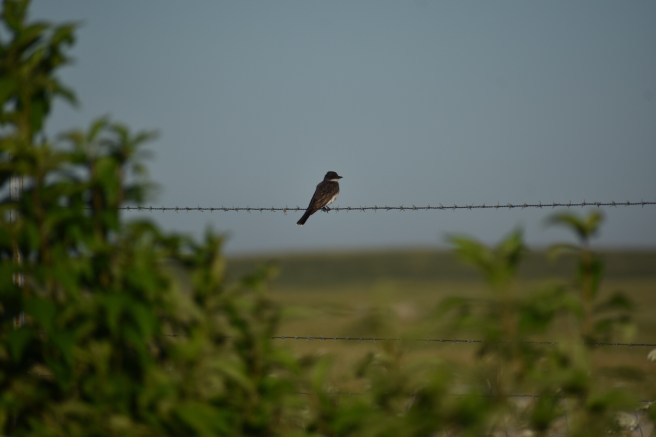
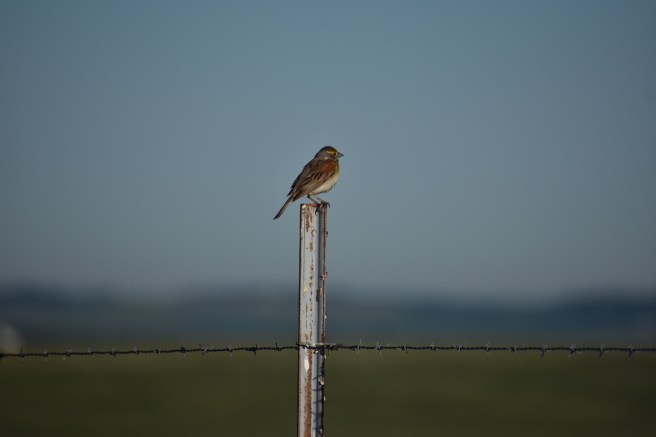
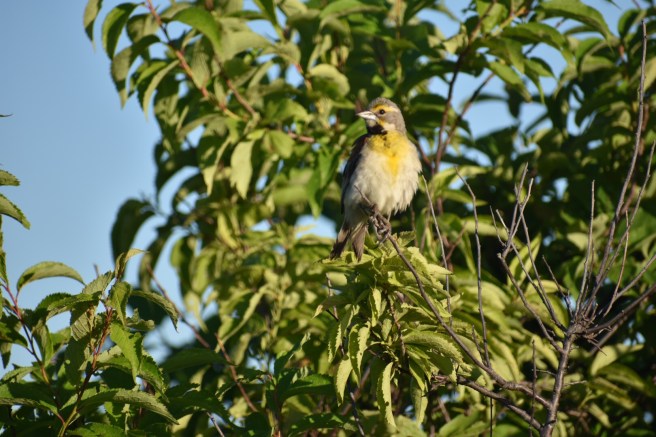
Many birds posed for me, which was a kindness I appreciated very much. Usually when we tromp noisily down a path, the birds are wise to our presence and refuse to come out for a photo. If our lives were a movie, I would have broken out in a song and dance routine (not unlike Snow White when all the woodland creatures gather around her. Oh, and we saw one of those, too. Probably singing, but we couldn’t tell.)
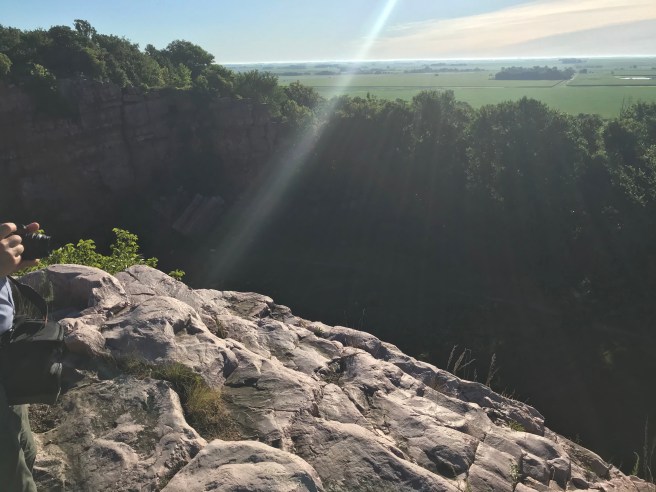
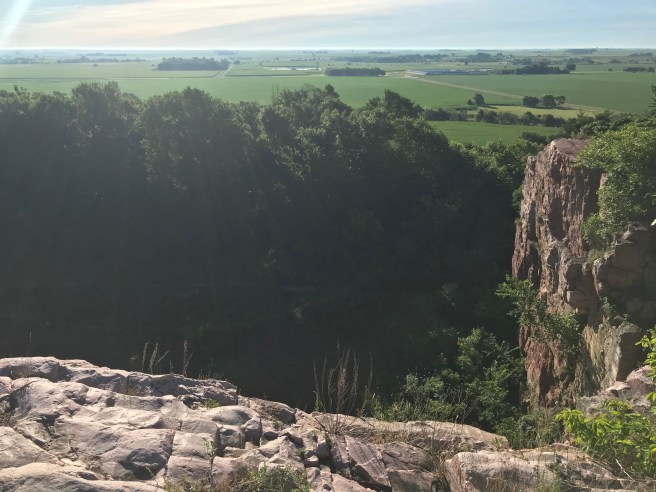
About halfway through the hike, we were by the famous Sioux Quartzite cliffs of Blue Mounds. We walked over to take some photos, but I stayed well away from the edge due to the “fear of heights” thing. A sun beam showed up and gave a little extra sparkle to the view.
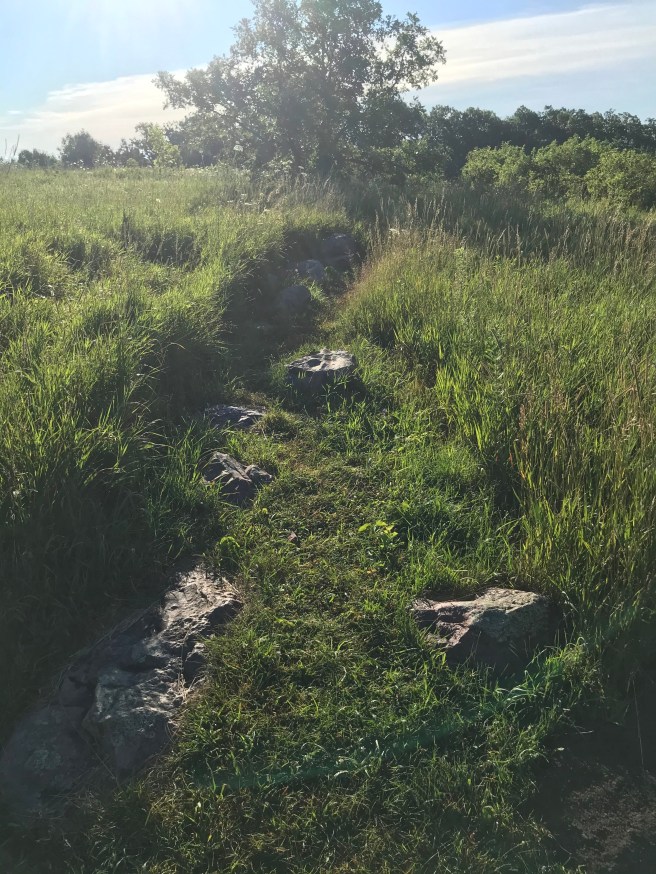
We kept seeing notations on the maps for something called “Rock Alignment,” and this wasn’t descriptive for us to know exactly what this was or what we should be looking for. Had we already passed it and not known it? After the quartzite cliffs, we finally came across a sign with a description. It’s an alignment of stones and boulders that extends 1250 feet east to west, constructed of Sioux Quartzite. Nobody knows who made this line of stones, but everyone agrees that somebody built it. Kris commented that it was nice to see the park acknowledge that something that appears to have a design must have a designer. Boom!
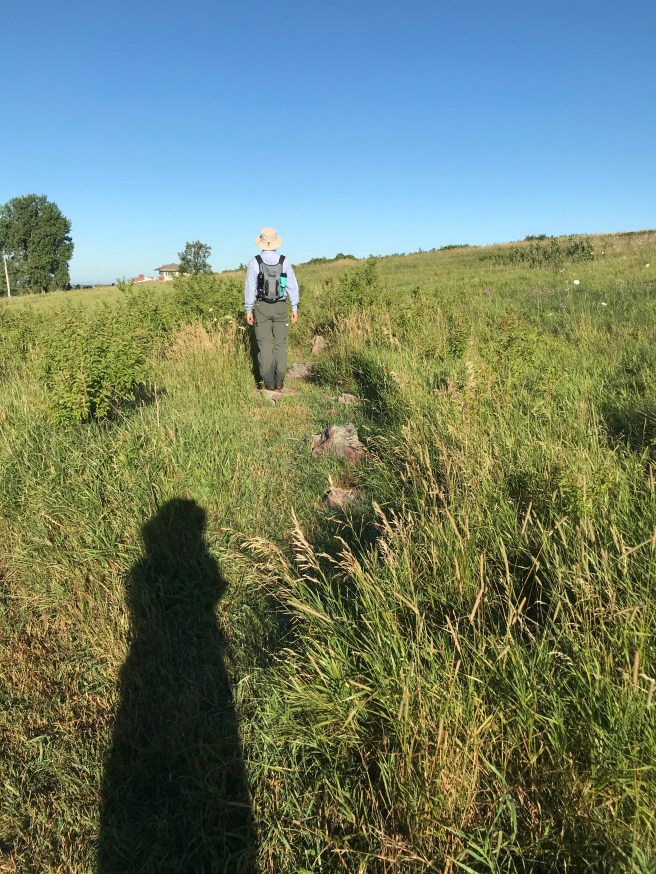
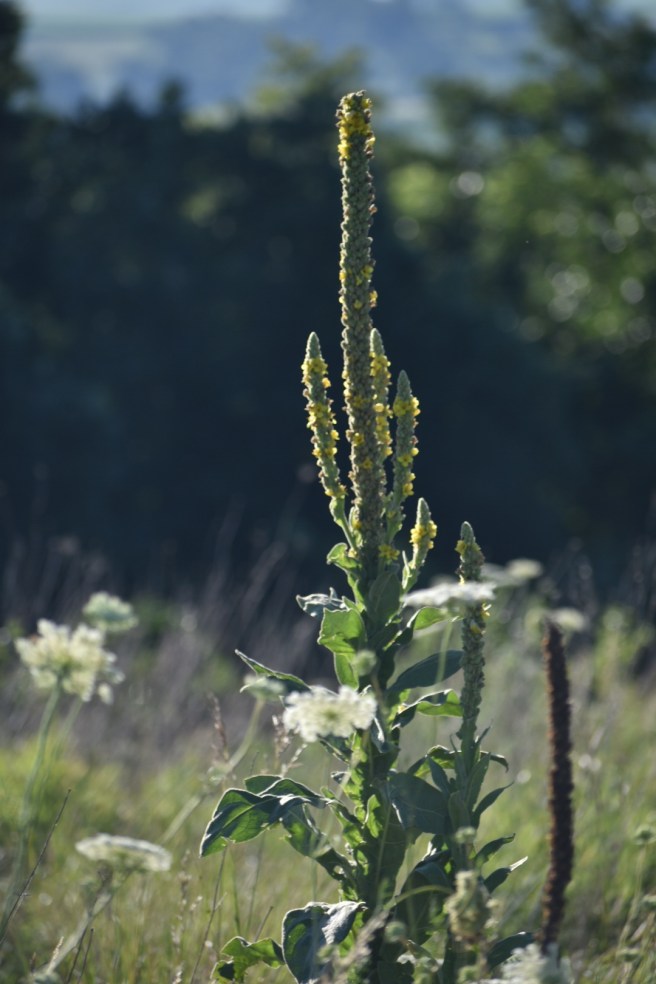
The information on the map said to stay on the trails and watch out for prickly pear cacti, the spines of which can even pierce shoes. You don’t need to tell me twice. We saw something that reminded me of mini-saguaro cactus and I wondered if that’s what it was. If it’s not, I’ve got dibs on naming it “The Minnesota Saguaro.” [Later: I looked it up on Picture This. It’s Common Mullein. Oh well…]
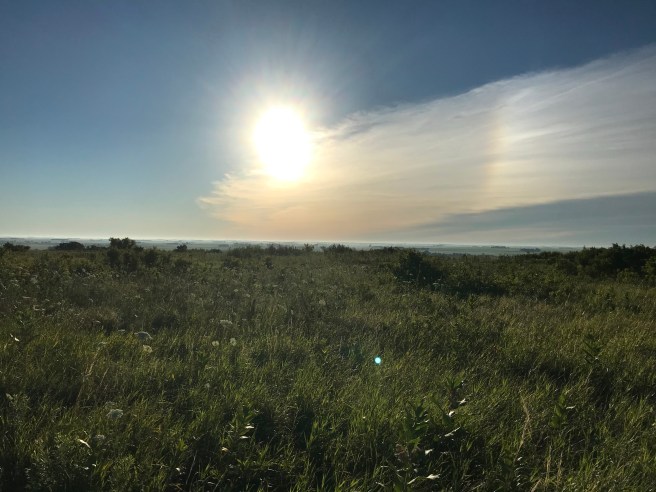
I know that people from mountainous areas find our small hills and flatlands to be uninteresting topography, but I love looking out over these areas where you can see so far into the distance. I thought the vistas of Blue Mounds were really lovely.
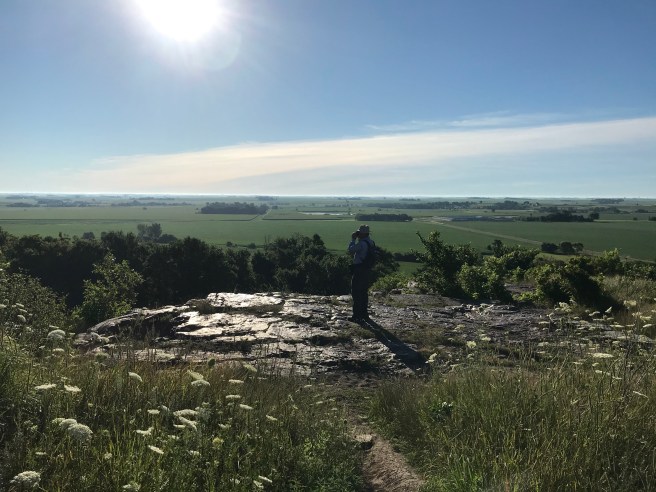
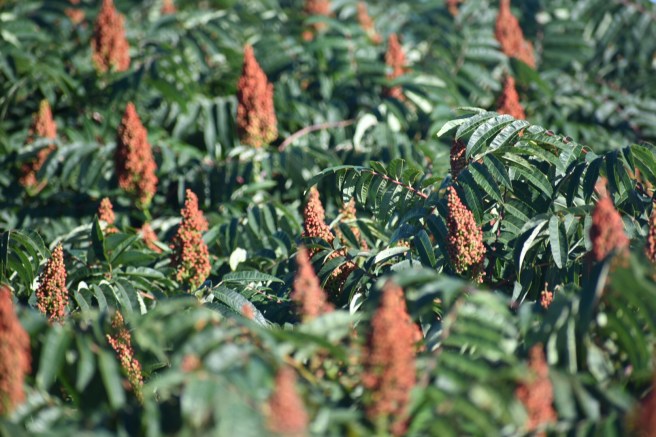
Most of the state parks we’ve been to have had a variety of trail areas: grassy meadows, dirt paths, forested parts, riverside trails, etc. Blue Mounds was pretty much the same kind of trail all the way through – a wide, mown path through the prairie. Works for me. Toward the end we walked past a large stand of sumac, which was about as forested as it got.
To our astonishment, we were done with the 6.2 mile hike at 8:34 a.m. How did we manage to walk that fast to get done in less than two hours? I was being very self-congratulatory about the whole thing – we are real hikers now! Kris stopped in at the office as we were leaving and found out that there’s an extra loop that got flooded and taken off the hike. We still get credit for 6.2 miles, but probably walked less than 5. I’ll take it. By the way, Blue Mounds State Park was established in 1961, the same year that my husband was established. It was a good year.

Final notes: About halfway through the hike, I reached my stride with using the trekking poles which were awkward at first to use, especially when I wanted to stop and take a photo. Blue Mounds didn’t really have a lot of up and down, which helped. I’m giving them a solid thumbs up.

Also, I had an inner playlist going on while we walked. For the first part of the hike, I was singing a song from My Fair Lady:

Just get me to the church,
Get me to the church.
Oh, get me to the church on time.

Towards the end of the hike, I had switched to the song from The Sound of Music about the lonely goatherd. Not sure what that was about, but it was stuck in my mind.

High on a hill was a lonely goatherd
(yodeling syllables)
Loud was the voice of the lonely goatherd
(more yodeling syllables)

This was our 25th State Park on the Park Passport, so we were awarded with a certificate for a free night of camping to use sometime later. Also, we got our 50-mile patch for the Hiking Club. It was a banner day.

AND…we got to the church on time!

Knee score: 1-2. Fairly even ground, long hike. We’re at 71.5 miles total.

I’ll probably delete this in the morning.

Next Hike: Temperance River State Park

Wednesday, July 22, 2020 Wayside Chapel

We were in Luverne, Minnesota, last weekend to camp at Blue Mounds State Park and do the Hiking Club hike the next morning. More on that in a future blog post, of course.

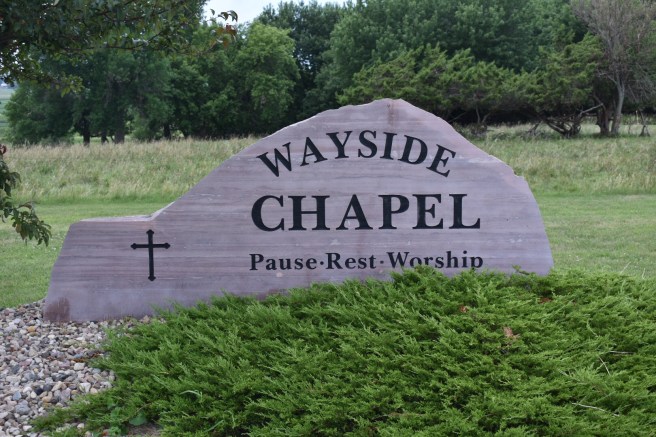
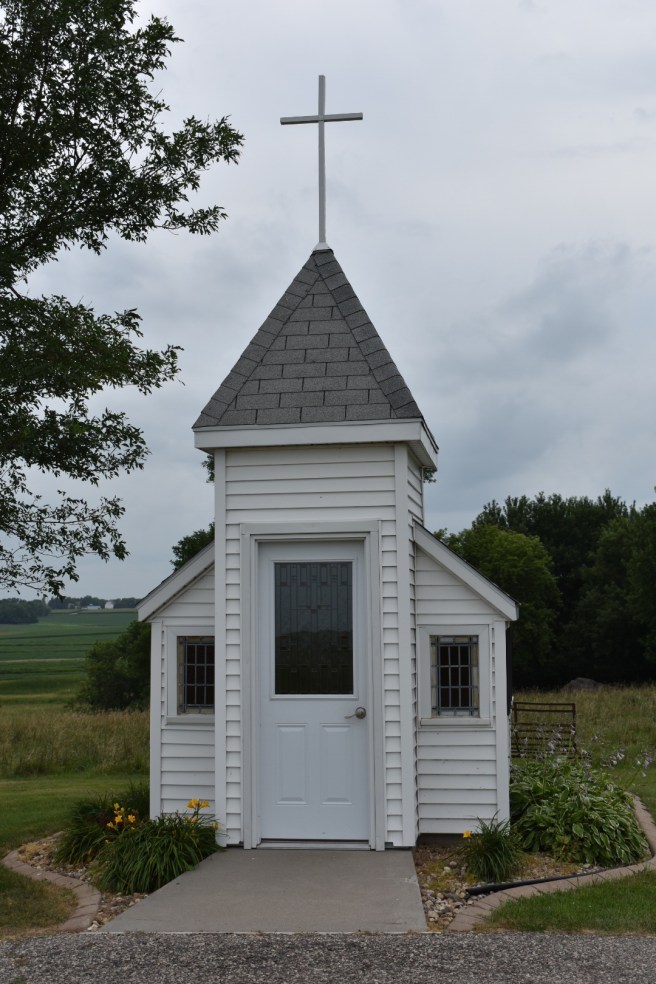
On the way to the park, we passed this lovely little wayside chapel and decided to stop in.

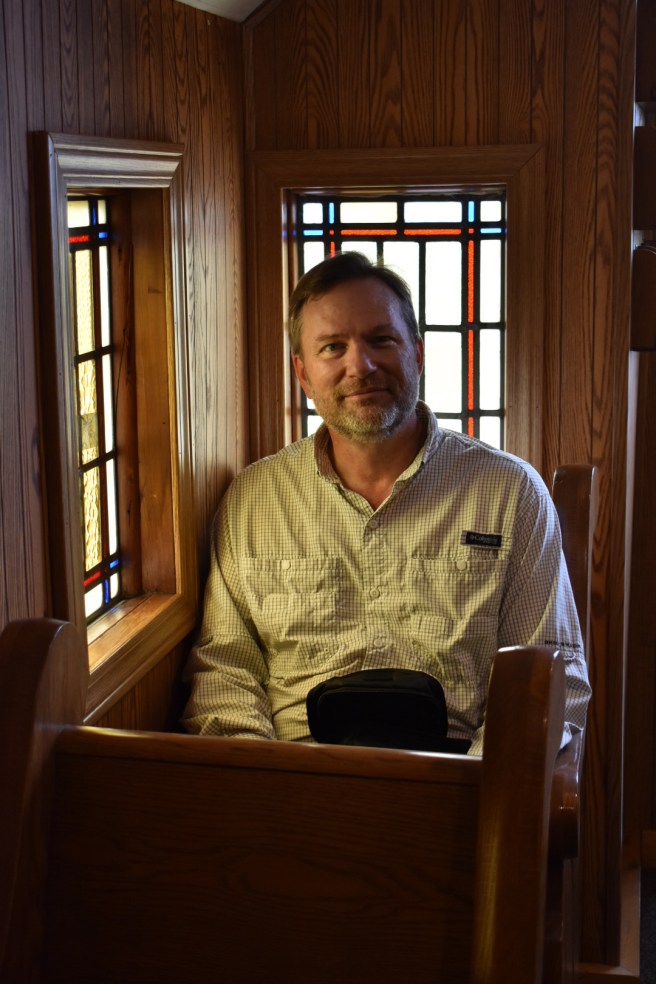
It was one of the hottest days of the year and quite stifling inside, so we didn’t stay long – just long enough to take a few photos.

I was really intrigued by this tiny God’s house, so I did a little internet research after we got home. It was built by the Christian Reformed Church in Luverne and was dedicated on June 30, 1963, so it’s been around for over 50 years. The mission of the chapel is as follows:

For all those in this community who seek quiet in the midst of the storm,
who seek relief from burden and anxiety,
who seek peace beyond the understanding of mankind,
who seek a restful place to pray and worship,
For all those who travel through our community,
for those who have forgotten God and for years have not appeared in His house,
for those who have never forgotten God,
for those on business,
for those seeking pleasure and vacation,
for those who flee from the past and trouble,
for those who are tired and need rest,
for these we dedicate this chapel.

More than 40,000 people visited the chapel by the end of its first summer and people have come from all over the world. The Bibles are provided by the Gideons. And guess how many weddings have been officiated in this wee chapel? Just one. The groom’s father had helped in the construction of the chapel; they managed to stuff about 20 people in there for the event. No social distancing required.

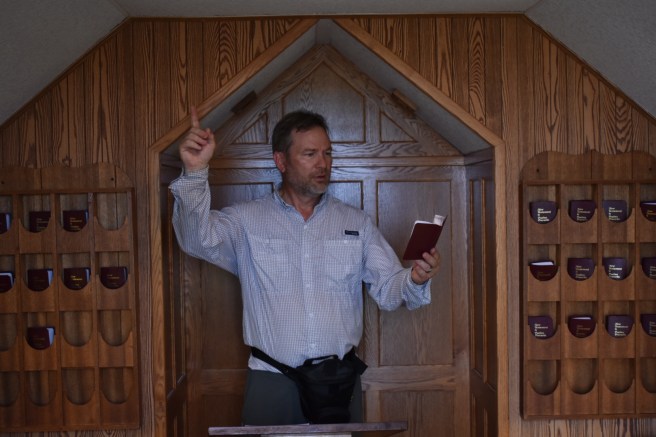
We stayed for a short sermon (ha ha!)…

…and then went out back to check out the view and the bench. It’s all very sweet and if it hadn’t been so hot, we would have stayed longer.

The door is always open. Quiet in the midst of the storm.

Come to me, all who are weary and heavy laden and I will give you rest.
Take my yoke upon you and learn from me, for I am gentle and humble in heart, and you shall find rest for your souls. For my yoke is easy and my load is light.” Matthew 11:30

Amen and Amen.

I’ll probably delete this in the morning.

Tuesday, July 21, 2020 Thistle While You Work

Do not touch the thistle.
It’s a weed that is noxious.
Let’s go all the way
And say it’s obnoxious.

Blowing on it does nothing
But make you a thistle blower.
If you thistle while you work,
Your weeds will need a mower.

Rubbing it on your hands
Makes you clean as a thistle
While thistling in the dark
Sounds too much like a missile.

And of course a train thistle
Is one that says “toot, toot!”
And I’m not just thistlin’ Dixie
When I say “I am Groot.”

A thistle-stop tour,
Can only end in pain.
So just wet your thistle
And pull it out again.

If it bares its fangs at you,
Why then, it’s a wolf thistle.
Oh, and a really fancy one,
Has got bells and thistles.

You’re probably getting weary,
And wish I weren’t such a goon.
So I think I’ll just go off

And thistle another tune.

I’ll probably thistle this in the morning.

Monday, July 20, 2020 Mistakes Were Made

Yes, mistakes were made. I did a post about “Daucus Carota” a while back (Queen Anne’s Lace), but had a niggling doubt that I had identified the flower correctly. Something wasn’t quite right about it. My husband got an app recently called “Picture This,” which will identify any plant photos you have, so I consulted with the experts and found out that it was actually yarrow. Mea culpa! Since that revelation, I’ve been on the lookout for true Queen Anne’s Lace so I could get a photo and switch it out, thus erasing my shame.

My husband and I took a short road trip this last weekend and kept passing groupings of QAL in the ditches alongside the road. Eventually, we got off the freeway so I could get my photo. It was such a blistering hot and humid day that my camera lens immediately fogged up when I took it out of the air-conditioned car, so this is what I got:

Falling back on the time-honored tradition of cleaning it with my clothing, I was able to get a couple better shots.

We were on the road for several hours after that and Queen Anne’s Lace kept us company by the roadside the entire time. She is a lovely lass.

Of course, yarrow is perfectly nice as well. And her Latin name, Achillea Millefolium, is much more mellifluous than Daucus Carota, so she can hold her head high.

I have set the record straight and will finally be able to get a good night’s sleep. (Ha ha!)

I’ll probably delete the photo of yarrow in the morning and replace it with Queen Anne’s Lace.

Friday, July 17, 2020 Lantana Musings

Lantana of the family Verbena,
Your name means “wayfaring tree,”
You protect us from the mosquito,
You deter the rabbit and deer.

Squirrels will not eat your blossoms
And your fragrance is citrusy-sage.
All this would have been plenty,
Indeed you’re superlative.

But above all of this, your flowers
Are of color combinations divine.
A kaleidoscope of wonders
A palette truly sublime.

I’m a big fan of lantanas.

I’m not sure if you can really call that a poem, but it felt right to me.

I’ll probably delete this in the morning while trying to figure out how to be like lantana and repel mosquitos.