Friday, April 10, 2026 Boundaries

Here’s another short writing assignment from a different class that I started. The assignment was to write a scene that takes place at an edge or boundary—the edge of town, the edge of a forest, the boundary between two neighborhoods or two countries. Here’s my take on it:

Lena wished she could see all the way to the lake from her house. It was four blocks down, two blocks over, and then over the hill and down the curvy road. She wondered what it would be like to live there, to see the sparkling blue from her window, to hear the waves lapping on the shore, to run outside and jump in the wet coolness on a hot day. She knew which house she’d want to live in – she’d seen it many times when biking around the lake. It was like a mansion perched on the edge of that circle of water. Her mother had told her that you had to be really rich to have a house on the lake. Lena didn’t know any rich people, but she figured they were stuck up and snobby. She sometimes got off her bike and stood near that house and then she’d close her eyes and imagine that the house was hers. She’d breathe in the lake air and think “That’s MY lake air, now.” She’d look at the graceful sailboats and say, “That little red one is mine and I can go sailing any time I want.”

Ellen had seen the girl before, the one with the red bike. What an odd duck she appeared to be, standing on the outside of their fence with her eyes closed. As Ellen watched from her window, she heard the cleaning lady vacuuming downstairs and wished she weren’t alone. Her parents were both physicians and between their two busy schedules, the time they spent with her wasn’t often. She wasn’t allowed to go wandering on her own, so she spent a lot of time reading. Today, though, she kept her eyes on the girl and wondered what it would be like to be able to get on a bike and go riding anytime she wanted to. Ellen thought if she wasn’t so shy, she’d say something, maybe call out a friendly greeting. Suddenly, the girl opened her eyes, looked up, and saw Ellen staring at her. Their eyes met. Ellen was just beginning to give a tentative smile when the girl frowned, mounted her bike and rode off. And Ellen, who had for a moment felt the nearness of someone, was alone again.

I haven’t written any more about these two girls, but I think they ought to meet, don’t you?

The Lord bless you and keep you, friends.

I’ll probably delete this on the edge of the town in the morning.

Friday, March 20, 2026 The Jackdaw’s Story

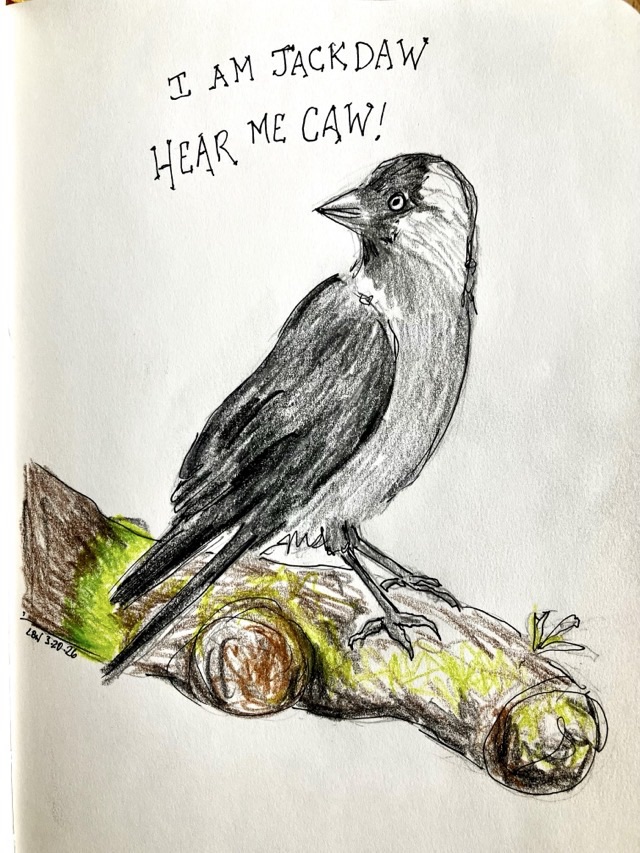
Our last writing assignment for the class was to write a poem inspired by the book The Magician’s Nephew. I chose to write one from the viewpoint of the jackdaw, featured in the glorious creation scene in the book. You might not “get” this poem if you haven’t read the book, but I hope you enjoy it anyway (and please do read all the Chronicles of Narnia). It felt incomplete without an illustration so I did a quick sketch for the occasion.

Darkness, then light
Stillness, then flight
The Singer makes,
The world awakes.
Sweetest singing
Sends me winging
I am Jackdaw
Hear me caw!

His nose to my beak
He is all that I seek
All eyes now on him
We leave our own kin.

His eyes steady burn
Our hearts strangely warm
Then breath like a fire
Soars ever higher

“You trees, be walking!
You beasts, be talking!
All Narnia is yours,
Seas, woods and stars.
I give you yourselves;
I give you myself.

“But on this bright morning
I give you clear warning,
The beasts who don’t speak
You must love and well treat.
Never walk in their ways
Lest your talking shall cease,
And your minds are undone;
You’ll be once again Dumb.”

“Hail Aslan, our King,”
We creatures all sing.
“We hear and obey,”
We gratefully say.
“And when you say ‘don’t’
We will not, we won’t.”

Perky with cheer
I sing out, “No fear!”
At the top of my voice.
(Unfortunate choice.)
Embarrassment deep,
I pretend I’m asleep.
While the others soon after
Erupt into laughter.

But joy upon joys
Aslan blesses the noise.
Humor’s divine,
So jokes are just fine.

I made the first joke!
I’m that kind of bloke!
Oh the stories they’ll tell
(I’ll be known quite well).

But wait, it gets better,
Hold on to your feathers,
For don’t you see?
The first joke was me!

The first joke was me!
I’m filled with glee,
I fall off the horse
But have wings, of course.
I’m flying, I’m happy
I’m funny, I’m flappy
I am Aslan’s Jackdaw
Just hear me caw!

I’ll probably wait for the caw of the jackdaw to delete this…in the morning.

Friday, March 12, 2026 Short Story: Hall of Tantrums

This another writing assignment for the class I’m taking on The Habit (Writing with Digory). The assignment was to portray characters that are seeing something they don’t have a context for and are therefore confused.

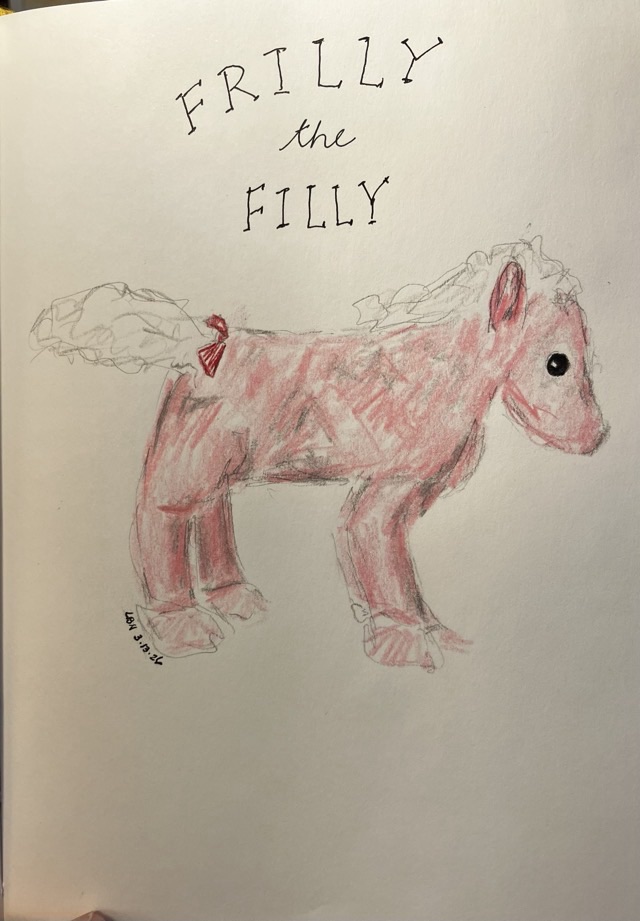
I actually wrote this story for the grands a few months ago, but shortened it for the purposes of the assignment. The main character, Frilly, is a beanie baby that is a favorite of our granddaughter’s, so she often asks me to tell her “Frilly Stories.” Now you know!

Mr. and Mrs. StrongHorse took their filly, Frilly, to the fair, along with Frilly’s baboon friend, Cheeks. They spent a pleasant morning riding the carousel, watching Mr. StrongHorse run races, getting groomed, and eating fair food.

After lunch they strolled around the fairgrounds for a little while, enjoying the sights together. As they passed one building, they heard terrible cries and screams coming from inside. Frilly and Cheeks were frightened, but Mr. StrongHorse said, “Oh, that’s just the Hall of Tantrums – there’s nothing to fear there. Would you like to go inside? We’ll stay with you, and you’ll see some things that are very interesting.” Frilly and Cheeks were as curious as you should be.

The building inside was a hallway of videos on the wall. The sounds of screaming, wailing, crying and whining were coming from all around them, but as they stopped in front of each video, the other videos silenced automatically. The first one showed a little girl sobbing hysterically, her little face red and her eyes shut tight. “NOOOOOOO!” She was screaming. “I WANTED THE YELLOW CUP, NOT THE BLUE ONE!” And she said this over and over.

“Is she hurt?” Cheeks asked with some concern.

“You’d think so, wouldn’t you?” chuckled Mr. StrongHorse. “No, she’s upset because someone gave her some water in a cup that she didn’t want.”

Frilly and Cheeks watched in fascination. “So, she’s not hurt at all,” said Frilly, just to make sure.

“Oh, no, she’s perfectly fine!” explained Mrs. StrongHorse.

“But what difference does it make what color the cup is?” Cheeks couldn’t help asking.

“None at all! That’s what makes it sad and a little funny at the same time,” said Mr. StrongHorse.

“Let’s keep going,” said Frilly, quite interested now to see what was on the other videos.

The next one showed a little boy who had been using a crayon when it broke. His mother offered him a different one, but he threw it across the room in a fit, wailing “IT’S ALL RUINED! I CAN’T DO IT NOW!” and with that, he swept his hands across the table throwing everything on the floor. “RUINED!” And this scene played over and over as well.

Frilly and Cheeks spent a little too much time watching that one – each time the crayon broke and the boy threw a fit, they couldn’t help giggling. They started chanting “RUINED! RUINED!” until Mr. and Mrs. StrongHorse shushed them.

As they approached the next one, they heard the most awful noise – it made them want to cover their ears! Two little ponies had been told it was time to go to bed. They stomped their hoofs and shook their heads, all the while neighing and whining “IDONWANNA IDONWANNA IDONWANNA! IDONWANNA!” The noise was so annoying that the four of them moved quickly onward. Cheeks kept elbowing Frilly and whispering, “Those ponies looked a lot like you – ha ha!”

The next video was the last one in the hallway. Two young monkeys were each given a banana. The first monkey cried, “I WANTED THAT ONE! WHY DID SHE GET IT? HERS LOOKS BETTER THAN MINE! I WANT IT! I WANT IT!” And with that, he threw his perfectly good banana on the ground and stomped on it. Frilly and Cheeks were particularly interested in the way the banana squirted out of the skin when he stomped on it. Cheeks said, “Let’s watch it again- I can’t see any difference between the bananas, can you?” But there was no difference. Frilly couldn’t resist nudging Cheeks, saying, “That monkey looks a lot like you!”

They left the Hall of Tantrums and it was time to go home. Mr. and Mrs. StrongHorse trotted ahead of the two young ones, but could still hear them laughing and shouting, “RUINED!”

. . . . . . . . . . . . . . . . . . . . . . . . . . . . . . . . . . . . . . . . . . . . . . . . . . .

And if this post is RUINED, it’ll be thrown on the floor in the morning.

Friday, March 6, 2026 Twelve Years

Our writing assignment last week was to take a familiar story and write it from a different perspective. I struggled the whole week to come up with something, but eventually settled on the following. See Luke 8:40-56 for the inerrant version.

What was it like to be healthy, to be whole, to be accepted into society, to be clean? Mahlah could not remember anymore, it had been so long. The flow of blood that started twelve years ago had changed everything. She’d spent all that she had on physicians. They took her money and gave her medicines, but nothing changed. Friends and family gradually began to stay away, as if being with her would transfer her condition to them. Mahlah did not understand why the good God had appointed her to bear this affliction, but she knew He was a faithful God. She cried out to Him day and night to come and heal her, to lift this curse from her. At times, it was hard not to sink into despair, but the psalms were her comfort and hope. “Wait on the LORD; be of good courage, and He shall strengthen your heart; Wait, I say, on the LORD!” So she waited in hope.

The year Mahlah’s affliction began, Jairus and his wife had a child after many long years of waiting. Mahlah rejoiced with the rest of their village as the new parents showed off their tiny daughter, the only child that was given to them as it turned out. Mahlah felt that in some strange way their lives were bound together, as from a distance she watched the girl, Tabitha, growing up. “Tabitha is four years old now and I have been four years in this wilderness,” she would say to herself. Seeing the girl full of health and vitality was somehow a balm to her own soul. And in this way twelve years had gone by.

A multitude had gathered this day because Jesus had returned. Mahlah had heard of Jesus – who had not? There were stories of him performing miracles of healing. Many speculated that Jesus was the long-awaited Messiah, the promised One! Others were saying he was from the devil, but Mahlah had thought, “Why would the devil bring healing?” Normally Mahlah would stay on the fringes of any crowd, fearful of being recognized as unclean and sent away. But today her heart was lifted up in hope; she believed this man Jesus could heal her and she was determined to ask him.

Before she could make her way to him, a voice rang out, a voice of desperation. Even from where she was, Mahlah saw Jairus sink at Jesus’s feet. The crowd fell silent as Jairus begged Jesus to come to his house where his daughter was dying. Tabitha, dying! It cannot be! Mahlah was stunned by this news and watched as Jesus began to make his way to the house of Jairus. Mahlah could hardly see him now as the crowd hemmed him in on every side. “I will not stop him from going to Tabitha,” thought Mahlah, “It is enough if I can touch the hem of his garment as he goes by.” She pushed her way through to his side and while she still had the courage, she touched his robe at the very edge. Immediately she knew her flow of blood stopped; she had been made whole. With joy, she turned to push her way out of the crowd.

“Who touched me?” Jesus asked. Mahlah wanted to hide. “Somebody touched me, for I perceived power going out from me,” he continued and as he scanned the crowd, he caught her eye. For a moment, it was as if they were the only two people there. He knew it was her and she could see that there was no hiding from him, as if anyone could. She trembled and fell down before him, telling him why she had touched him and how she had been healed.

“Daughter, be of good cheer; your faith has made you well. Go in peace,” Jesus said. Just as Mahlah was marveling at this tremendous blessing, this gift of love, someone came to Jairus to tell him not to trouble the Teacher any longer, for his daughter was dead. Mahlah felt all her joy bleed back into sorrow as she thought of the delay she had caused Jesus. At that moment she would have gladly traded her healing to give Tabitha back her life. She looked back up into Jesus’s eyes, but his focus now was on Jairus.

“Do not be afraid,” he told Jairus, “only believe, and she will be made well.” With that Jesus resumed his walk toward Jairus’s house, the crowd still following. But Mahlah had heard everything she needed to hear. She did not need to follow the crowd to know that she would see Tabitha again, alive, whole and happy. Mahlah’s twelve years of affliction had ended, and Tabitha’s twelve years of life would be made new.

I’ll probably procrastinate and struggle to delete this in the morning.

Friday, February 27, 2026 You Saw What?

I’m taking a writing class for the first time since my college days. There are actual writing assignments, which aren’t graded but are peer reviewed. The first assignment was to write a short (600 word) crowd scene in which there is action and dialogue. I spent two days panicking about this assignment, drawing a complete blank and wondering why I ever thought I could write anything at all. Eventually an idea struggled its way through my wall of panic and I was able to submit something. Phew! It’s weird being “in school” again. Anyway, here it is for your perusal.

Martin and Beulah hopped on the crowded shuttle bus at Zion National Park at the last moment, squeezing their way toward the back where there was just enough room for the two of them to stand, holding onto some straps. The bus had barely gotten moving again when they heard a commotion somewhere near the front of the bus.

“I saw him! I saw Bigfoot!” shouted a woman they couldn’t see.

“Yeah, right,” said the man behind Martin. He was wearing a Disney shirt.

“Look! There!” she cried again.

Everyone had their phones out, trying to figure out which way to point them, just in case. A lot of jostling ensued, accompanied by excited voices as people tried to get closer to the windows.

“Did anyone see which way she was pointing?” said a large man not far from Beulah, swiveling his Nikon camera this way and that.

“Get that camera out of my face!” The woman next to him jabbed him in the shoulder with her finger.

“I thought I saw something moving just behind those trees,” offered up a fellow with a man bun, getting caught up in the moment.

“We wanna see Bigfoot!” whined a couple little kids farther up. “Bigfoot! Bigfoot!”

“How stupid can you get,” muttered Disney, “Bigfoot is not real. Everybody with half a brain knows that.”

Martin had decided to stay put, but he could see Beulah trying to edge her way forward, taking photos of the people, rather than looking out the windows.

Meanwhile, Nikon was determined to get his award-winning shot, pushing his way toward where he hoped the action was.

“Ouch, you stepped on my foot, you oaf!” Finger Jabber was really annoyed now.

“BIGFOOT! BIGFOOT!” the kids continued their chanting, while somebody, presumably their mother, was saying, “Let’s use our indoor voices, children. No need to shout.” This had no effect.

Man Bun was saying to anyone who would listen, “I read an interesting article about Sasquatch recently…” perhaps hoping to be established as an expert on the topic.

The bus driver tried to calm the crowd down by speaking into the PA system. “Folks, you’re going to have to stay in your seats or stay standing where you are. We’ll be at the first stop in just a few minutes.” This also had no effect.

Martin caught a glimpse of Beulah looking absolutely delighted with the whole chaotic scene.

Disney kept grumbling, mostly inaudibly, but Martin heard the word “Idiots,” a few times, accompanied by a shaking of his head.

Almost everyone was looking out a window on either side of the bus by now, with much finger pointing and photo taking going on. Half a dozen people could be heard to say that they were sure they’d gotten a photo of something that could have been Bigfoot.

At last the bus driver pulled over to the first stop, calling out “Court of the Patriarchs!” The last time Martin and Beulah had visited Zion, nobody had gotten out at this stop except them, making them feel like chumps. This time, however, almost everybody got off, still excitedly talking about which way they’d need to go to find their quarry. Nikon appeared to be in the lead. As the bus doors closed, Martin and Beulah could still hear “BIGFOOT! BIGFOOT!” To Martin’s surprise, even Disney was out there following the crowd.

Martin and Beulah sat down in the empty bus, Beulah with a happy sigh. “I don’t think our vacation experience can get much better than that,” she said. “Want to see my photos?”

Yes, he did.

Actual Court of the Patriarchs, but no Bigfoot, sadly

I’ll probably be deleting this Blogfoot in the morning.

Friday, January 16, 2026 The City on a Hill

Long ago, a simpleton named Simon was walking along a dusty, deserted road and saw a small city up ahead on a hill. The entrance was at the highest part of the hill, so it was a bit of a slog to get there. But Simon needed a place to stay for the night and it was the only town in sight.

At last, Simon saw the city gates. Two women, identical twins, stood at the entrance. They called out simultaneously, “Whoever is simple, turn in here!” It was odd – their voices saying the same thing should have had a pleasing unity, but instead the sound was discordant. The one on the left beckoned to Simon, saying, “Don’t listen to my sister. She will only tell you lies.” The one on the right laughed and replied, “The liar accuses me of lying.” Turning to Simon she said, “Listen and think for yourself, esteemed visitor.”

The one on the left spoke again. “There are two doors into this city. We are the doorkeepers. You may only enter by one door, mine or my sister’s. Pay heed, for the wrong choice will bring you much sorrow.”

Simon asked, “How will I know which door to enter?”

The twin on the right answered, “You must listen to our invitations. It is not complicated. My sister is already trying to frighten you, but I can tell that you are not the kind of person to be easily frightened.”

The woman on the left addressed Simon, “You are simple, you lack understanding, but I can help you. Won’t you listen to me?”

Simon the simpleton was a little put off by being called simple and without understanding (there’s a reason he was known as a simpleton, after all.)

The woman on the right called out, “Sister, you said a true word there. This fellow is simple, he lacks understanding. But he’s also clearly more attuned to my voice than yours.” To him, she said, “Come closer and I will tell you what you want to hear.”

But Simon decided he should listen to both invitations to be fair. He turned to the left and gestured for her to begin.

“I have prepared a meal for you, the best meat is on my plate, roasted to perfection. See what bread I have baked. It is made from golden grains that drank sunshine all the day long. I have wine for you to drink, mixed with fruit and spices. It is a meal that will satisfy you and give you life.”

It is a good speech, one that Simon wished he could have paid complete attention to, but while she was speaking, her twin was banging on old pots and making a clamor. Still, he got enough to know that the invitation was to a meal, and it reminded him that he was very hungry. He turned to the right to hear the other invitation.

“My sister wants to fill you up with her simple food. Don’t you know that it’s cruel to kill animals to eat their meat? How could you possibly enjoy that? Doesn’t wine dull your senses? Be careful – there’s trickery on her plate! And where’s the excitement in such fare as she has to offer? She thinks to satisfy you with wine, but I know of a well that has the clearest, purest water which is only fit for kings. It would be simplicity itself for you and I to steal some of that, and the thrill of stealing it would make it sweeter than wine. As for bread…”

And here she gestured for Simon to come closer, whereupon she whispered in his ear. “I have bread that is best eaten in secret, if you know what I mean.” A broad wink and a smile accompanied that last part and Simon flushed with pleasure.

Ah, what a choice. Each sister had spoken to Simon’s simple heart. There was something in the invitation from the right, however, that had begun to entice Simon’s mind and fill his senses. Almost without thinking, he began to walk toward her door, but at the last moment, he looked over to the other sister and saw a look on her face that stopped him. There was light, love and compassion shining from her eyes. Simon was completely undone and suddenly aware that he had been guilty of the most preposterous foolishness.

The sister on the right began her clamor with banging on pots again, but it was too late. Simon walked toward the door on the left and asked, “Might I know your name, fair lady?”

“You may. I am called Wisdom and my sister is Folly. Had you entered her door, you would have joined the company of the dead in hell. Go through my door where your days will be multiplied and years of life will be added to you.” She held the door open for him.

Simon accepted the invitation and walked into the light.

Proverbs Chapter 9

This simple post will be deleted in the morning.

Friday, September 19, 2025 Four Friends

The four of them had been friends since they were little girls: Olivia, Diane, Sally and Mabel. They grew up in the same neighborhood, went to the same schools, and hung out together in between times. Now they were in their mid 20’s, out of college, and still living in the same city so they tried to get together at least once a month to keep in touch. And oh, the times they had – “gossip sessions,” they called it. No topic was off limits and a thought, once brought to mind, was instantly expressed. They wanted to stay “real” with each other. They complained to each other about their husbands or boyfriends, or about men in general. They raged about politics. They couldn’t wait to tell the scandalous secrets they’d heard about mutual friends, and if they didn’t know any secrets, they speculated based on very little information. Their fears and anxieties were brought out, examined and magnified. If one of them had cause to express a sense of possible guilt about anything, the others would rush in to justify her and stamp out those kinds of impulses. It was all quite satisfying.

And then one day, Olivia changed. They met for one of their usual gossip sessions and Diane took the lead.

Continue reading “Friday, September 19, 2025 Four Friends”

Thursday, March 20, 2025 The Folding Wizard

As a young boy, Clyde had a strange fascination with folding things. The family learned not to leave important papers lying around, for Clyde would appropriate them for his folding works. By the time he was in high school, he had a display of things he had artfully folded – three shelves full in his bedroom. When he got up and when he went to bed, he took great delight in surveying these clever creations. If he told anyone about his interest in folding, it gave him great pains that their first assumption was that he took to Origami. “I do NOT do origami,” he would state in a tone that communicated his disdain for the topic. He had no interest in taking small colorful squares of paper and making cranes, frogs and boxes out of them.

No, his passion was for the unusual, the artful, the delicate matter of folding all manner of items: newspapers, scraps of cloth, posters, church bulletins, record album covers, etc. (This latter effort got Clyde in trouble with his older sister who did not appreciate what he did with her mint-condition Pink Floyd Dark Side of the Moon cover. He had been interested in making the album cover look more like a crescent moon to go along with the title of the album, thinking it would only increase the value. He didn’t even touch the inner sleeve which actually held the record – he wasn’t that stupid!)

His father and mother tolerated his odd obsession, but were fond of telling Clyde, “You can’t make a living by folding things. Once you get out of college, you need to find a proper job!” Clyde reluctantly agreed with them and chose a major in college that would lead to this “proper job” that he was expected to get. But his heart wasn’t in it.

One day, however, Clyde was perusing the want ads and came across an ad that simply astounded him. It said, “Do you like to fold things? We are looking for experts in this area to work in our business. Please apply to The Brilliant Haberdashery.” What?! It looked like his parents had been wrong. Perhaps he could make a living using his folding prowess.

Clyde skipped classes that day and went directly to the address listed for the BH. He strode into the store confidently and stated he was interested in the folding job advertised in the newspaper. The store owner, Mr. Argonil, was a nattily dressed fellow sporting a pencil mustache and a sharp bow-tie. Mr. Argonil dispensed with the usual employment forms and instead led him through increasingly complicated folding challenges that thrilled Clyde and made him sweat. At the end, Mr A offered Clyde a job. He quit college and began his illustrious career that very day.

Mr. Argonil told him that he’d start small and work his way up, in spite of his quite impressive job interview. “You’ll begin with folding some of our socks and underwear. Don’t despise small beginnings, young Clyde, for these are the very steps that will lead you to the pinnacle of folding at the haberdashery: our pocket squares. Each pocket square that we sell is made of the finest silk and has a different design. Each one must be folded in a unique way. You’ll have no outlet for creativity with the socks and underwear, nor will you branch out with any sort of flare when you graduate to pants, undershirts, and shirts. When you reach handkerchiefs, there will be some fancy and fashion. But when you get to pocket squares, that’s where your genius will shine!” Clyde was inspired. Clyde was impressed. Clyde had goals and aspirations!

“But one more thing, my young apprentice,” Mr. Argonil said, “We do not believe in magnifying names here at the Brilliant Haberdashery. Your work will be anonymous. Each level of folding is designated by the letter H – for Haberdashery of course – and a number. The higher the number, the more prestigious the level of folding you have graduated to. We start with the number 5 and move up by 5’s. The highest achievement of folding that you will reach is H-30. You can go no higher. Even I have never achieved higher than that.”

Clyde loved a challenge and took Mr. Argonil’s statement as such. Over the next few years he worked his way up, meticulously folding first socks, then underwear, then pants, undershirts, then shirts, then handkerchiefs. At last the great day arrived when Mr. Argonil promoted him to H-30, folder of pocket squares. No one was prouder than Mr. Argonil, who by this time viewed Clyde as his most talented protege. “Clyde, my boy, you’re a boy no longer. You are a man. Welcome to the top of the folding ladder. You have arrived.”

But Clyde was by no means finished. His genius had begun but had not reached full flower. Each day he arrived at work and took the day’s pocket squares to the office that he now had. He spent hours crafting the most exquisite folding designs for his pocket squares and did not even allow the new employee (still stuck at H-5) to transport them to the sales floor. He carried them carefully himself and displayed them in such glorious array that customers were often hesitant to touch them. But touch them they did, and then bought them by the dozen, each one boxed delicately and with just a small piece of typed paper at the bottom that said: “Folded by H-30.”

The Brilliant Haberdashery grew and flourished, thanks to Clyde’s artistry. He was ever aspiring to new heights of folding wizardry and everyone knew to leave the master to his work in solitude when the door was closed. One day, one unforgettable day, he brought out his latest masterpieces and set them on the display. Mr. Argonil and the other staff gathered in silent awe to gaze at them. Clyde stole a look at Mr. Argonil and saw tears silently streaming down his cheeks. Mr. Argonil excused himself, presumably to blow his nose, and came back with a small but expertly crafted box made out of cherry wood. He gave it to Clyde saying, “I almost didn’t dare to hope that I’d give these out to someone someday. Clyde, these are yours. You have earned them. You have my highest admiration.”

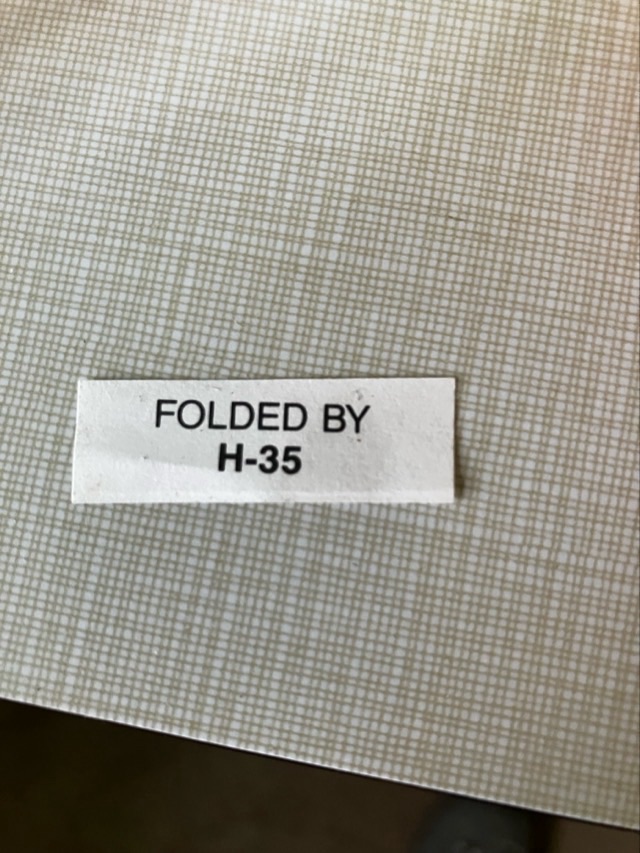
Clyde opened the box and gasped, seeing a pile of little typed pieces of paper, each one saying, “Folded by H-35.”

He had arrived.

I was inspired to write this story after finding a little slip of paper in one of my mom’s old boxes that said, “Folded by H-35.”

This post will be folded into oblivion in the morning.