Wednesday, April 22, 2026 Imitating the Masters: Renoir

I tackled a Renoir painting in my latest attempt to imitate the masters. “Tackled” feels about right. More on that later.

Pierre-Auguste Renoir lived from 1841 to 1919, a French artist who was a leader in the development of the Impressionist style of painting. His father was a tailor who moved his family to Paris in 1844 in hopes of finding a better living. Young Renoir was naturally talented at drawing, but (to my surprise) had an even greater talent for singing. Renoir took music lessons but had to quit at age 13 due to financial constraints. He became an apprentice in a clay factory at that time.

At age 21 he began studying art under Charles Gleyre in Paris, but still struggled to afford paint over the next years. By 1874 (age 33), he collaborated with artists like Monet and Pissarro to put on the First Impressionist Exhibition. By 1879 he had achieved success and some renown as an artist.

Later in life he developed rheumatoid arthritis, which eventually affected his ability to paint. He died at the age of 78 in 1919.

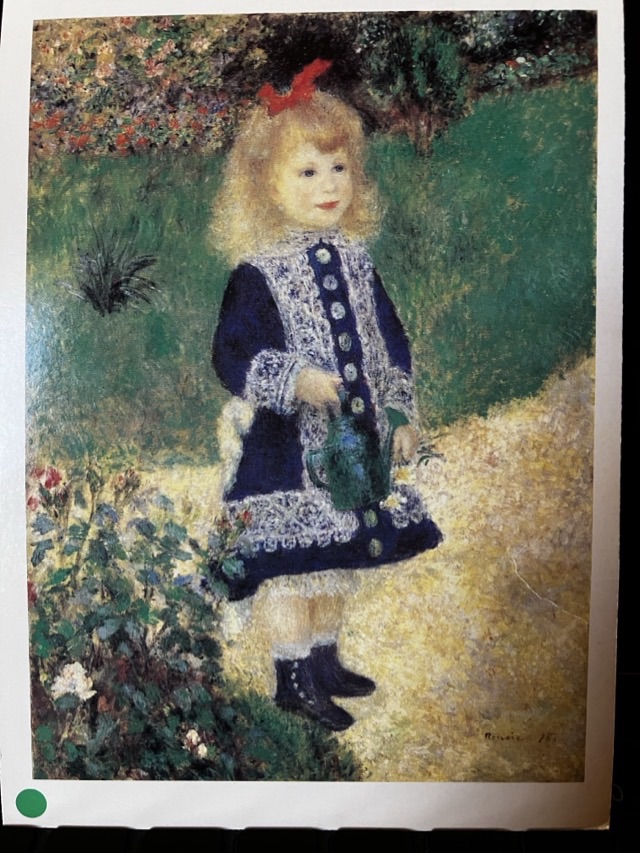
A Girl with a Watering Can was painted in 1876, an oil painting on canvas. It was apparently painted in Claude Monet’s garden, the little girl possibly a neighbor of Renoir’s. It is on exhibit at the National Gallery of Art in Washington D.C.
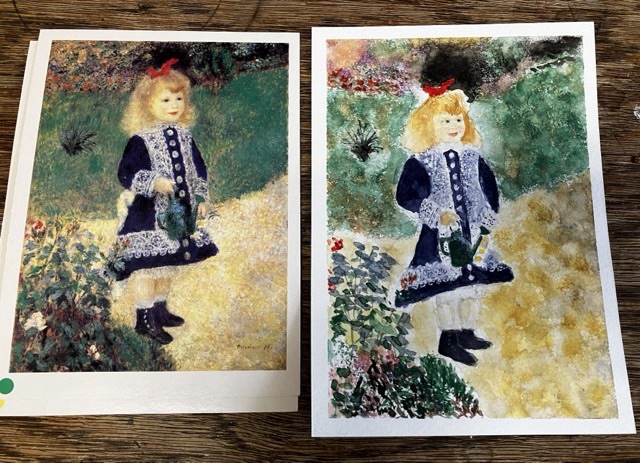
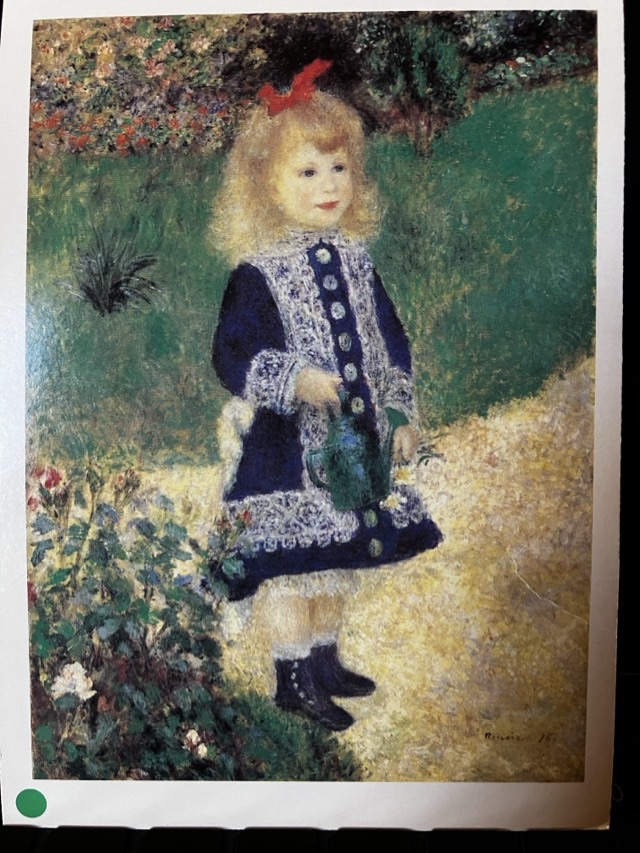
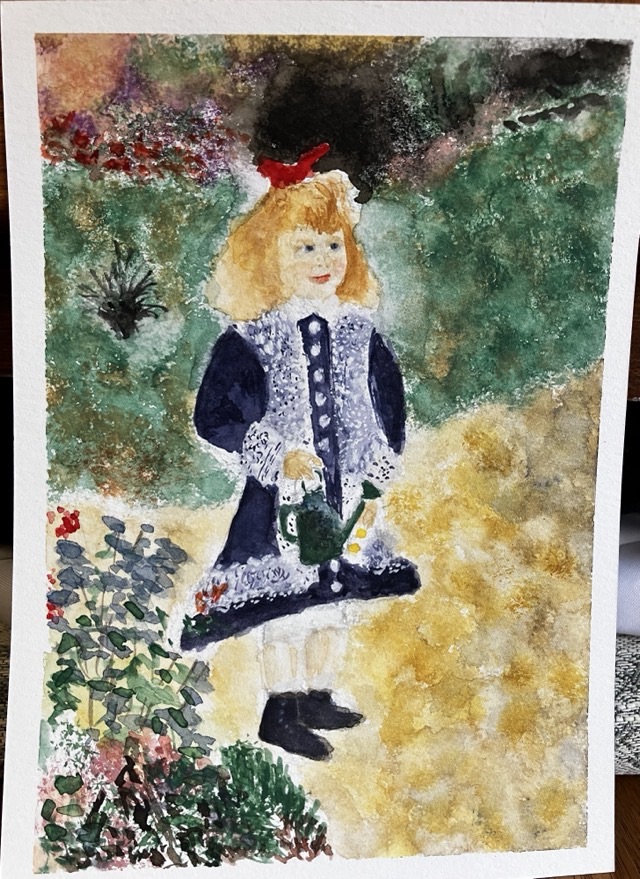
Getting the proportions right continues to elude me, but since this painting was in the impressionist style, it left me some wiggle room for interpretation. As always, it is well nigh impossible to achieve the same effect with watercolor as an oil painting (at least for me). I labored the longest on mixing just the right color blue for the girl’s dress. Couldn’t get the facial colors or her expression right, though. I ended up being fairly pleased with how the lacy part of her dress turned out (but don’t look too closely at it).

This is my sixth painting in this series…and it might be my last. At the very least, I will be taking a break before going on with the next group of six.

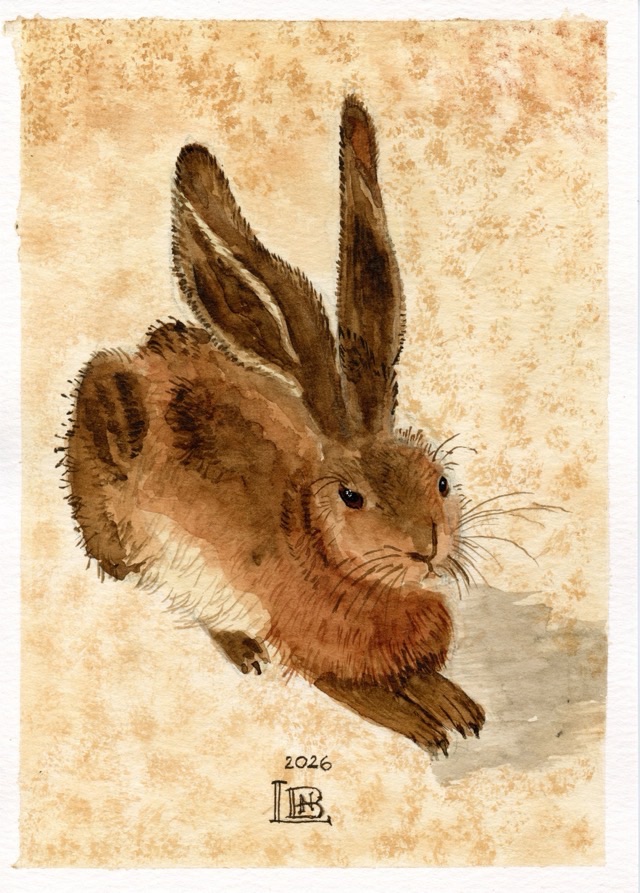
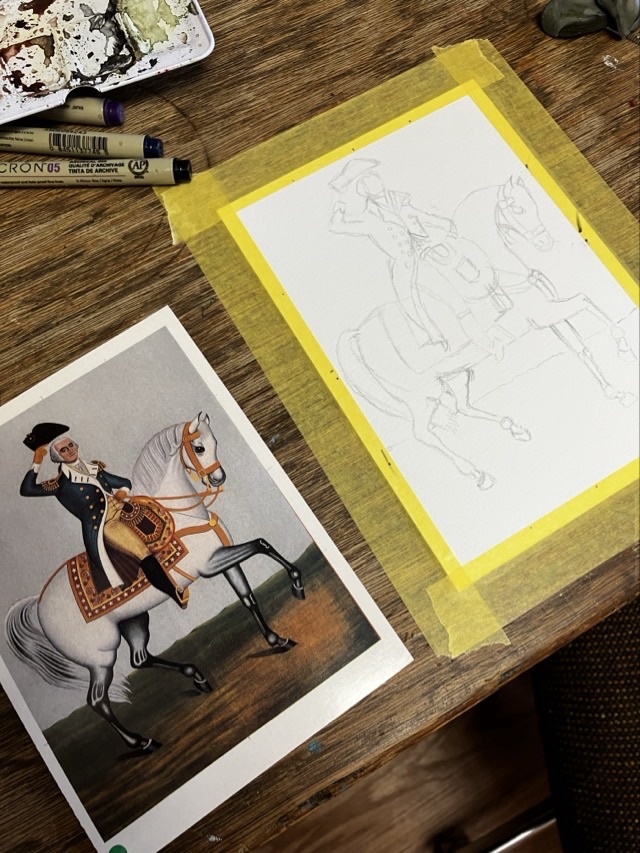
If you’ve been following this series, which one was your favorite so far? Here they are again, to refresh your memory:
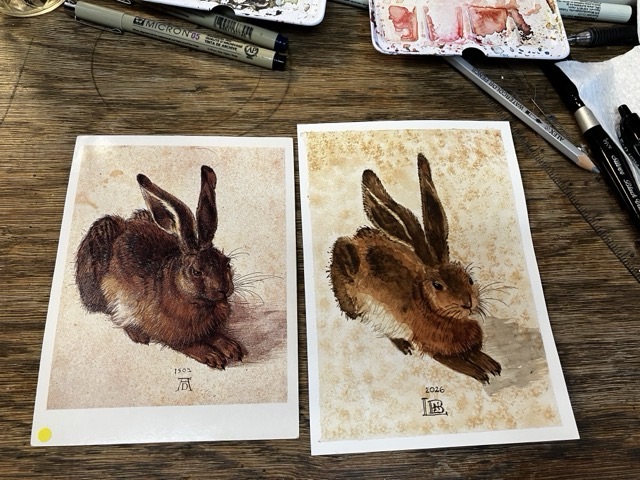
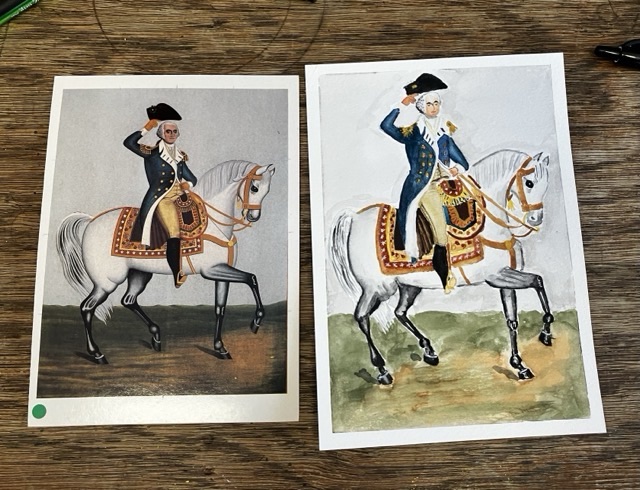
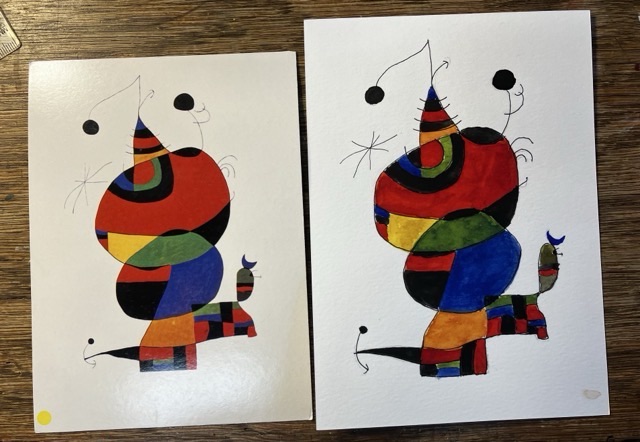
I think my favorite was Durer’s hare.

Au revoir!

I’ll probably be imitating deleting this in the morning.
Wednesday, April 15, 2026 Imitating the Masters: Matisse

Henri Emile Benoit Matisse was born in northern France in 1869, the son of a wealthy grain merchant. He didn’t start painting until he was 20 years old when his mother bought him some art supplies to keep him occupied while recovering from appendicitis. His decision to pursue art as a career disappointed his father deeply.

In 1896 he was introduced to Impressionism and the work of Vincent Van Gogh, which influenced him to change his color palette completely – from earth tones to bright colors. He began collecting expensive paintings that he couldn’t afford and went into debt.

The intense colors of his works between 1900 to 1905 made him one of the “Fauvists,” (wild beasts) of the art world, a style that was only popular for about 10 years. These paintings expressed emotion with wild, sometimes dissonant colors, often ignoring the natural colors of the subject.

When many fled France during WWII, he decided to stay, saying, “If everyone who has any value leaves France, what remains of France?” His daughter, active in the resistance, was caught and tortured by the Gestapo and sent to Ravensbruck, but she escaped from the train on the way there and survived.

Matisse died of a heart attack at age 84 in 1954, having spent the last decade of his life concentrating on paper cut-outs as an art medium.

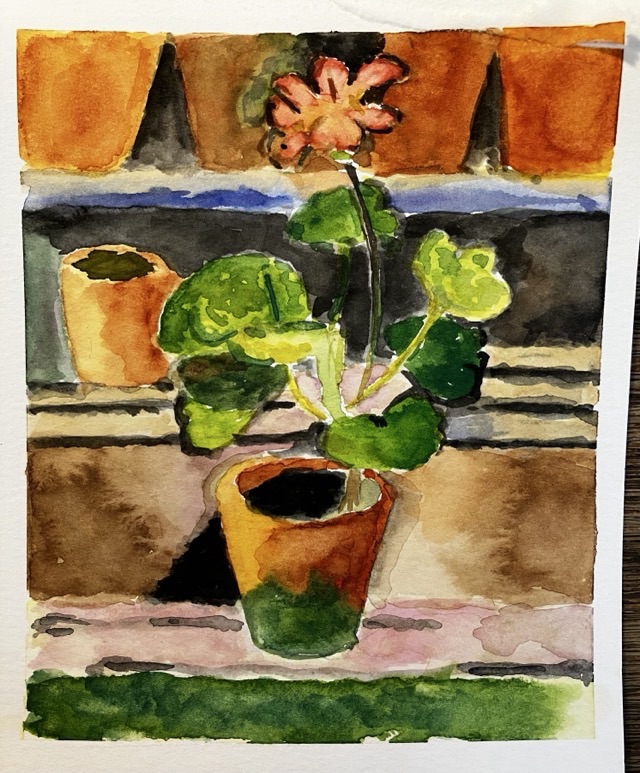
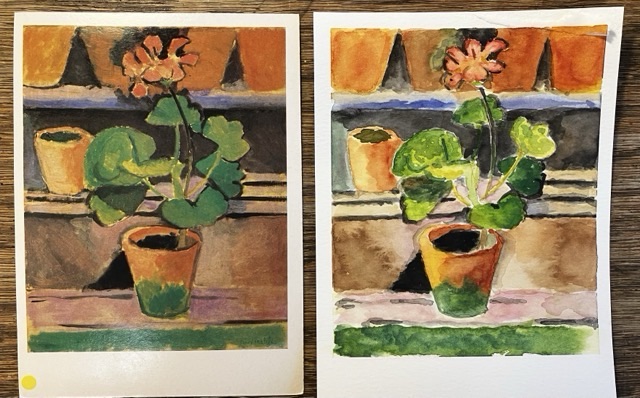
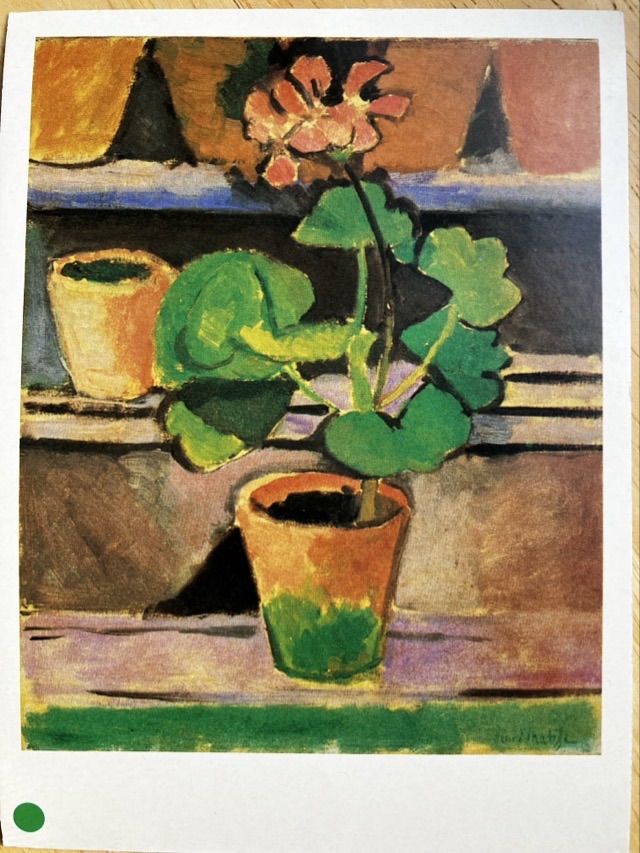
“Pot of Geraniums” was painted in 1912, oil on linen. It is on display at the National Gallery of Art.

When I saw this one, I thought with only few colors and a simple design, it might not be too hard to copy. I was wrong, as usual!

It’s an adventure, that’s for sure. I almost gave up on this one, but decided to persevere.

Next up:

Renoir! Am I crazy? Watercolor will be pretty difficult with that dress of hers…

I’ll delete this wild beasts of a blog post in the morning.

Wednesday, April 1, 2026 The Workshop: Van Gogh’s Chair

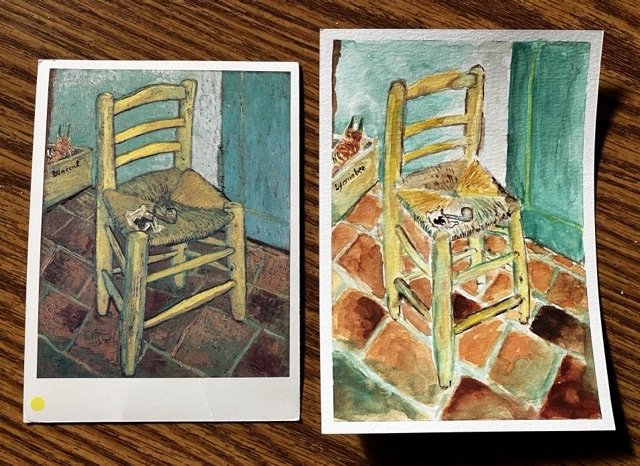
This is week 4 in my series of “Imitating the Masters.” I’m actually surprised that I’ve kept up with it thus far. As promised, I worked on copying a Van Gogh painting this time.

Vincent Van Gogh was a Dutch post-impressionist painter, who lived from 1853 to 1890. If you do the math, that means he died at age 37 – more on that later. He was the very definition of tortured artist. He showed early signs of mental instability which he never really overcame. He worked as an art dealer as a young man. At one point, he threw himself into religion, probably hoping to defeat the demons in his life, and even spent time as a missionary in Belgium.

Eventually Vincent drifted into a life of solitude, having poor health as well. He was in and out of psychiatric hospitals with depression and psychotic episodes, and famously mutilated his ear with a razor in one of his bad spells. These days we would call him a “hot mess.” Most of what we know about him, we know from his correspondence with his brother Theo. The day came when he could endure life no more: he shot himself in the chest. This, amazingly, did not kill him. He was able to walk back to town, but two days later he died from an infection to the wound. His last words were “The sadness will last forever,” haunting words.

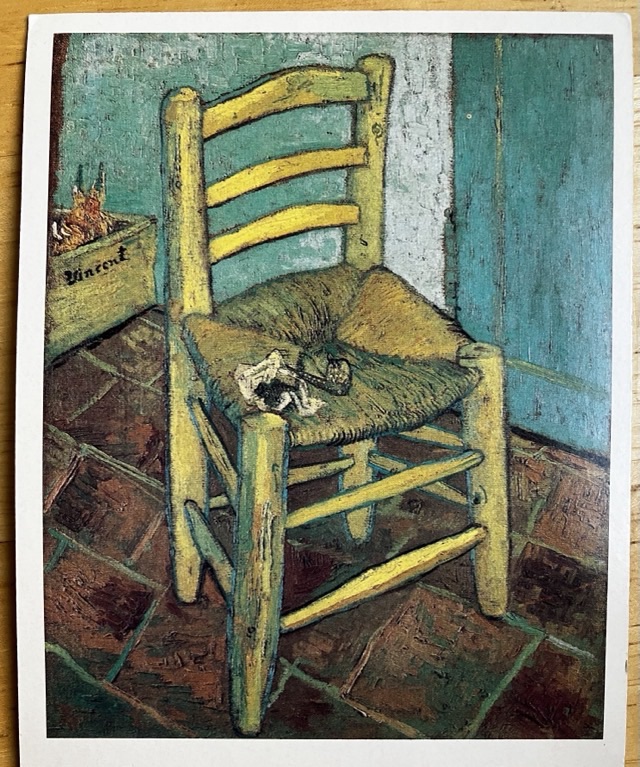
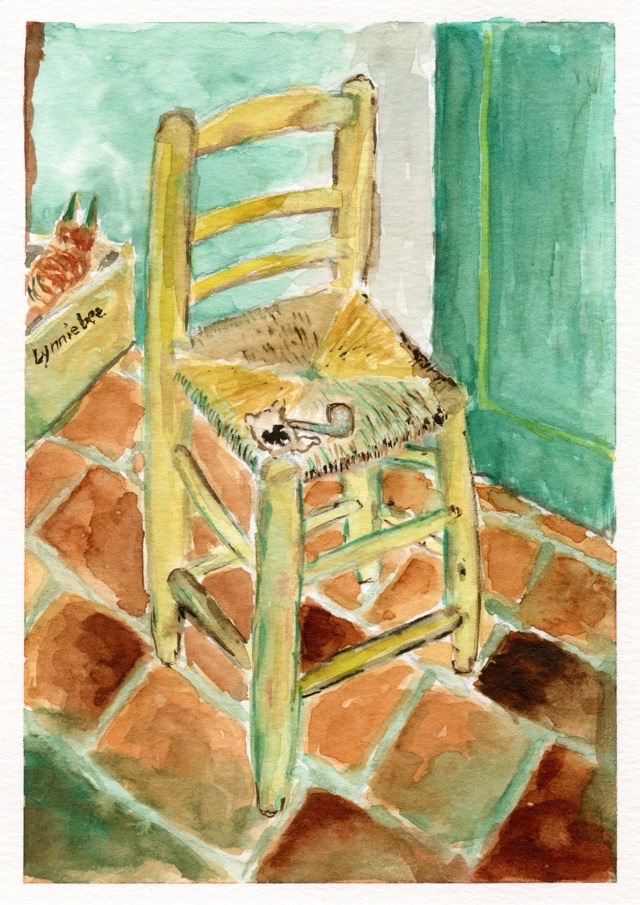
Over his lifetime, Van Gogh did over 2,100 pieces of art, coming to a style that featured bold colors and dramatic brush work. Over 800 of those paintings he did in his last two years! He painted “Van Gogh’s Chair” (also called “The Chair and the Pipe”) in 1888, using oil on canvas. I found out that the box in the painting was an onion box! He chose to paint this one in the complimentary colors of blue and orange and said that he “sought an effect of light with bright color.” It hangs in the National Gallery in London.


I have continued to struggle with getting proportions correct, something I’ll be working on in future paintings. I didn’t aim to get exact color matches; mine is a great deal brighter than Van Gogh’s. If you look carefully at mine, you’ll see a major change I made, putting my mark on the painting. Wink, wink.

Next week: Henri Matisse!

And now I’m singing to myself Don McLean’s song, “Starry, Starry Night,” about Vincent Van Gogh.

I’ll probably cram this into an onion box in the morning.

Wednesday, March 25, 2026 The Workshop: Miro’s Woman, Bird and Star

When we were homeschooling our children, I bought an art appreciation curriculum called “Look, Mommy, It’s a Renoir!” It came with small reproductions of many paintings done by a variety of artists spanning centuries and demonstrating many different styles. I’m using those now as my inspiration as I attempt to “imitate the masters.”

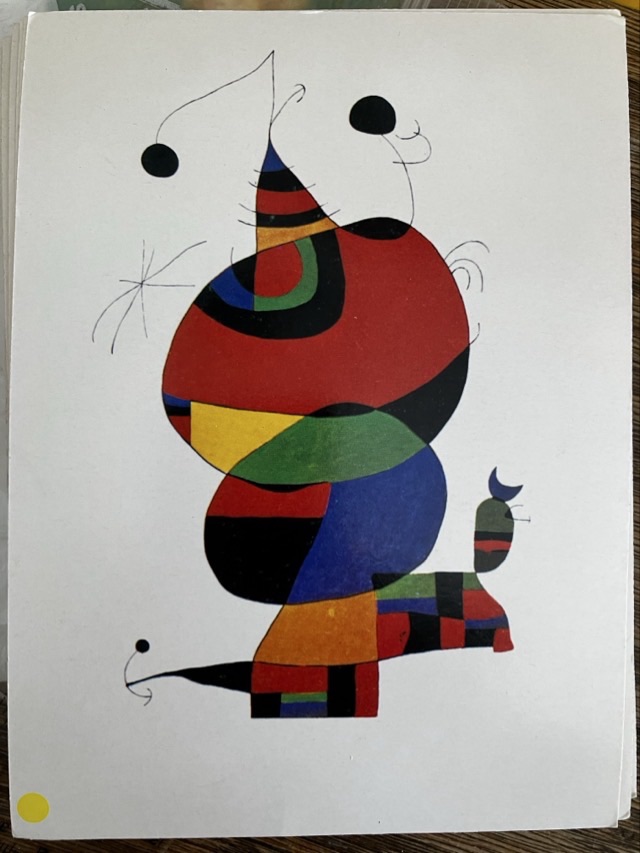
This week’s painting is called “Woman, Bird and Star” by Joan Miro, a Spanish artist who lived from 1893 to 1983. I’d heard of Miro before but didn’t realize until doing some research for this post that Joan Miro was a man. Didn’t see that coming.

Like Albrecht Durer, Miro’s father was a goldsmith, although Miro’s father was also a watchmaker. Miro developed an early interest in art. At his first solo art show in 1918 (at the tender age of 25), his work was ridiculed and defaced. Since some of his work now sells for millions of dollars, Miro clearly rose above this early humiliation. He struggled with depression, however, and used painting as a way of dealing with it.

“Woman, Bird and Star” was an oil painting that was completed on the day that Pablo Picasso died (April 8, 1973), so Miro dedicated this work to him. A prominent visual motif in Miro’s paintings is birds. He once said of his work, “In my paintings, there is a kind of circulatory system. If even one form is out of place, the circulation stops; the balance is broken.”

I’m pretty sure that the star portion of this painting is on the left, under the black ball. But as far as being able to see the woman and the bird, your guess is as good as mine. And maybe it doesn’t matter.

It was kind of fun working on this one. Since it is abstract and symbolic in nature, I didn’t concern myself with trying to make it a perfect copy. But I’m not sure that Miro would be happy with the circulatory system in it; the balance might be broken.

Next week: on to Vincent Van Gogh (whom Miro was inspired by).

I’m intrigued by the box with the name “Vincent” on it. What is that object in it? A toy?

Bidding you adios, amigos! This post may have to be deleted in the morning if I detect balance being broken.

Wednesday, March 18, 2026 The Workshop: The Father of Our Country

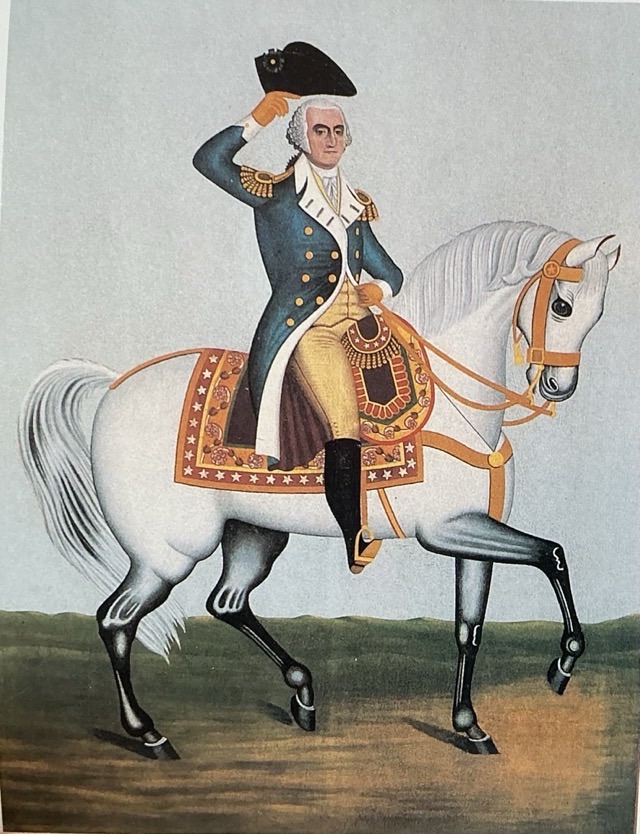
Continuing on with my project of imitating some of the masters in painting, I tackled a painting called “General Washington on a White Charger.” The copy I have doesn’t attribute it to a particular painter, just “American School,” which is unhelpful.

I had to do some research on this, but the internet was very coy and not forthcoming on the topic. Nobody seemed willing to commit on what the American School was or who its painters were. I finally found one site that definitively attributed the painting to Nathaniel Currier, he of Currier and Ives fame. He lived from 1813 to 1888 and supposedly did this oil painting in 1845. His training was as a lithographer. Other tidbits: he served as a volunteer fireman in New York City, was a Unitarian, and a personal friend of P.T. Barnum (yes, the circus guy).

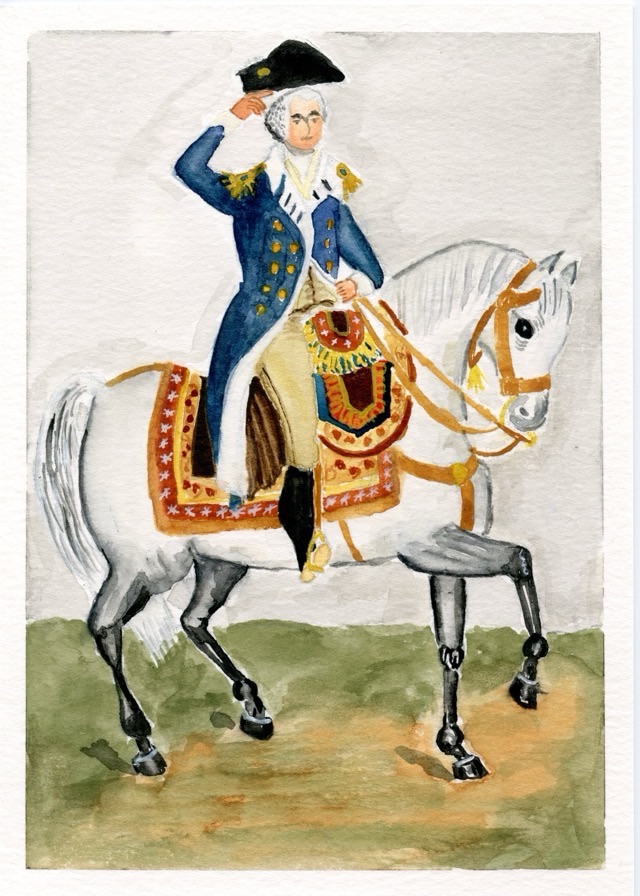
This was a really difficult painting! The original was oil, very detailed, and quite a bit larger in real life. My watercolor rendition is a lot messier. It looks better the farther away you are from it, but in case you want to get a better idea of the things I fudged on:

My purpose for copying paintings, however, was to learn as I go. I learned from this one that a lot of exquisite detail in a small space takes more talent than I’ve got. Having said that, I ended up being happy with the horse’s legs, his eye, and Washington’s pant leg. My Washington has a wry half-smile, as opposed to the more serious look in the original, but mine is rather more like an emoji face than I think is appropriate.

I’m going to give myself a little break and work on this painting by Joan Miro next week:

Maybe it will be a lot harder than I think.

Time to take off on the blog charger in the morning.

Wednesday, March 11, 2026 The Workshop: Albrecht Durer

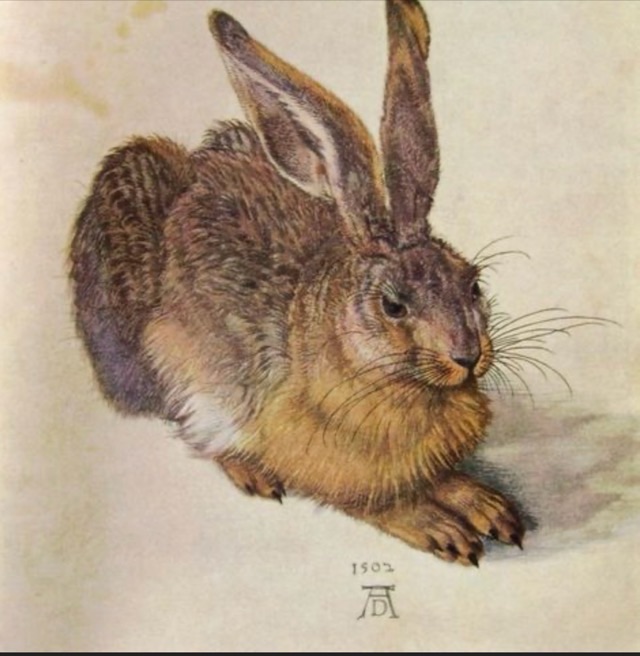
For those of you just catching up, I’ve decided to spend a season imitating some of the masters of painting as a way to practice sketching and painting. I had a dream that I’d started with Albrecht Durer’s painting “Young Hare,” which made it a good place to start.

Albrecht Durer was born in Nuremberg, Germany in 1471 and died in 1528 at the age of 56. He gained an early reputation for his high quality woodcuts, and learned goldsmithing and drawing from his father. “Young Hare” was painted in watercolor and gouache in 1502. Another well-known painting by Durer is “Praying Hands.” In his later years, Durer was sympathetic to the teachings of Martin Luther. He wrote, “And God help me that I may go to Dr. Martin Luther; thus I intend to make a portrait of him with great care and engrave him on a copper plate to create a lasting memorial of the Christian man who helped me overcome so many difficulties.”

I shared last week my initial sketch and unfinished painting. This is how it turned out.

And here’s just my version:

I was particularly happy with the signature, which I also dreamed about. No one is going to mistake mine for the original (for one thing, my hare looks like it’s been on meager rations compared to Durer’s fat little buffer), but I was quite pleased with the way it turned out anyway.

Next week, I’ll be tackling this painting of George Washington by the American School:

Gulp. What was I thinking? This might be a short-lived experiment.

I’ll probably get rid of this hare-brained post in the morning.